

THIS WEEK: >> Hold on, high >> Pattern break >> Key terms

FLYING LESSONS uses recent mishap reports to consider what might have contributed to accidents, so you can make better decisions if you face similar circumstances. In most cases design characteristics of a specific airplane have little direct bearing on the possible causes of aircraft accidents—but knowing how your airplane’s systems respond can make the difference in your success as the scenario unfolds. So apply these FLYING LESSONS to the specific airplane you fly. Verify all technical information before applying it to your aircraft or operation, with manufacturers’ data and recommendations taking precedence. You are pilot in command and are ultimately responsible for the decisions you make.
FLYING LESSONS is an independent product of MASTERY FLIGHT TRAINING, INC.
Pursue Mastery of Flight®
This week’s LESSONS
As promised, let’s continue with your comments and insights. To the Debrief!
Questions? Comments? Supportable opinions? Let us know at [email protected].

Debrief
Readers write about recent LESSONS:
Reader Gregg Gardnier allows me to correct an item in last week’s report:
Regarding the EWR UA169 approach – I believe it was the Stadium Visual Rwy 29 (from the north), not the Bridge Visual Rwy 29 as depicted on May 20. Still a challenging approach that I have flown in the A321/A320.
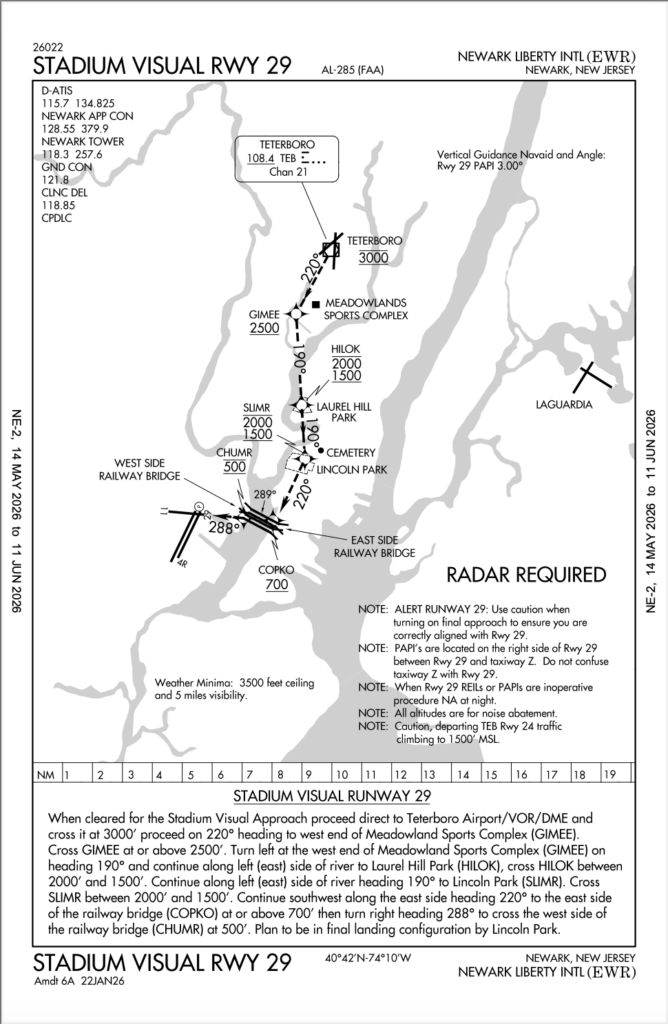
You’re right, I pulled the wrong approach chart (boy, did I fail that ride!). It was a tight right base to landing…and, as reader Jeff Edwards had noted last week, contrary to the airline standard of a stabilized approach. Thanks, Gregg.
Reader and FAA Safety Team Representative Gerry Visel asks:
Thanks for all your insights in FLYING LESSONS. I always pick up something. I teach VMC Club at our active EAA Chapter 22 in Rockford, Illinois, and use many of your LESSONS as part of our outside-the-box discussions there. We also have a chapter email list with 333 members and an active chapter Facebook group with almost 1600 members.
I was wondering what permissions I needed to share your newsletters in each of these three situations. Is it ok, for instance, to forward a FLYING LESSONS message to our chapter email list when it is something of particular interest? Do I need to add particular verbiage encouraging people to subscribe, etc., beyond what is already in there?
Thanks again, and keep up the good work! I look forward to seeing you (again) at Oshkosh!
This answer goes to all readers: Yes, of course you may use anything from FLYING LESSONS if it helps you in your mission of pilot safety and education. I only ask two things:
1. Cite the source—let people know where you got the information; and
2. Invite people to subscribe to FLYING LESSONS at www.thomaspturner.com.
If you simply forward the email (or link to it from my website) these are already accomplished.
I’m gratified that you’re finding useful information in my weekly reports. Thanks, Gerry, for helping spread the message.
Reader Robert Lough continues our discussion on trim runaway that began with an anomaly from an NTSB preliminary report:
Thank you for your continued excellent Mastery of FlightÒ safety reports – they always draw on a great body of knowledge, both yours and contributing pilots.
The late model Seneca V with only two front row occupants required a careful flare with heavy pitch control forces. The electric trim was quite responsive, arguably the Bonanza’s is more measured, and one of the threats you briefed was that trimming in the flare was a no-no. Precisely, because of the risk of a runaway trim, or the pilot continuing to trim unwittingly as they focus on the flare, setting up for an out of trim condition on final or on a go around.
A good SOP is to set trim for approach and leave the trim alone once stabilised and configured on final approach. Another threat is engaging or disengaging the autopilot with the airplane in an out of trim condition.
I trim through much of the landing flare, knowing—and reenforcing with practice—the need to apply forward control pressure during a go-around from that condition in the airplanes I commonly fly. But I see the logic of your way as well. And you’re right, it’s easier on the trim system of you have the airplane trimmed before you engage the autopilot. And since an autopilot can apply some “manual” control force without running the trim, it’s not unusual for the airplane to be somewhat out of trim when you disengage. So don’t turn off the autopilot too close to the ground, and hold the controls firmly when you do. Thank you, Robert.
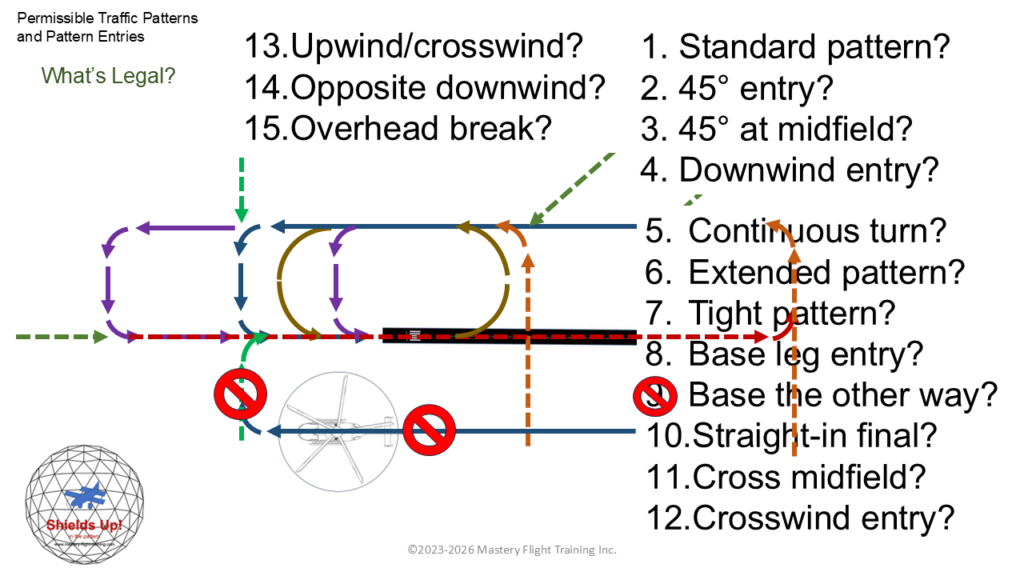
Frequent Debriefer Jeff Edwards writes about traffic pattern entries as discussed in the April 30 LESSONS:
Excellent!!!! I had a close one last weekend returning from the biennial A-6 Intruder Reunion in Dallas. On the RNV RWY 6 approach into Spruce Creek [at Port Orange, Florida], I was making radio calls every mile reporting position and intentions to land straight in (legal) runway 6 due to the 8 knot wind from 050 degrees. My trusty flying companion noted a brief ADS-B return in the vicinity of the airport. The return disappeared. I inquired if the aircraft was in the pattern. No response. At less than a mile from the runway a small plane, possibly an RV, appeared passing opposite direction nearly head-on to us. Obviously the pilot made a touch and go on [RWY] 24. No radio calls… nothing. I asked on the radio if he had a radio. He replied “affirmative, 4×4.” I said, “then use it!”
It baffles me why some pilots refuse to use the radio with position and intentions when in the pattern or near an airport. Nearly half of all midairs occur within a few miles of an airport. ADS-B is not installed in all aircraft nor [is it] required to be. If it works, great, but it is one tool in the toolbox. Look out the window…check backwards base, as you say and use the dang radio!
There was a time when I flew a no-radio airplane (I’ll mention that again shortly), but that time is past. The radio is the last defense against collision, but it still a defense we should all use…and use correctly. Thanks as always, Jeff.
Reader Pat O’Brien continues:
I was going to send comments on the Jabara traffic pattern story (I purchased my Columbia 400 from this field) but thought for sure that someone else would chime in. But since it doesn’t appear so, thought I would ask for a discussion on crossing over the field to enter the downwind. I always thought that crossing the field 500 feet above the pattern was the correct method.
Not too long ago a well-known CFI (might have been Jason Miller) promoted that the correct procedure was to fly over the field at pattern altitude so when you make the turn to the downwind the traffic, if any, is right in front of you and easier to see as opposed to 500 feet below you. I like his reasoning, but it seems that the common technique taught as flight schools is 500 feet above pattern altitude. Perhaps there is some education needed for the industry on the proper technique.
It may be that some flight schools and individual instructors are confusing two very different techniques. I was describing the “crossing midfield” method—at pattern height, to avoid descending on downwind leg with the accompanying increased hazard of collision, especially the risks of high wing vs. low wing airplanes and limitations to visibility.
What you’re describing is a technique for crossing over the pattern to avoid having to make a major deviation, then after clear of the pattern on the other side making a descending turn to enter a 45° entry to downwind to arrive in the circuit at pattern altitude.
I used this method a lot back in the (distant) day when I flew a no-radio Cessna 120. It allowed me time to search the entire pattern for traffic (in a C120 you have time), and it permitted me to find the wind sock to confirm which runway to use if it was not obvious from other cues. Does that make sense? Thanks, Pat.
Another frequent Debriefer, Brian Sagi, takes us back further, to the April 16 LESSONS:
What is your opinion about, in the case of propeller overspeed occurred at low altitude, first pitching up? The idea is to accomplish two things: First, it loads the propeller disc, which will lower engine RPM. Second, it gains some altitude, which may be useful if engine power is subsequently lost. Of course, all this should be done while paying attention to airspeed and angle of attack, so as the keep the airplane under control and well away from a stall.
This was the procedure in the T-28 I had. Obviously, it requires practice and must be balanced against the risk of loss of control due to an inadvertent stall. Maybe this is not a great idea for GA pilots.
This is similar to the same idea applied to the onset of engine failure—which can work if the pilot is trained and proficient, as apparently you were in the big radial-engine trainer. Part of the practice would be pitching to a specific attitude that results in an airspeed trend that does not result in a rapid loss of airspeed such that the airplane nears a stall quickly and does not increase G load in the pull. With that in mind, and a pitch target of maybe 5° to no more than 10° nose up (call it “cowling to the horizon” in most types), one could safely practice this technique to see how it works and make it an ingrained emergency response. Thanks as always, Brian.
Award-winning instructor Peg Ballou of Ballou Skies Aviation wraps it up this week, writing about engine-out glide as discussed in the March 19 FLYING LESSONS Weekly:
Don’t you just hate it when someone comes up with a “new” phrase for aviation use like “last call”, “anyone in the area please advise”, or the even older “Tally-ho!” ? In aviation, folks can’t see you on the radio, only respond to your voice. When on an instrument approach use calls ANY pilot [can turn into useful information about your location and intentions], whether student or a seasoned, like 12-mile straight in final vs. Inbound RNAV 22 at VIZXO.
When I hear phrases like High Key or Low Key, I get similarly perturbed. A search through FAA glossaries will show no such entry, but these calls catch on like wildfire and are hard to extinguish. I believe it is a military term that confuses in the civil world. Recently a long-time pilot asked me what that term means. If THEY don’t understand, how can a student pilot get it?
So I am asking you to please lose that term in your publication and usage. It only makes communication harder. I’m not the end all, be all in aviation with tons of accolades to my credit, but a simple instructor trying to teach in a simple way. Please take this in the spirit in which it is given.
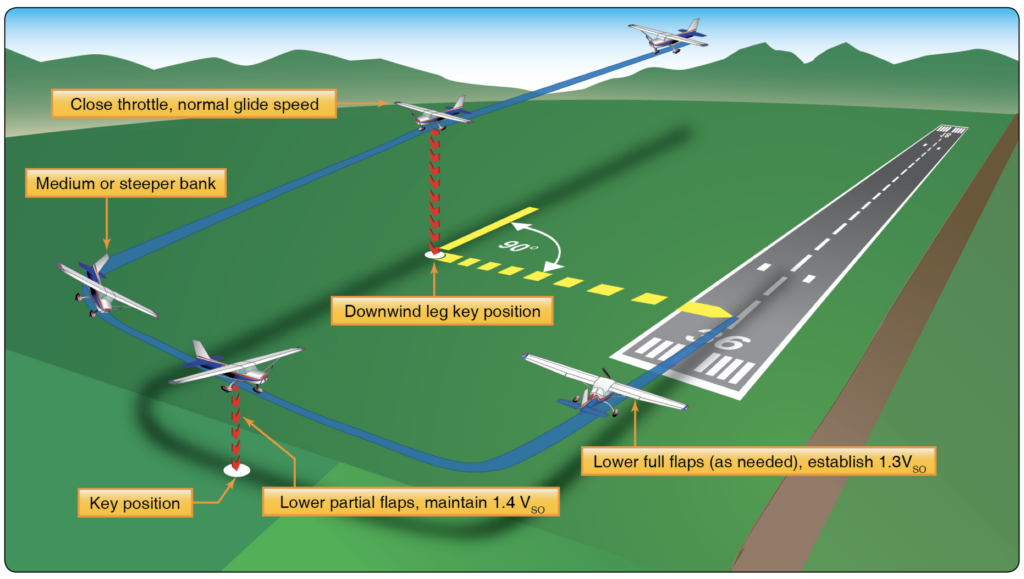
The terms “high key” and “low key” are indeed military terms and apply to what is a normal pattern entry for military aircraft (the overhead break) but frequently applied to an engine-out descent—as I did in that report.
The FAA uses the term “key” in its description of the Power Off 90 approach maneuver, with my emphasis added:
The glide from the key position on the base leg…airspeed, wind correction and altitude are maintained while proceeding to the 45° key position….
And in the diagram for the Power Off 180 “key” is used both on downwind and base. But FAA does not use the terms “High Key” or “Low Key.” Perhaps you’re right—I should stop using these terms as well. Or at least, use them for briefing purposes but not on the radio, just as I report “five miles north, straight in Runway 18” instead of “HARVS inbound” when practicing the ILS approach at Newton, Kansas (KEWK). Thank you, Peg, for this and all you do for flying safety.
More to say? Let us learn from you, at [email protected].

Share safer skies. Forward FLYING LESSONS to a friend.
Please help cover the ongoing costs of providing FLYING LESSONS through this secure PayPal donations link. Or send a check made out to Mastery Flight Training, Inc. at 247 Tiffany Street, Rose Hill, Kansas USA 67133. Thank you, generous supporters.
Thank you to our regular monthly financial contributors:
Steven Bernstein, Montclair, NJ. Robert Carhart, Jr., Odentown, MD. Greg Cohen, Gaithersburg, MD. John Collins, Martinsburg, WV. Dan Drew. Rob Finfrock, Rio Rancho, NM. Norman Gallagher. Bill Griffith, Indianapolis, IN. Steven Hefner, Corinth, MS; Ellen Herr, Ft Myers, FL. Erik Hoel, Redlands, CA. Ron Horton. David Karalunas, Anchorage, AK. Steve Kelly, Appleton, WI. Karl Kleiderer. Greg Long, Johnston, IA. Rick Lugash, Los Angeles, CA. Richard McCraw, Hinesburg, VT. David Ovad, Resiertown, MD. Steven Oxholm, Portsmouth, NH. Brian Schiff, Keller, TX. Paul Sergeant, Allen, TX. Paul Uhlig, Wichita, KS. Richard Whitney, Warrenton, VA. Jim Preston, Alexandria, VA. Johannes Ascherl, Munich, Germany. Bruce Dickerson, Asheville, NC. Edmund Braly, Norman, OK. Steven Hefner. Lorne Sheren, New Vernon, NJ. “The Proficient Pilot,” Keller, TX. Kynan Sturgiss, Hereford, TX. Bluegrass Rental Properties, LLC, London, KY. John Foster. Joseph Victor, Bellevue, WA. Chris Palmer, Irvine, CA. Barry Warner, Yakima, WA. Todd LeClair, Cadiz, KY. Jim Hopp, San Carlos, CA. Adrian Chapman, West Chester, PA. Ed Stack, Prospect Heights, IL. Robert Finley, Dubois, Wyoming. Robert Finley, John Kinyon, Lawrence Copp, V. Andrew Smith, Kevin Echols. Claude Bundrick, Shreveport, LA. John Croft, Upper Marlboro, MD.
Thank you to these 2026 donors:
Robert Sparks, Mark Sletten, Thomas Jaszewski, Douglas Olson, David Field, Michael McRobert, Wayne Colburn. Albert Chaker, Textron Aviation Employees Flying Club, Denny Southard, Henry Fiorentini, Thomas Fankhauser, Rob Humble, Nandakumar Sankaran, Jay Apt, Bill Farrell, Stu Spindel
NEW THIS WEEK: Robert Holtaway, George Stromeyer
Pursue Mastery of Flight®
Thomas P. Turner, M.S. Aviation Safety
Flight Instructor Hall of Fame Inductee
2021 Jack Eggspuehler Service Award winner
2010 National FAA Safety Team Representative of the Year
2008 FAA Central Region CFI of the Year
FLYING LESSONS is ©2026 Mastery Flight Training, Inc. For more information see www.thomaspturner.com. For reprint permission or other questions contact [email protected].