

THIS WEEK: >>Know your airplane, know the hazards >>Investigating the anomaly >>Unstable, or base?

FLYING LESSONS uses recent mishap reports to consider what might have contributed to accidents, so you can make better decisions if you face similar circumstances. In most cases design characteristics of a specific airplane have little direct bearing on the possible causes of aircraft accidents—but knowing how your airplane’s systems respond can make the difference in your success as the scenario unfolds. So apply these FLYING LESSONS to the specific airplane you fly. Verify all technical information before applying it to your aircraft or operation, with manufacturers’ data and recommendations taking precedence. You are pilot in command and are ultimately responsible for the decisions you make.
FLYING LESSONS is an independent product of MASTERY FLIGHT TRAINING, INC.
Pursue Mastery of Flight®
This week’s LESSONS
As promised, let’s catch up with your comments and insights by going straight to the Debrief.
Questions? Comments? Supportable opinions? Let us know at [email protected].

Debrief
Readers write about recent LESSONS:
Several readers wrote about last week’s LESSONS delving into the unusually detailed NTSB preliminary report on a fatal F33A Bonanza crash in Minnesota. Reader Cliff Hoffman writes:
Thank you for the article on 8032X. Thanks for being transparent for the event you had when you were so close to the ground. Your fellow pilots will remember your experience.
His airplane was not turbonormalized. He had tip tanks. Joe’s all GARMIN TXi Glass panel was less than five years old and it included the GARMIN G5[00] autopilot. He had the trim disconnect circuit breaker marked with a red plastic snap on the trim and red autopilot disconnect switch on the wheel and red plastic snap on the autopilot circuit breaker.
When I flew with him he always used the TOGO [Takeoff/Go-Around] button to establish the proper [initial climb] pitch on the flight director. I instructed him and he never turned the autopilot on until he was at least 1000 feet off the ground.
His Bemidji, Minnesota [based] designated examiner for his instrument and commercial check rides told the FAA that Joe was one of the last persons he has ever flown with that [he thought] would have an accident like this.
I thought Joe might have landed with full flaps then the next day possibly had not reset the trim at 3 degrees nose up so the nose trim would up at say 8 degrees nose up as he took off. You have been excellent in emphasizing at safety sessions the danger of a go-around with full flaps. I have shared that wisdom with Joe many times over the 10 years I have known him. His Bonanza was a single yoke [i.e., one control wheel], so if he had a heart attack/stroke his non pilot passenger was helpless. His trim switches were relatively new so (last five years) so it is hard for me to believe he had a runaway trim unless he pushed the button switch the wrong direction while he was having a health event.
Joe was a retired Mayo Clinic Rochester spinal surgeon who was “teacher of the year.” He was an annual checklist follower who always evaluated his performance after EVERY flight for things he could do better. He was not a cowboy pilot.
I’m very sorry for the loss of your friend, Cliff. I had a long phone call from Mark Cook, another pilot who knew Joe (and knows you) well and he echoed most of what you’ve said. He did not mention a possible pilot incapacitation event. My main point was for us all to know our airplanes well enough to anticipate the type-specific “gotchas” and prepare to detect and respond to them. From your (combined) comments it sounds like Joe did just that.
Back to the NTSB report that helped me develop my point: there is only one normal condition that results in the 15° UP trim position NTSB found in the F33A, and you’ve confirmed that condition would not exist in the non-turbonormalized accident airplane. That leaves the abnormal conditions: trim runaway, inadvertent activation during an incapacitating medical event (which I had not considered), or some other scenario. Regardless of what the NTSB finds in its investigation, its job won’t be complete until it explains this anomaly. Thanks, Chris and Mark.
Frequent Debriefer and cabin-class twin instructor Dave Dewhirst adds:
Nice job of describing the Bonanza accident. Never feel there is something wrong with trying to make an early analysis of an accident. As pilots, we what to learn as much as possible about the unfortunate accident as soon as possible. As instructors, we want to incorporate anything that might be known about an accident into what we teach. This is especially true when the issues might be make- and model-specific.
We [Dave’s SABRIS, Inc. training and aircraft management company] do a lot of accident summaries. We use the term, “fits the data.” That means, this is one summary that matches what is known up to this point. It may not be the final answer.
We did a summary of the C[essna] 421 accident in Weatherly, Texas, on 4/1/26 [sic; actually 2306 local time 4/30/26]. We did this three days after the accident. Regardless of the actual findings, the lessons for training are obvious.
Keep up the good work, my friend.
Thanks, Dave. Your analysis is excellent also. I’ve not linked it here because it’s your proprietary information, but your approach is similar to what I strive for: using the known circumstances of accidents to suggest what might have happened so we all learn, even if the official investigation proves a cause other than the discussion point.
Reader and high-end (including Bonanza) instructor Brian Sagi asks:
Even will full up trim in a Bonanza or Baron, don’t you find the airplane controllable (except that a pilot would need to exert a considerable force on the elevator)? Of course the pilot may be alarmed by (not being familiar) with the force required, and this may cause a loss of control in it of itself.
I may have to go up in a Bonanza and see if it’s possible to overpower full up or down trim at various speeds. It may be possible, but I suspect the “startle effect” of an unexpected pitch trim runaway, combined with the (at least in my experience) very rapid rate of change in trim and resulting control forces, would present a different control and survival experience for the pilot not prepared to almost immediately detect and respond to trim runway with the appropriate emergency checklist. Thanks, Brian.
Reader Josh Harnagel, COO of Redbird Flight (the simulator people) continues:
This is excellent and hit home for me. I fly a B36TC [turbocharged Beech Bonanza] with a TN [turbonormalizer] modification and frequently land with a significant amount of nose up trim when I’m lightly loaded. LESSON noted.
Additionally, your remarks about practicing for a pitch trim runaway until you’re able to preform it one handed without lookingis an excellent suggestion. This procedure will become part of my standard training routine from now on. Thanks for the wisdom.
Although I asked the question about the turbonormalizer in last week’s LESSON, that’s only because that makes the reported trim indication a possible normal condition in the accident airplane type. In reality a post-landing trim condition that is much more nose-up than the takeoff position is common to any nose-heavy airplane, including a factory turbocharged B36TC as well as your modified aircraft—and turbocharged Cirruses, even normally aspirated Cessna 182s, lightly loaded Piper Turbo Lances and Saratogas, turbocharged and pressurized Barons and more. In your specific case it’s normal for the trim to be between 19 and 21 units UP if trimmed for landing unless there’s significant weight in the aft cabin…while the safe takeoff range is 3 to 6 units UP. It’s another case of know your airplane, know the hazards.
Glad to be an inspiration for your preflight checks, Josh. Thanks again.
Reader and retired U.S. Air Force C-5 Galaxy pilot John Scherer takes us back to the May 7 LESSONS and things we should all consider when landing on what for our aircraft is a fairly short runway:
Great article on the B-767 at Newark. I’m sure the B-767 was required to cross the threshold at 50 feet. That was a hard limit in the C-5. We aimed at the 1,500 foot markers because aiming at the 1,000 foot markers would cause us to be TOO low over the threshold. (And the main gear were 200 feet behind us in the cockpit). A C-5 is bigger than the B-767, but 50 foot at the threshold still applies.
We would have the Flight Engineer calculate the landing distance on the runway we were landing on. If it was too tight, we’d find another runway. In the C-5 we could use partial flaps and add 15 KIAS to approach speed. That would give us a lot of crosswind capability. That may have been a better choice (EWR Runways 22L or 22R) than Rwy 29.
You’re right, there may have been a better choice. Thanks for your insights, John.
Frequent Debriefer, instructor and air crash investigator Jeff Edwards adds:
The plate looks like the approach lends itself to a non-stabilized situation.
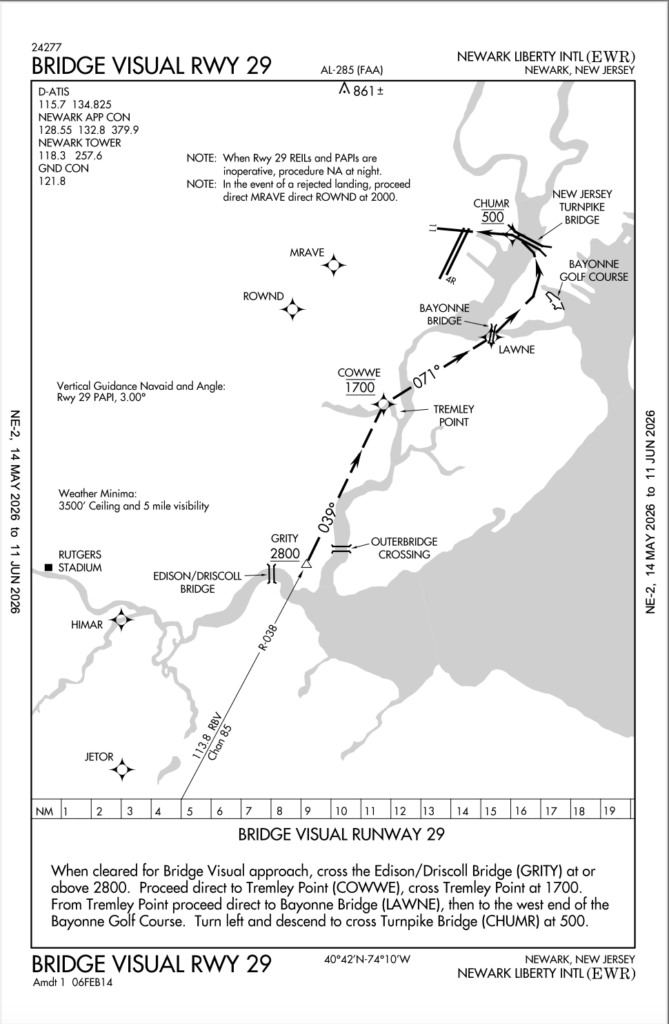
True, this published, visual circling approach maneuver is incompatible with an airline-style stabilized approach. It could be flown like an entry on a left base leg and turn to final—a maneuver familiar to all pilots, at least at some point in their training. Is it inappropriate for a transport category airplane, or a lost skill that should have been retained for case like this? Thanks, Jeff.
Frequent Debriefer Tom Black takes the theme of visual illusions further:
My dear friend Mickey Rountree (now deceased) discusses the impact of visual illusions at night from many factors, including non-standard lighting arrangements, in this recollection regarding one of the most famous accidents at Hamilton AFB.
Good article, Tom. Thanks for sharing it.
Reader Boyd (Jack) Spitler wraps it up this week:
Lots of parts, all of which should be included in any airline’s type specific training and operational content.
I borrowed an explanation of PAPI considerations from the web, taking no credit for the content or for absolute accuracy, to illustrate the differences among airframes due to wheel height versus line of sight from the cockpit.
Regardless of surrounding details, there is no occasion under which being low with any portion of the airframe is a good thing…duh. Distance from cockpit to main wheels and deck angle when configured for landing suggest that using 3 white in widebody operations is a preferred technique. Seeing any white, (3 red), is encouragement to continue the approach, but is unacceptable in longer transport aircraft.
Cockpit to main wheels in the 767-300 is 75 feet, 777-200 is 85 feet, MD-11 is 104 feet. I was fortunate to be qualified/operate all three of these types, among several others. Way back there, stuff is hanging down. Radio altimeter callouts of wheel height at “minimums”, 100, 50, 40, 30, 20, and 10 are essential in these aircraft to achieve precise landing performance. This works over even terrain under the aircraft, but must be understood to be of limited accuracy in reference to the runway surface if the runway is elevated above surroundings to increase obstruction clearance.
All this and a good deal more is illustrative of the need for type specific crew training in general and crew briefing over “this specific approach” in particular, highlighting the “special” features of this one. Automation fans will claim that the machines would not make this mistake, but, as the Korean 777 at SFO [San Francisco] a few years ago illustrated, crew competence is irreplaceable and crew briefing is its own essential, (UPS Airbus at Birmingham, et al).
I join the rest of our community in giving thanks to the Almighty for the outcome of this one.
Regarding PCL [pilot controlled lighting] at nontowered airports, I added “lights” to callouts at the final fix inbound back in my commuter days, briefed to the PM [Pilot Monitoring] beforehand.
Regarding jet operations at nontowered airports: During my post airline medivac days, I made clear position reports early and often since we all have expectations of progress from time elapsed since the last call based on our own normal ground speed rather than the occasional faster/slower guy who may or may not be familiar with the local habits.
Thanks for your insights, Jack.
I have more Debrief emails on topics of standard vs. nonstandard terminology in training, unusual weight and balance considerations, propeller overspeed response, traffic pattern entries, near-collisions in the traffic pattern and more that I’ll get to next week barring some major incident that generates widespread comment. Thanks for your patience, Debriefers.
More to say? Let us learn from you, at [email protected].

Share safer skies. Forward FLYING LESSONS to a friend.
Please help cover the ongoing costs of providing FLYING LESSONS through this secure PayPal donations link. Or send a check made out to Mastery Flight Training, Inc. at 247 Tiffany Street, Rose Hill, Kansas USA 67133. Thank you, generous supporters.
Thank you to our regular monthly financial contributors:
Steven Bernstein, Montclair, NJ. Robert Carhart, Jr., Odentown, MD. Greg Cohen, Gaithersburg, MD. John Collins, Martinsburg, WV. Dan Drew. Rob Finfrock, Rio Rancho, NM. Norman Gallagher. Bill Griffith, Indianapolis, IN. Steven Hefner, Corinth, MS; Ellen Herr, Ft Myers, FL. Erik Hoel, Redlands, CA. Ron Horton. David Karalunas, Anchorage, AK. Steve Kelly, Appleton, WI. Karl Kleiderer. Greg Long, Johnston, IA. Rick Lugash, Los Angeles, CA. Richard McCraw, Hinesburg, VT. David Ovad, Resiertown, MD. Steven Oxholm, Portsmouth, NH. Brian Schiff, Keller, TX. Paul Sergeant, Allen, TX. Paul Uhlig, Wichita, KS. Richard Whitney, Warrenton, VA. Jim Preston, Alexandria, VA. Johannes Ascherl, Munich, Germany. Bruce Dickerson, Asheville, NC. Edmund Braly, Norman, OK. Steven Hefner. Lorne Sheren, New Vernon, NJ. “The Proficient Pilot,” Keller, TX. Kynan Sturgiss, Hereford, TX. Bluegrass Rental Properties, LLC, London, KY. John Foster. Joseph Victor, Bellevue, WA. Chris Palmer, Irvine, CA. Barry Warner, Yakima, WA. Todd LeClair, Cadiz, KY. Jim Hopp, San Carlos, CA. Adrian Chapman, West Chester, PA. Ed Stack, Prospect Heights, IL. Robert Finley, Dubois, Wyoming. Robert Finley, John Kinyon, Lawrence Copp, V. Andrew Smith, Kevin Echols. Claude Bundrick, Shreveport, LA. John Croft, Upper Marlboro, MD.
Thank you to these 2026 donors:
Robert Sparks, Mark Sletten, Thomas Jaszewski, Douglas Olson, David Field, Michael McRobert, Wayne Colburn. Albert Chaker, Textron Aviation Employees Flying Club, Denny Southard, Henry Fiorentini, Thomas Fankhauser, Rob Humble, Nandakumar Sankaran, Jay Apt, Bill Farrell
NEW THIS WEEK: Stu Spindel
Pursue Mastery of Flight®
Thomas P. Turner, M.S. Aviation Safety
Flight Instructor Hall of Fame Inductee
2021 Jack Eggspuehler Service Award winner
2010 National FAA Safety Team Representative of the Year
2008 FAA Central Region CFI of the Year
FLYING LESSONS is ©2026 Mastery Flight Training, Inc. For more information see www.thomaspturner.com. For reprint permission or other questions contact [email protected].