
THIS WEEK: >> Right ways, and other ways >> The best use. >> Balancing act

FLYING LESSONS uses recent mishap reports to consider what might have contributed to accidents, so you can make better decisions if you face similar circumstances. In most cases design characteristics of a specific airplane have little direct bearing on the possible causes of aircraft accidents—but knowing how your airplane’s systems respond can make the difference in your success as the scenario unfolds. So apply these FLYING LESSONS to the specific airplane you fly. Verify all technical information before applying it to your aircraft or operation, with manufacturers’ data and recommendations taking precedence. You are pilot in command and are ultimately responsible for the decisions you make.
FLYING LESSONS is an independent product of MASTERY FLIGHT TRAINING, INC.
Pursue Mastery of Flight®
This week’s LESSONS
I was flying home from a business trip. Approaching Wichita Colonel James Jabara Airport (KAAO) in good visual conditions, I canceled my instrument clearance about 15 miles east of the airport.
Most traffic into Jabara, especially the local pilots, will cross at midfield then turn on downwind. This helps keep traffic into nearby Stearman Field, Augusta, and Beech Factory Airfield in sight and remains well clear of the Wichita Class C airspace. Jabara’s pattern is on the west side of the airport for both Runway 18 and 36 to deconflict with Beech arrivals and departures. So coming in from the east you cross at midfield then turn right for right traffic if landing on runway 18 or left for left traffic to Runway 36. This arrival path essentially duplicates the RNAV (GPS) E instrument approach, my go-to “circle to land” approach to meet the requirements when conducting an Instrument Proficiency Check (IPC).
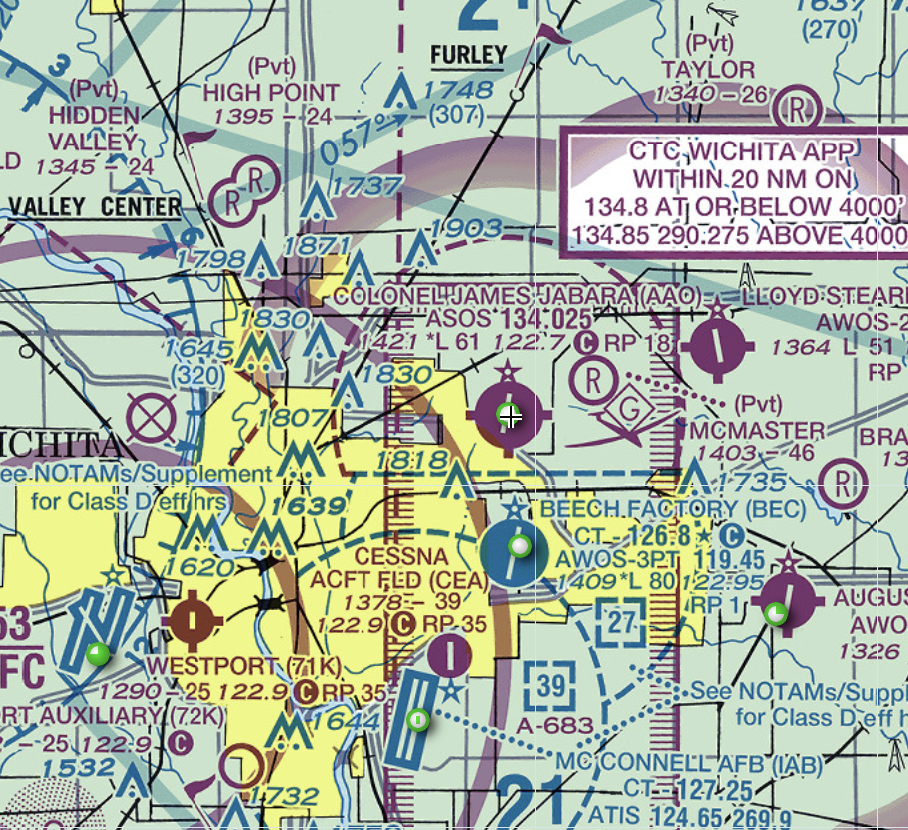
Turning downwind to land to the south and then onto right base, I heard a Cessna Citation jet check in on the CTAF (Common Traffic Advisory Frequency): “Jabara Traffic, Citation XXX entering left downwind runway 18.” I didn’t have the jet in sight yet, but I saw it on my ADS-B display and it was not currently a conflict. Still, I expedited my arrival and made the usual turn-off, taxiing clear of the runway before the Citation pilot announced a three-mile final. His very wide pattern definitely helped with collision avoidance.
There are many ways to enter an airport visual traffic pattern. Only one of them is a violation of Federal Air Regulations regulations—and that was the way the Citation pilot chose to fly.
Review FAA documents, advisory circulars and manuals and you’ll find 14 approved ways to enter a visual traffic pattern at a nontowered airport. Only one entry is specifically outlawed by regulation: flying a traffic pattern in the opposite direction from that prescribed for the runway in use.
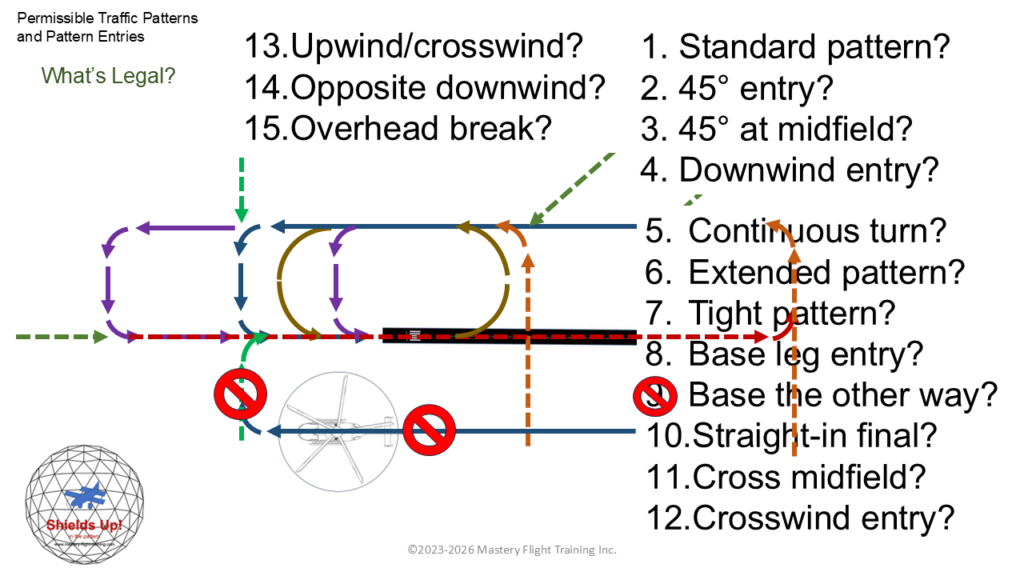
15 pattern entries, 14 of them legal
For my international readers, please follow along and check your local regulations. I suspect they are very similar when it comes to nontowered aerodrome operations.
14 CFR 91.126, Operating on or in the vicinity of an airport in Class G airspace, tells us:
(b) Direction of turns. When approaching to land at an airport without an operating control tower in Class G airspace—
(1) Each pilot of a powered fixed-wing aircraft must make all turns to the left unless the airport displays approved light signals or visual markings indicating that turns should be made to the right, in which case the pilot must make all turns to the right….
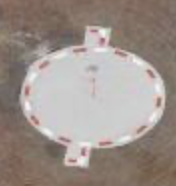
The folks at Jabara have met their obligations in this regard, having indicated the direction of traffic patterns visually around the windsock.
Wait a minute, you might say. The dashed line encircling KAAO on the Sectional chart indicates that Class E airspace extends to the surface. So 91.126 does not apply. Except, 14 CFR 91.127, Operating on or in the vicinity of an airport in Class E airspace, starts by saying that unless otherwise required by ATC persons operating in Class E airspace must comply with the [Class G] requirements of 91.126.
So I was right, and the Citation crew was wrong. That’s hardly comforting if we had had a midair collision. What’s more important is to anticipate and visually check for “backwards” traffic as well as pilots conforming to the 14 other approved ways to enter the airport traffic pattern.
Further, although 91.126(b)(1) tells pilots of fixed wing aircraft to conform to the prescribed traffic pattern, 91.126(b)(2) states:
Each pilot of any other powered aircraft [not fixed wing] must avoid the flow of traffic specified in paragraph (b)(1) of this section.
Helicopters in particular should avoid the fixed-wing pattern. Sometimes that means flying beneath the pattern altitude and/or landing away from the runway. It can be (and sometimes is) interpreted to mean the rotary wingers may fly a pattern opposite that prescribed for the runway, e.g., left-hand traffic when the identified pattern calls for turns to the right.
In other words, there are indeed (at least) 15 approved ways to enter the pattern at nontowered airports, depending on the type of aircraft. And we all must actively search for other aircraft that may be occupying airspace in any of those potential arrival paths…legally or not.
That’s why I’ve developed the habit of checking all around the airport as I enter and fly through the pattern. I follow the rules carefully so others know where to look for me and can predict where I’m going to go next, but I’m looking as carefully for pilots who are not following the pattern rules, and the helicopters that by regulation are flying something other than the prescribed traffic pattern (we have a lot of rotary wing medivac traffic at Jabara).
I’m a huge fan of ADS-B traffic displays to point out aircraft I may never have seen otherwise. But not all aircraft have the equipment to show up on ADS-B. And the best use of traffic displays is to make it easier to visually acquire and then avoid other aircraft.
On base leg I call aloud as I check: “Final approach is clear, the backwards base is clear, the runway is clear, I’m cleared to land.” I also look for anything on the ground that might taxi onto the runway.
Ready to take off I look for airplanes crossing overhead, then as I’m ready to taxi onto the runway I look as best I can at the pattern: “Base leg is clear, backwards base is clear, final approach is clear, the runway is clear, I’m cleared for takeoff.”
There’s a right way to enter and fly a traffic pattern…in fact at least 14 of them for fixed wing aircraft. Still, some pilots are going to do something else. And helicopters and some other aircraft types are going to deviate from the published pattern whether you know the rules or not.
That Citation jet was another reminder to keep my eyes outside the aircraft and constantly moving when entering and flying in the airport traffic pattern. I hope you’re looking too.
Questions? Comments? Supportable opinions? Let us know at [email protected].

Debrief
Readers write about recent LESSONS:
Several readers wrote about last week’s LESSONS on weight and balance and performance charts. Bill Mills writes:
I am reminded of the A36 accident a few years ago at KAAO, where a prominent physician, two of his sons, and a pharmacist were killed on takeoff during a severe thunderstorm when a 50-knot gust from the tail killed their airspeed to well below stall speed. While that gust (and the decision to try and race the storm to the field so they could go on their camping trip) was the proximate cause of the accident, a look at the weight and balance calculations for that flight showed (to me at least) that the end result was likely inevitable: they took off well overweight, and just aft of the aft CG limit. Had they made it off all right, at some point down the road the airplane would likely have become uncontrollable in pitch due to the CG moving aft as fuel burned off. Truly a tragic case but as can be seen several poor decisions rolled into this accident occurring.
Interesting comment on fuel burn normally resulting in a linear shift in CG. One example I am aware of that does not follow this trend is the Sino-Swearingen SJ30-2 very light jet, at least as it was a quarter of a century ago when I was involved in its early flight tests. The fuel system was designed to try and take advantage of as much available space for fuel tanks (large main fuselage tank behind the cabin, several fuel tanks in the small wings), and used standpipes in the tanks to force fuel to feed from different tanks at different times to help manage CG shift. The result was a rather jagged CG trace as fuel was burned. I don’t know if the final product retained this “feature”. It definitely made evaluating CG migration with fuel burn interesting….
I remember that crash. It was 1994. My wife was driving on the newly built K96 (then the “Northeast Expressway”) about a mile from Jabara at the time and the rain was so intense she pulled off on the side of the highway (along with several others) because visibility was so bad.
The NTSB final report details the weight and balance exceedances you note as well, and your comments are spot on. Overweight and/or out-of-CG conditions may not themselves immediately cause a crash. But they can make responding to some other anomalous condition difficult or impossible. Thank you, Bill.
Reader Randy Starbuck quotes part of last week’s report, and comments:
I have not touched on distribution of weight laterally, that is, along the wingspan. I don’t know of a single Pilot’s Operating Handbook that provides information for checking the lateral balance.
Yes sir! Asymmetric fuel can cause lateral “balance” issues, possibly aggravated with tip tanks.
Indeed. Like Bill’s comment about the SJ30 jet, weight and balance issues are very type-, model-, and even serial number specific in some cases. Make a thorough study of the weight and balance section of your aircraft’s handbook, and any adjustments contained in the similar weight and balance section of any POH Supplement for modifications to that aircraft. Thanks, Randy.
My frequent wishes-to-remain-anonymous student pilot Debriefer (how’s your training coming along?) continues:
This article puts a new spin on looking at weight and balance. Had to read it through a few times, especially zero fuel condition – first time I heard of this calculation. I found a webinar (https://www.youtube.com/watch?v=MlWUsiq_G90) that explained it with a simple example. After doing the standard W&B I did the Zero Fuel version for a flight lesson to an airport 45 minutes away in single engine GA plane. Both points were still in the envelope but in different locations. This visual observation of the points in two different locations was like a picture, that visual spoke a thousand words at a glance. Thank you for posting this!
I’m very glad to be of help. I recall early in my instructional career discovering that our rental Cessna 172 could go aft out of limits with fuel burn when passengers were in the back seats. That was a wakeup call for me and my students as well. Like you, I don’t ever remember the concept being addressed in the red Cessna Pilot Centers or the Jeppesen textbooks that were the standard student pilot texts of the day. Thank you too.
Frequent Debriefer John Majane also writes:
Anyone who has built model planes knows all about the importance of balance and weight. A heavy model performs poorly. An out of balance model becomes uncontrollable. A simple sheet wood rubber band plane can easily be used to demonstrate all the effects.
True. Me, I was more into plastic scale model airplanes growing up. I liked tailwheel aircraft models better because with the nosewheels you must find a fishing line sinker or a few metal washers and glue them inside the nose to make the model sit down on its nosewheel on the shelf. Your example is more pertinent to this discussion, however. Thanks, John.
Reader and advanced maneuvers instruction advocate Ed Wishmeyer chimes in:
Some Pipers have lateral c.g. limits. Not sure which ones, but probably the Cherokee 6 and maybe the Seneca. Also, forward c.g. may show up in the ability to flare the airplane. IIRC, some Cessnas with full flaps may be hard to flare with a forward c.g.
Same goes for 58P and 58TC Barons, and turbocharged and turbonormalized Bonanzas too—they are all very nose-heavy and require a lot of effort to flare when there’s not much payload or ballast in the back. From my decades-old insurance underwriter experience I know other typically nose-heavy types, including the Beech Aero Club-series (Sundowner, Musketeer, etc.) and some Mooneys have a long history of nose gear damage and propeller strikes in part because they don’t have enough elevator authority at slow speeds to compensate for very “forward” center of gravity conditions. Again, there’s a lot of type specificity to weight and balance calculations. Thank you, Ed.
Frequent Debriefer Jeff Edwards wraps up this week’s Debrief:
Excellent piece. I have worked several accidents where aircraft flown beyond aft CG limits came to grief. I have also been a party to one fixed wing accident caused by a lateral fuel imbalance caused the crash. Limitations are there for a reason.
There’s no arguing with that. Thank you, Jeff.
More to say? Let us learn from you, at [email protected].

Share safer skies. Forward FLYING LESSONS to a friend.
Please help cover the ongoing costs of providing FLYING LESSONS through this secure PayPal donations link. Or send a check made out to Mastery Flight Training, Inc. at 247 Tiffany Street, Rose Hill, Kansas USA 67133. Thank you, generous supporters.
Thank you to our regular monthly financial contributors:
Steven Bernstein, Montclair, NJ. Robert Carhart, Jr., Odentown, MD. Greg Cohen, Gaithersburg, MD. John Collins, Martinsburg, WV. Dan Drew. Rob Finfrock, Rio Rancho, NM. Norman Gallagher. Bill Griffith, Indianapolis, IN. Steven Hefner, Corinth, MS; Ellen Herr, Ft Myers, FL. Erik Hoel, Redlands, CA. Ron Horton. David Karalunas, Anchorage, AK. Steve Kelly, Appleton, WI. Karl Kleiderer. Greg Long, Johnston, IA. Rick Lugash, Los Angeles, CA. Richard McCraw, Hinesburg, VT. David Ovad, Resiertown, MD. Steven Oxholm, Portsmouth, NH. Brian Schiff, Keller, TX. Paul Sergeant, Allen, TX. Paul Uhlig, Wichita, KS. Richard Whitney, Warrenton, VA. Jim Preston, Alexandria, VA. Johannes Ascherl, Munich, Germany. Bruce Dickerson, Asheville, NC. Edmund Braly, Norman, OK. Steven Hefner. Lorne Sheren, New Vernon, NJ. “The Proficient Pilot,” Keller, TX. Kynan Sturgiss, Hereford, TX. Bluegrass Rental Properties, LLC, London, KY. John Foster. Joseph Victor, Bellevue, WA. Chris Palmer, Irvine, CA. Barry Warner, Yakima, WA. Todd LeClair, Cadiz, KY. Jim Hopp, San Carlos, CA. Adrian Chapman, West Chester, PA. Ed Stack, Prospect Heights, IL. Robert Finley, Dubois, Wyoming. Robert Finley, John Kinyon, Lawrence Copp, V. Andrew Smith, Kevin Echols. Claude Bundrick, Shreveport, LA. John Croft, Upper Marlboro, MD.
Thank you to these 2026 donors:
Robert Sparks, Mark Sletten, Thomas Jaszewski, Douglas Olson, David Field, Michael McRobert, Wayne Colburn. Albert Chaker, Textron Aviation Employees Flying Club, Denny Southard, Henry Fiorentini, Thomas Fankhauser, Rob Humble
Pursue Mastery of Flight®
Thomas P. Turner, M.S. Aviation Safety
Flight Instructor Hall of Fame Inductee
2021 Jack Eggspuehler Service Award winner
2010 National FAA Safety Team Representative of the Year
2008 FAA Central Region CFI of the Year
FLYING LESSONS is ©2026 Mastery Flight Training, Inc. For more information see www.thomaspturner.com. For reprint permission or other questions contact [email protected].