

THIS WEEK: > Show some restraint > My sacrifice > Straight in

FLYING LESSONS uses recent mishap reports to consider what might have contributed to accidents, so you can make better decisions if you face similar circumstances. In most cases design characteristics of a specific airplane have little direct bearing on the possible causes of aircraft accidents—but knowing how your airplane’s systems respond can make the difference in your success as the scenario unfolds. So apply these FLYING LESSONS to the specific airplane you fly. Verify all technical information before applying it to your aircraft or operation, with manufacturers’ data and recommendations taking precedence. You are pilot in command and are ultimately responsible for the decisions you make.
FLYING LESSONS is an independent product of MASTERY FLIGHT TRAINING, INC.
Pursue Mastery of Flight®
This week’s LESSONS
Three Most Basic LESSONS
from mishaps this past week
A FLYING LESSONS reader texted me the sad photo of a beautifully polished 1947 Model 35 Bonanza sitting in a field, its nose gear collapsed. The airplane, on its first flight after an extensive restoration, lost power for some unknown reason. The test pilot put the airplane down in the field and reported he had neck pain from “whiplash” as a result.
I know the pilot, so I contacted him to see if he is ok. He replied that his “neck hurt pretty good from whiplash” and the Bonanza had “no shoulder harness…. My spirit is a bit broken but time will heal.” He added that he appreciated my sincere concern.
I replied: “I’m very glad you’re OK. Sad about the airplane but perhaps it will be re-restored.” I added:
History tells me that without a shoulder harness you were very lucky to have survived. Head trauma is very common in off-airport landings without shoulder harnesses, especially if the nose wheel collapses or drops into a rut causing a sudden stop.
The pilot responded:
You nailed it. I was rolling relatively ok until the nose hit a rut.
This week’s LESSON 1: Wear shoulder harnesses. If the airplane is not equipped with shoulder harnesses and you have a say in modifications and money spent on the aircraft, have shoulder harnesses installed. If you do not have a say, do not fly the aircraft, insist that the owner adds shoulder harnesses, and until they are installed obtain a portable shoulder harness systemif one is compatible with the aircraft and wear it.
A 1985 National Transportation Safety Board study determined that wearing a shoulder harness in a sample of 800 fatal light airplane accidents would have reduced injury severity below fatal levels in 20% of the cases. Among crashes resulting in “serious” injuries, 32% would have had only “minor” injuries or no injuries at all if a shoulder harness had been worn. There’s a whole lot more in the NTSB research, but the very short course is that shoulder harnesses make a huge difference in survivability. The biggest risk of serious or fatal head trauma is to front-seat occupants, or front- and rear-seat occupants in tandem airplanes with a bulkhead structure or instrument panel ahead of both seats.
Another likely LESSON that requires further study is the apparent wisdom of landing a retractable gear airplane gear-up in the event of an off-airport landing (I know of one such investigative look but I’ve not seen the actual study). Since that is not yet definitive but is also a possible corollary of the next LESSON I’m not counting it as one of the three this week…at least not yet.
I missed a phone call while driving a U-Haul truck across the cell service-sparse Flint Hills of eastern Kansas, but the caller’s follow-on text came through as strangely they sometimes do out there on the prairie. A FLYING LESSONS reader and well-known airshow pilot was asking if I had any advice for someone who had called him from an airborne A36TC Bonanza (if it wasn’t a Bonanza they would have likely called someone else). The pilot reported his main landing gear was down but the nose gear was not extended. I replied:
Sorry I missed your call. If the mains are down and the nose [gear] is stuck:
- Try manual landing gear extension.
- After (1), if the nose gear is not down, try a hard pull-up to see if the G load snaps the gear down.
- If neither work, best bet is to retract the mains, if able, and make a smooth landing on pavement to avoid nose “slap-down.” This is even more important if front seat occupants do not have a shoulder harness.
Good luck.
The reader later updated me that they “put it in on the belly flaps up” and there were no injuries. There was photographic evidence of a mechanical failure in the nose wheel well that blocked gear movement and “caused the pushrod to kink.” Once that happened there was no way to get the gear down, electrically or manually. But it would allow the main wheels to retract.
This week’s LESSON 2: Once you have exhausted all possibilities for resolving an inflight failure in a way that restores normalcy, beginning with airplane checklists and adding the sum of your knowledge of airplane systems and that of those you may reach remotely, stop thinking about saving the airplane and focus on using it to minimize the risk to occupants including yourself. There are all sorts of online stories and videos about trying “heroic” means to resolve mechanical issues that are far more dangerous to everyone involved than a minimal-risk belly slide onto pavement (mechanic standing through a car’s open sunroof to pull down a Piper Arrow’s stuck landing gear, I’m thinking of you). Sure, it worked—that time. How terribly wrong it might have gone when the Arrow pilot could likely have retracted the wheels and slid the airplane smoothly on.
The 12-fatality crash of a Pacific Aerospace PAC P-750 XSTOL skydive airplane has received worldwide media attention, including at one point (when I looked) the #2 headline spot after the apparent resolution of the U.S./Iran War on the BBC. A friend and FLYING LESSONS reader contacted me for information about skydiving pilot requirements so he could better answer questions he was getting about the tragedy (Commercial certificate for a minimum of 250 hours, although I’ve known pilots with thousands of hours who flew jump planes, and individual operators may have higher minimum requirements driven by their own policies and/or insurance coverage).
Early reports include a statement from the airport manager are that the loaded airplane departed runway 36 and “never got more than 100 feet in the air” before it “made a left turn…. I think it was losing power, and he was trying to make it over to the highway and land, and he stalled and went down nose first and caught fire.” It was far below any altitude from which the parachute-equipped divers and pilot had any chance of escape.
News photos show the wreckage was contained within about the wingspan of the airplane so it went in vertically, probably in a spin. It appeared to have plenty of fuel on board because it burned to be nearly unrecognizable as an airplane. It impacted between the runway and a two-lane road that is no more than 200 yards from the runway (probably less) and inside the normal VFR traffic pattern that is a little west of the road. In post-crash photos you can see flags and picnic tables behind the wreck that are the skydive operation’s waiting and viewing area. That’s immediately north of the northernmost hangar on the airport in the photograph. The airplane hit between that area and the road.
I know some of this because I’m very familiar with Butler, Missouri, the airport where the tragedy took place. KBUM is closest to where my wife’s parents lived and we flew in there many times in my Cessna 120 (which I purchased at Butler in 1985 and owned until 1992), a Cessna 150 and 172, and a succession of borrowed and rented Beech Bonanzas and Barons. I even stopped there for fuel in a turbonormalized Cessna 185 on a delivery flight once. I’ve also flown there with reader and past editor LeRoy Cook in his 1946 Aeronca Champ a couple of times. So I’m pretty familiar with the airport and its immediate surroundings.
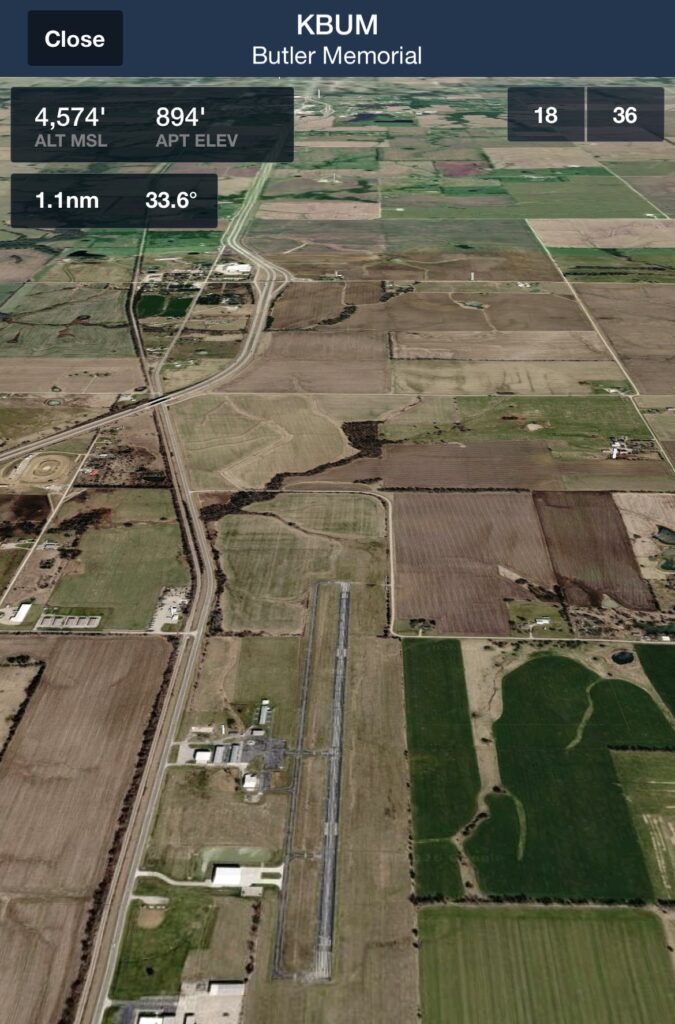
KBUM, looking north
The accident airplane departed Runway 36. There’s nothing but open fields just north of the airport, not even power lines across the departure path. Wings level, under control to touch down at the slowest safe speed would probably have saved them all. Turning back did not.
This week’s LESSON 3: Attempting to turn back to the departure runway following engine failure after takeoff almost never has a successful outcome (that’s why it’s such a big media and chat board deal when someone makes it). Landing more or less straight ahead to touch down wings level, under control at the slowest safe speed—just above stall speed for the airplane’s weight and flap configuration…unless the Airplane Flight Manual/Pilot’s Operating Handbook recommends a slightly higher Landing Without Power speed to assure sufficient elevator effectiveness to flare, in which that published speed is appropriate. Use the aircraft’s structure to protect occupants and provide the very best chances of survival.
Three very basic FLYING LESSONS, from three accidents that took place this week, remind us that some of the best survival decisions are made before taking off:
- Use shoulder harnesses,
- Be willing to sacrifice the airplane to save its occupants, and
- if an engine fails immediately after takeoff touch down more or less straight ahead, under control at the lowest safe speed.
Once in the aircraft, use the decisions you made at low-stress zero indicated airspeed and one G to maximize survival chances for your passengers and yourself.
Questions? Comments? Supportable opinions? Let us know at [email protected].

Debrief
Readers write about recent LESSONS:
Reader Robert Hoffman, 767 captain as well as pilot of a Beech Duke, turbine-modified Beech Duke and Beech B33 Debonair, adds to our recent discussion of “minimum fuel” emergencies and the Debrief items that followed:
GA pilots can be excused for not being able to correlate the relationship between minimum, emergency and reserve fuel, since the topic is not been clearly defined in FAR’s or the AIM, and is not effectively emphasized during initial pilot certification.
FAA attempted to clarify the issue in InFO 09004, dated 2/7/08, however, the audience was clearly limited to 121 and 135 operators. Apparently, FAA did not consider the topic worthy of distribution to the wider GA community.
Regarding the King Air fuel exhaustion incident discussion in June 4 FLYING LESSONS: aviators, (mostly GA) possess a limited understanding of the relationship between ATC and Captains authority, and specifically how that authority applies to minimum, emergency and reserve fuel decisions, due primarily the failure of FAA and the training industry to provide clear operational guidance.
In my opinion, the primary causal factor in the King Air incident was the Captain’s decision to execute a go-around during a low fuel state. A Captain, as the sole arbiter of flight safety, cannot morally or legally abdicate authority to ATC – or any external entity.A Captain’s authority is absolute and encompasses decisions before, during, and immediately following a flight. In this instance, the Captain did not assert his authority in a clear, assertive, respectful and commanding manner, by making it clear that a go-around would not be an option. In short, the pilot was not in command, (small “c” here) nor was he the captain (small “c”) when he committed the unconscionable act of abdicating his authority to ATC by executing a go-around.
Unfortunately, the present GA culture has a love affair with abdication of authority to ATC. Too many Instructors train, and pilots believe, that every syllable enunciated by ATC, is a commandment from a deity. Sadly, blind obedience to ATC clearances (suggestions), without considering operational control or flight safety, seems epidemic in the GA culture. Obedience to ATC is not contrary to 91.173.
Factually, ATC possesses no command authority, as referenced in the preamble of the 7110.65. ATC separates airplanes, manages flow, provides additional services, (will call your mother for you), and finally, after 9/11 will call someone to shoot you down if [you are] perceived to be a national security threat. ATC simply does NOT possess the authority to inject itself into flight safety decisions. There is no big “C” in ATC. Perhaps a more appropriate acronym would be ATSS – Air Traffic Suggestion Service. There is, however, a big “C” in the acronym PIC, Pilot in Command. The big “C” is what makes a pilot the Captain, the sole and final arbiter of flight safety decisions. This Command authority is clearly supported in 91.173.
Finally, every decision made by a Captain is subjective, mandating an emergency to be whatever the Captain says it is – “Urgency: a condition of being concerned about safety and requiring timely assistance.” As the final authority, the Captain always decides the terms of the transaction – the emergency.
The term Fuel Emergency is in itself subjective, in that the Captain’s judgment is the deciding factor: InFO 08004, “The point at which in the judgement of the pilot in command, it is necessary to proceed directly to the airport of intended landing due to low fuel.”
Excellent, Robert. Thank you. I’ve long thought one of the great gaps in personal aviation is formal training on responsibilities of the captain of an airplane.
Reader, flight instructor and decorated military aviator Mike Friel adds:
From the FAA [InFO 08004]:
“Declare “minimum fuel” when, in your best judgment, any additional delay will cause you to burn into your reserve fuel. Declare a fuel emergency at the point at which, in your judgment, it is necessary for you to proceed directly to the airport at which you intend to land. Declaration of a fuel emergency is an explicit statement that priority handling by ATC is necessary and expected.”
From ICAO (the International Civil Aviation Organization):
The declaration of MINIMUM FUEL informs ATC that all planned aerodrome options have been reduced to a specific aerodrome of intended landing and any change to the existing clearance may result in landing with less than planned final reserve fuel. This is not an emergency situation but an indication that an emergency situation is possible should any additional delay occur.
3.7.2.3 The pilot-in-command shall declare a situation of fuel emergency by broadcasting MAYDAY, MAYDAY, MAYDAY, FUEL, when the calculated usable fuel predicted to be available upon landing at the nearest aerodrome where a safe landing can be made is less than the planned final reserve fuel.
Thank you for the references, Mike.
And airline pilot/reader Karl Sherwood demonstrates that definitions are not uniform across all aviation:
At my airline “minimum fuel” would be declared if any further changes / clearance would result in us landing below FINAL RESERVE and we would declare a Fuel Mayday if we will be landing below final reserve [even with no changes or delay].
From my airline operations manual, Final Reserve is defined as fuel to fly for 30 minutes at holding speed at 1500 ft above aerodrome elevation in standard conditions, calculated with estimated weight on arrival at the destination alternate aerodrome, or the destination aerodrome when no alternate is required.
So final reserve is the minimum we should land with.
Thanks for the data point, Karl. The point takes us back to Robert Hoffman’s comments: minimum fuel and low fuel emergency are what the Pilot in Command decides. If you have any doubt you’ll have a safe amount of reserve fuel if delayed or re-routed, declare minimum fuel. Make it a declared emergency if ATC still gives you a delay or reroute (even if out of necessity such as weather or a disabled aircraft on your intended landing runway. If you won’t have what you consider a safe amount of reserve fuel regardless of priority handling then declare a fuel emergency and change power and/or divert to land somewhere within your fuel comfort level.
More importantly, monitor fuel burn and your progress across the ground to detect the possibility of a future fuel quantity issue, then adjust power setting and/or divert before it becomes necessary to use either term for low fuel state. Thanks to all who commented.
More to say? Let us learn from you, at [email protected].

Share safer skies. Forward FLYING LESSONS to a friend.
Please help cover the ongoing costs of providing FLYING LESSONS through this secure PayPal donations link. Or send a check made out to Mastery Flight Training, Inc. at 247 Tiffany Street, Rose Hill, Kansas USA 67133. Thank you, generous supporters.
Thank you to our regular monthly financial contributors:
Steven Bernstein, Montclair, NJ. Robert Carhart, Jr., Odentown, MD. Greg Cohen, Gaithersburg, MD. John Collins, Martinsburg, WV. Dan Drew. Rob Finfrock, Rio Rancho, NM. Norman Gallagher. Bill Griffith, Indianapolis, IN. Steven Hefner, Corinth, MS; Ellen Herr, Ft Myers, FL. Erik Hoel, Redlands, CA. Ron Horton. David Karalunas, Anchorage, AK. Steve Kelly, Appleton, WI. Karl Kleiderer. Greg Long, Johnston, IA. Rick Lugash, Los Angeles, CA. Richard McCraw, Hinesburg, VT. David Ovad, Resiertown, MD. Steven Oxholm, Portsmouth, NH. Brian Schiff, Keller, TX. Paul Sergeant, Allen, TX. Paul Uhlig, Wichita, KS. Richard Whitney, Warrenton, VA. Jim Preston, Alexandria, VA. Johannes Ascherl, Munich, Germany. Bruce Dickerson, Asheville, NC. Edmund Braly, Norman, OK. Steven Hefner. Lorne Sheren, New Vernon, NJ. “The Proficient Pilot,” Keller, TX. Kynan Sturgiss, Hereford, TX. Bluegrass Rental Properties, LLC, London, KY. John Foster. Joseph Victor, Bellevue, WA. Chris Palmer, Irvine, CA. Barry Warner, Yakima, WA. Todd LeClair, Cadiz, KY. Jim Hopp, San Carlos, CA. Adrian Chapman, West Chester, PA. Ed Stack, Prospect Heights, IL. Robert Finley, Dubois, Wyoming. Robert Finley, John Kinyon, Lawrence Copp, V. Andrew Smith, Kevin Echols. Claude Bundrick, Shreveport, LA. John Croft, Upper Marlboro, MD. Robert Hoffman, Sanders, KY.
Thank you to these 2026 donors:
Robert Sparks, Mark Sletten, Thomas Jaszewski, Douglas Olson, David Field, Michael McRobert, Wayne Colburn. Albert Chaker, Textron Aviation Employees Flying Club, Denny Southard, Henry Fiorentini, Thomas Fankhauser, Rob Humble, Nandakumar Sankaran, Jay Apt, Bill Farrell, Stu Spindel, Robert Holtaway, George Stromeyer
NEW THIS WEEK: John Whitehead
Pursue Mastery of Flight®
Thomas P. Turner, M.S. Aviation Safety
Flight Instructor Hall of Fame Inductee
2021 Jack Eggspuehler Service Award winner
2010 National FAA Safety Team Representative of the Year
2008 FAA Central Region CFI of the Year
FLYING LESSONS is ©2026 Mastery Flight Training, Inc. For more information see www.thomaspturner.com. For reprint permission or other questions contact [email protected].