
THIS WEEK: < Snapshot < 103 LESSONS < What is “minimum”?

FLYING LESSONS uses recent mishap reports to consider what might have contributed to accidents, so you can make better decisions if you face similar circumstances. In most cases design characteristics of a specific airplane have little direct bearing on the possible causes of aircraft accidents—but knowing how your airplane’s systems respond can make the difference in your success as the scenario unfolds. So apply these FLYING LESSONS to the specific airplane you fly. Verify all technical information before applying it to your aircraft or operation, with manufacturers’ data and recommendations taking precedence. You are pilot in command and are ultimately responsible for the decisions you make.
FLYING LESSONS is an independent product of MASTERY FLIGHT TRAINING, INC.
Pursue Mastery of Flight®
This week’s LESSONS
Snapshot
It’s the beginning of summer in the Northern Hemisphere and near the height of flying season for most FLYING LESSONS readers. I took a look at the FAA’s preliminary accident reporting system to get a snapshot of accidents and incidents over the past roughly two weeks—events occurring on May 22nd through June 9th—to see what’s happening, where our shortcomings may seem to be, and consequently what skills we all might work on to improve and reverse any trends. Bear in mind that FAA preliminary reports do not contain much detail, revealing the “what” but not necessarily the “how” and almost certainly not the “why” of mishap causation.
Those events that rise to the level of NTSB investigation are often found to have contributing factors that substantially change what we thought had happened from the scant details of earliest reports, as I noted in last week’s follow-up on an earlier FLYING LESSONS report. Like last week’s LESSONS, however, there is still validity in using preliminary reports to consider ways to mitigate risks and avoid future mishaps.
I focused this snapshot on fixed-wing, single-pilot, non-agricultural application aircraft to best reflect the vast majority of FLYING LESSONS readers.
So what mishaps have happened over the 19-day period? What might we learn from the trends?
There were 103 accident and incident reports in the snapshot period, averaging 5.4 reports per day. Events are biased toward weekends but definitely not limited to them.
Three of the reports involved fatalities (2.9%) and nine included serious injuries (8.7%). So roughly 11% of the reports involved life-changing physical impacts to the pilot, other aircraft occupants and (in one case) persons on the ground, and potentially life-changing circumstances to family, coworkers, employees (light airplane pilots are often business owners) and friends who are emotionally impacted and/or financially dependent on those who were directly involved in the crash. We’ll come back to identify the accident scenarios that involved serious injury or death.
Three events occurred during the approach-to-landing phase. Four took place during taxi on the ground. 19 events began during the enroute phase of flight, 22 during takeoff and 56 (more than half to the total) during landing. None of the preliminary reports mention instrument meteorological conditions, none were at night, and four cite winds at this preliminary stage.
The most common accident scenario in our snapshot is loss of directional control on the runway (LODC-R). There were 23 reports. None involved serious injury or death.
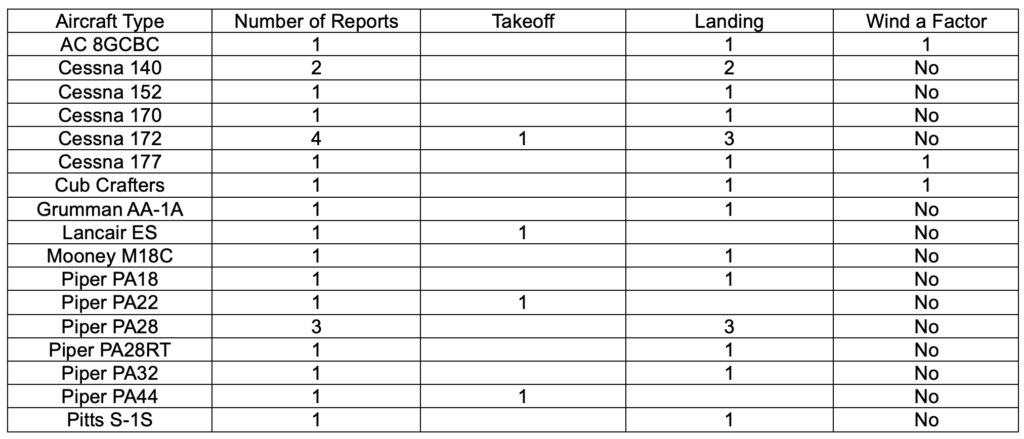
A close second most frequent in our snapshot is engine failure: 22 total. Only one was fatal—an attempted “turnback” to the runway after engine failure immediately after takeoff—and two resulted in serious injuries. 86% of engine failures during the snapshot period resulted in only minor injuries or no injury at all, an uplifting statistic.
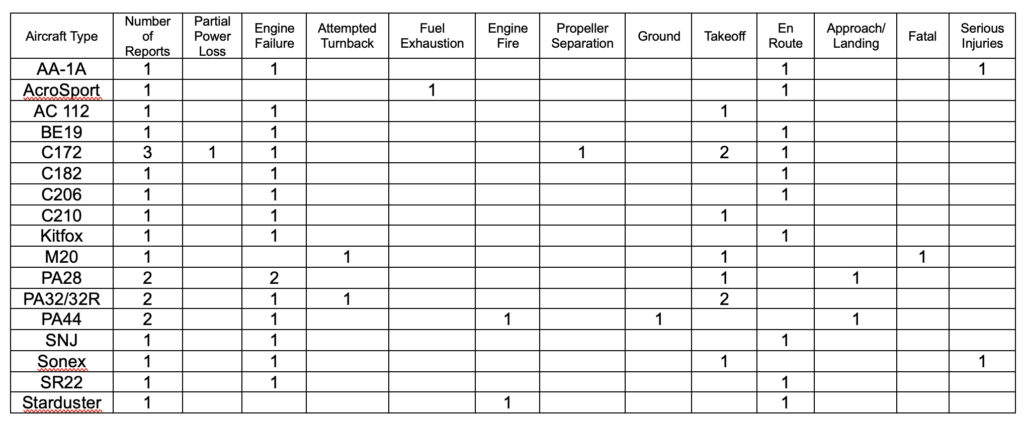
There were 13 of the next most common identified accident scenario, hard landings:
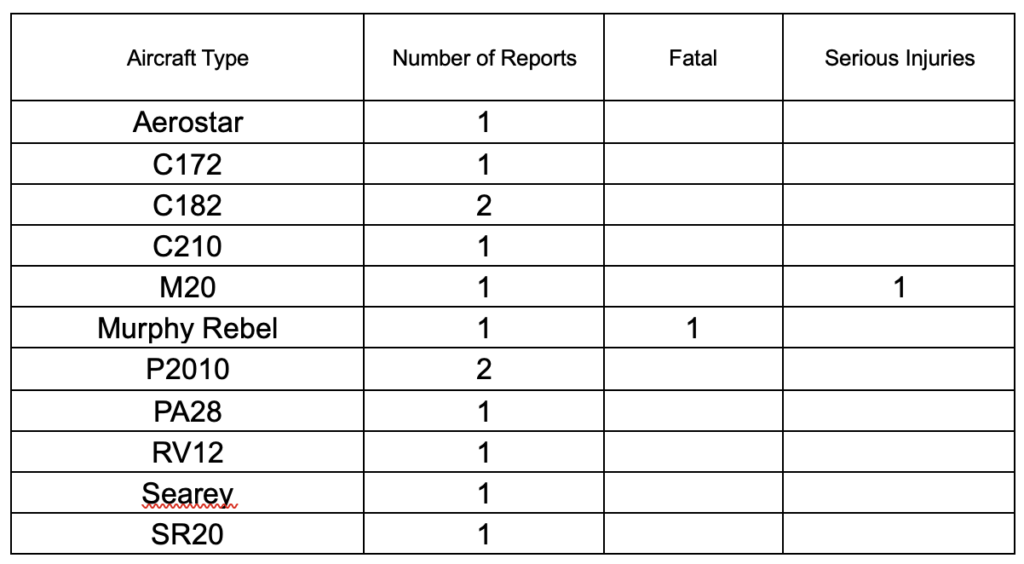
Next most common are the 12 events for which at this very early stage have “unknown” causes:
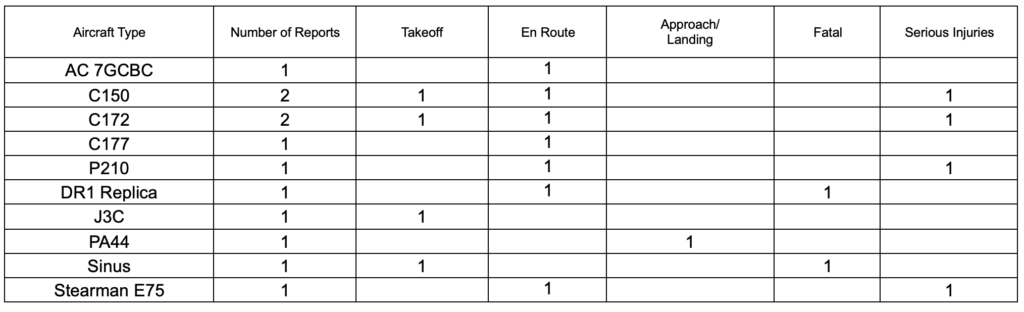
And nine cases of gear collapse on the runway, in which the gear was down but did not remain down for some reason. None resulted in injuries or fatalities.
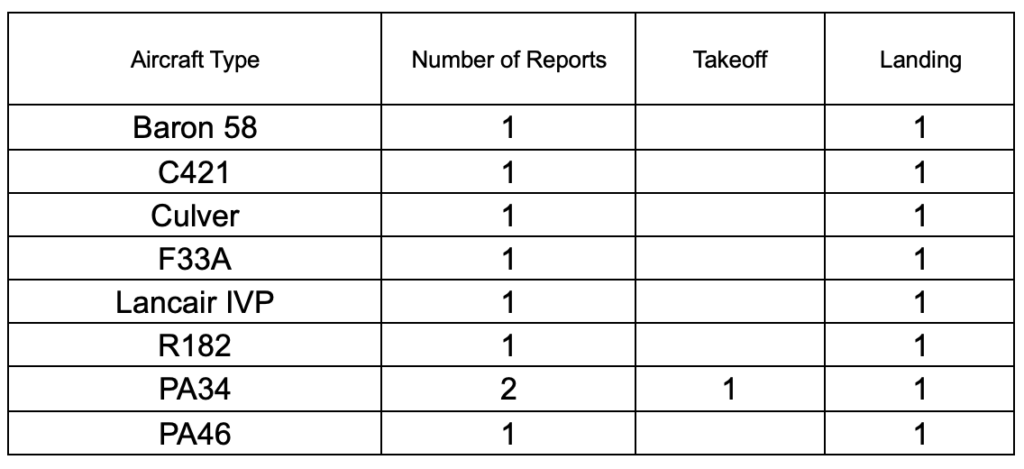
There were five reported gear up landings in the 19-day period, one each in a Celerity, a Cessna 177RG, a Cessna 182RG (R182), a Cessna P210 and a Piper PA24. None resulted in serious injury or fatality.
Five total collisions with non-airplane/non-vehicular objects on the ground occurred: a Cessna 172 and a PA28 during taxi, a Mustang II and a Lancair LC41 during takeoff, and a Cub Crafters CC18 during landing. There were no serious injuries or fatalities as a result.
Four runway overruns occurred: on landing a Commander 114TC, Diamond DA40 and a Mooney, and on takeoff a Cessna 182 out of a delayed rejected takeoff. None resulted in serious injury or fatality.
There were two stalls, a Sling on approach in reported gusty winds and a G36 Bonanza taking off. Neither caused serious injury or death.
There was also a brake failure (Cessna 421), a tire failure (A36 Bonanza) and two wheel separations (both Cessna 172s), with no one seriously hurt.
A Cessna 208 Caravan, the only turbine airplane on my focused list, landed short of the runway in a “serious injuries” crash. A Cessna 172 had a tail strike on landing, and a Piper PA28 had a window separate in flight, with no injuries in either of these last two reports.
What’s all this tell us? With a rate of over five reported mishaps a day during out 19-day snapshot period, here are some things we should all practice:
Directional control on the runway, Runway overrun prevention and Hard landing avoidance. This includes:
- Airspeed control on final approach so that landing is at a speed that supports directional control and does not result in impacting the runway too steeply or stalling too high in the flare;
- Glidepath management to arrive over the runway threshold and at the touchdown zone each at the proper energy state;
- Crosswind and drift control (although winds have not been mentioned in many of the snapshot reports); and
- Evaluating airplane and engine performance to make timely go-arounds and rejected takeoffs when necessary.
Engine failure procedures, including:
- Fuel planning, inflight management and monitoring. Only one of the FAA preliminary reports mentions fuel issues, but historically as much as 90% of reported engine failures are eventually found to be a result of improper fuel management on the part of the pilot.
- Off–airport landing site selection.
- Realistic evaluation of attempting to turn back to the runway following engine failure immediately after liftoff. Notice how incredibly newsworthy it is when a turnback attempt succeeds—your airframe and restraints will protect you if you wear shoulder harnesses and you touch down wings level, under control at the slowest safe speed.
In retractable gear airplanes, landing gear discipline and confirmation procedures to avoid gear up landings and gear collapse events. Many gear collapses seem to be the result of improper landing gear maintenance, rigging and adjustment, so if you own the aircraft ensure the landing gear is inspected and maintained properly by a mechanic well versed in the gear system of your particular airplane type.
This all comes from a snapshot of less than three weeks of FAA preliminary accident reports. It may not be representative of longer-term trends, although my experience says it’s not too far off. But it gives us all a list of tasks to debrief ourselves and evaluate our personal performance after every flight, and to practice if we find any failure to perform to exacting standards.
Questions? Comments? Supportable opinions? Let us know at [email protected].

Debrief
Readers write about recent LESSONS:
Reader Jack Spitler follows up on our discussion of the Boeing 767 that collided with a light pole and a truck while landing at Newark, New Jersey:
In review, the Bridge Visual is, by definition, a visual approach…not a circle to land instrument approach. Stable criteria still apply. It may or may not be FAA required, but at my employer, all my wide body type ratings came with the restriction, noted the card, that circle to land was not authorized at any time. We did do a variety of visuals, including the Canarsie to JFK.
Thanks again for all your efforts to encourage folks to get it right every time.
Thanks for your insights, Jack.
Reader Jason Robertson writes about last week’s LESSONS about fuel state reports:
Thank you again for your weekly newsletter. I wonder if you could give an example with some hard numbers on the fuel states. I read the ICAO definitions, but I still don’t really know when I would declare “Minimum Fuel” of “Mayday Fuel.”
ICAO seems to give two definitions of Minimum Fuel:
- “…a state where, upon reaching the destination, it can accept little or no delay.”
- “…any change in the existing clearance may result in a landing with less than planned final reserve fuel.”
I always plan to land my TBM with 60 gallons of fuel, which is about one hour. This is my “planned final reserve fuel.” I would not declare “Minimum Fuel if this dropped to 55 gallons. So, it appears that the ICAO definition of “planned final reserve fuel” is ambiguous to me and NOT the same as my planned reserve fuel. Can you please shed some light on that? How do I calculate “planned final reserve fuel?”
ICAO gives additional guidance in 4.3.7.2.2 of the 2012 document; “The declaration of MINIMUM FUEL informs ATC that all planned aerodrome options have been reduced to a specific aerodrome of intended landing and any change to the existing clearance may result in landing with less than planned final reserve fuel.” This seems to say that “minimum fuel” means sufficient fuel to reach your planned airport with ?? extra.
I believe that “Mayday Fuel” indicates that you only have enough fuel to reach the nearest suitable airport with ?? extra. This airport may not be your planned destination.
I was confused, and still not sure I have this right, so others are probably also confused. An example, with numbers, would be appreciated.
Again, thanks for your work to make us safer through education.
Readers, do you have specific guidance from ICAO? Absent any responses from knowledgeable sources I’ll do some research and see what I can find. Either way I’ll report back. Thanks, Jason.
More to say? Let us learn from you, at [email protected].

Share safer skies. Forward FLYING LESSONS to a friend.
Please help cover the ongoing costs of providing FLYING LESSONS through this secure PayPal donations link. Or send a check made out to Mastery Flight Training, Inc. at 247 Tiffany Street, Rose Hill, Kansas USA 67133. Thank you, generous supporters.
Thank you to our regular monthly financial contributors:
Steven Bernstein, Montclair, NJ. Robert Carhart, Jr., Odentown, MD. Greg Cohen, Gaithersburg, MD. John Collins, Martinsburg, WV. Dan Drew. Rob Finfrock, Rio Rancho, NM. Norman Gallagher. Bill Griffith, Indianapolis, IN. Steven Hefner, Corinth, MS; Ellen Herr, Ft Myers, FL. Erik Hoel, Redlands, CA. Ron Horton. David Karalunas, Anchorage, AK. Steve Kelly, Appleton, WI. Karl Kleiderer. Greg Long, Johnston, IA. Rick Lugash, Los Angeles, CA. Richard McCraw, Hinesburg, VT. David Ovad, Resiertown, MD. Steven Oxholm, Portsmouth, NH. Brian Schiff, Keller, TX. Paul Sergeant, Allen, TX. Paul Uhlig, Wichita, KS. Richard Whitney, Warrenton, VA. Jim Preston, Alexandria, VA. Johannes Ascherl, Munich, Germany. Bruce Dickerson, Asheville, NC. Edmund Braly, Norman, OK. Steven Hefner. Lorne Sheren, New Vernon, NJ. “The Proficient Pilot,” Keller, TX. Kynan Sturgiss, Hereford, TX. Bluegrass Rental Properties, LLC, London, KY. John Foster. Joseph Victor, Bellevue, WA. Chris Palmer, Irvine, CA. Barry Warner, Yakima, WA. Todd LeClair, Cadiz, KY. Jim Hopp, San Carlos, CA. Adrian Chapman, West Chester, PA. Ed Stack, Prospect Heights, IL. Robert Finley, Dubois, Wyoming. Robert Finley, John Kinyon, Lawrence Copp, V. Andrew Smith, Kevin Echols. Claude Bundrick, Shreveport, LA. John Croft, Upper Marlboro, MD. Robert Hoffman, Sanders, KY.
Thank you to these 2026 donors:
Robert Sparks, Mark Sletten, Thomas Jaszewski, Douglas Olson, David Field, Michael McRobert, Wayne Colburn. Albert Chaker, Textron Aviation Employees Flying Club, Denny Southard, Henry Fiorentini, Thomas Fankhauser, Rob Humble, Nandakumar Sankaran, Jay Apt, Bill Farrell, Stu Spindel, Robert Holtaway, George Stromeyer
Pursue Mastery of Flight®
Thomas P. Turner, M.S. Aviation Safety
Flight Instructor Hall of Fame Inductee
2021 Jack Eggspuehler Service Award winner
2010 National FAA Safety Team Representative of the Year
2008 FAA Central Region CFI of the Year
FLYING LESSONS is ©2026 Mastery Flight Training, Inc. For more information see www.thomaspturner.com. For reprint permission or other questions contact [email protected].