
THIS WEEK: >> Little tolerance for low >> You can always go around >> Where are YOU looking?

FLYING LESSONS uses recent mishap reports to consider what might have contributed to accidents, so you can make better decisions if you face similar circumstances. In most cases design characteristics of a specific airplane have little direct bearing on the possible causes of aircraft accidents—but knowing how your airplane’s systems respond can make the difference in your success as the scenario unfolds. So apply these FLYING LESSONS to the specific airplane you fly. Verify all technical information before applying it to your aircraft or operation, with manufacturers’ data and recommendations taking precedence. You are pilot in command and are ultimately responsible for the decisions you make.
FLYING LESSONS is an independent product of MASTERY FLIGHT TRAINING, INC.
Pursue Mastery of Flight®
This week’s LESSONS
If you’ve not seen or heard about it yet—and I don’t know how you could have missed it—there’s been widespread online video and comment about a transatlantic United Airlines 767 that descended below glidepath and collided with a light pole and a bakery truck on the Jersey Turnpike during landing at Newark Liberty Airport (KEWR), Newark, New Jersey, just across the river from New York City.
I found this somewhat potent description online:
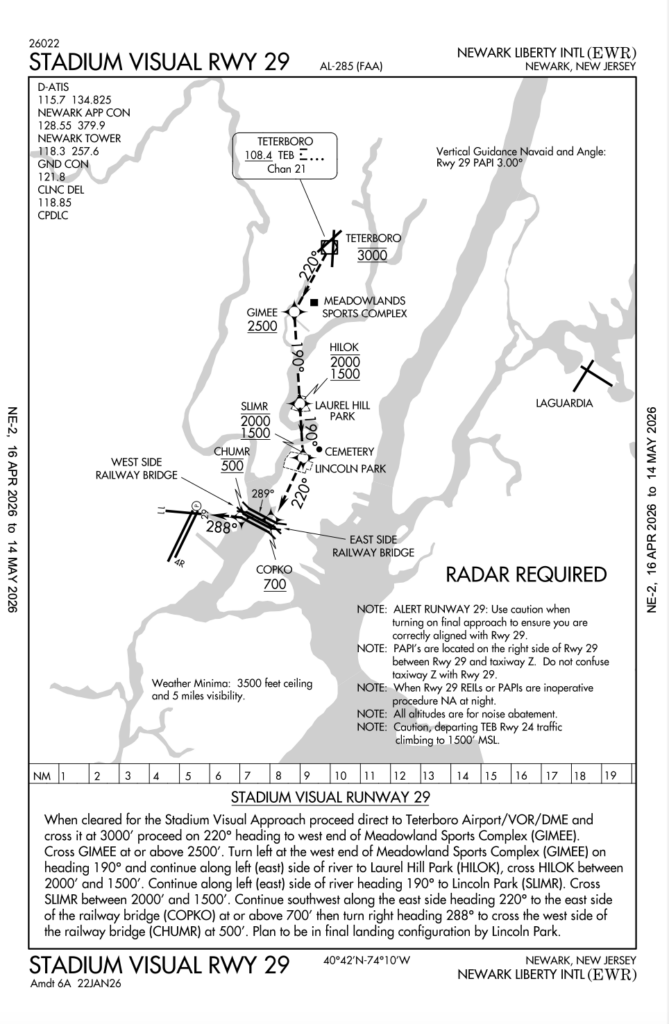
That approach is infamous for a sharp, 70-degree turn, an unusually short runway, nonstandard guidance lights, and other challenges, said Robert Joslin, former FAA’s chief scientific and technical advisor.
The procedure itself notes, with my emphasis added:
PAPIs are located on the right side of Rwy 29 between Rwy 29 and taxiway Z….
And also:
Vertical Guidance Navaid and Angle: Rwy 29 PAPI 3.00°.
A Precision Approach Path Indicator (PAPI) is a series of lights that define a visual glide path. From the FAA:
The PAPI system is the current standard Visual Glide Slope Indicator (VGSI) consisting of four light boxes arranged perpendicular to the edge of the runway. It projects a pattern of red and white lights that provide visual approach slope information. PAPIs provide a definite white and red light projection pattern along the desired descent path to the touchdown point. PAPIs are designed to reduce Controlled Flight into Terrain (CFIT) and landing distance over and under runs by assisting the pilot in establishing a stabilized descent.
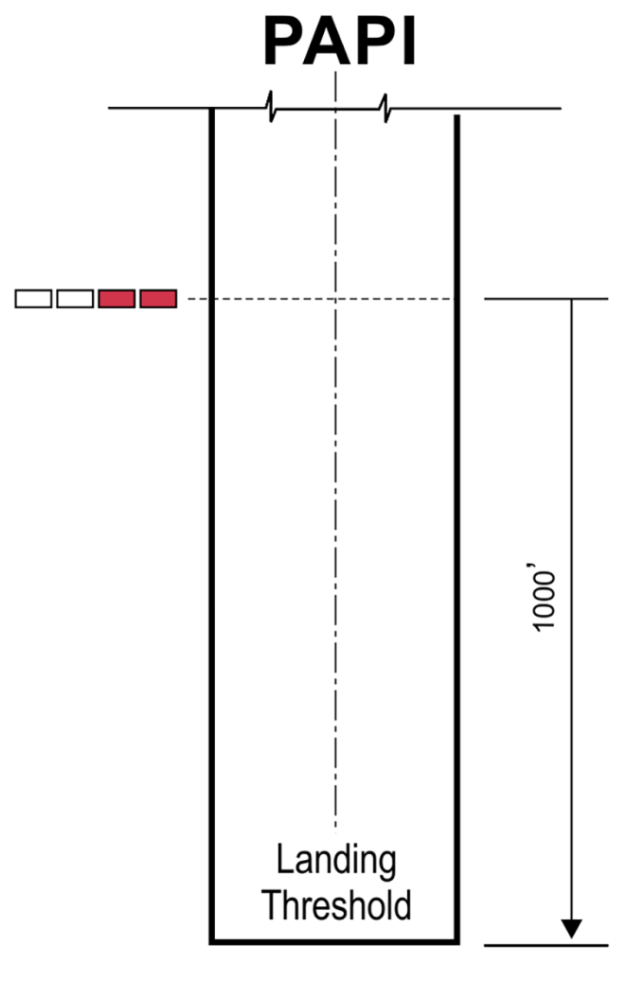
When on the visual glidepath two red and two white lights are visible because of the airplane’s location and the angle at which the lights project from the box. A little high and three white lights and one red light appear—increase vertical speed slightly with power and/or pitch to require the two red/two white indication.
Higher than that on glidepath and all four lights appear white. Increase angle of descent—reduce power and/or lower pitch—to reacquire the desired two red/two white state if you’re able to do so in a smooth, gradual and controlled manner before reaching the runway threshold. If not, go around.
Slightly below glidepath and three red lights appear along with one white. Add power and/or use any excess airspeed energy to reduce angle of descent until back on the proper two red/two white glidepath. If you can’t get there prior to the threshold, go around.
See four red lights? Positively arrest rate and angle of descent with power while managing airspeed to re-establish at least the three red/one white condition right away, then trend to the desired two red/two white state before reaching the runway threshold. If there is an immediate obstacle or terrain hazard when you see the four-red indication go around without hesitation. If you do not almost immediately see the three red/one white display when you begin your correction go around without delay.
When flying the visual glide path the aircraft will be approximately 50 feet above the runway threshold as you cross it (About one and a half Cessna 172 wingspans), and descending at an angle that results in touching down approximately 1000 feet past the threshold. There’s little tolerance for being low.
U.S. regulations require, when operating in Class D airspace (such as KEWR):
Each pilot operating an airplane approaching to land on a runway served by a visual approach slope indicator must maintain an altitude at or above the glide path until a lower altitude is necessary for a safe landing.
That glide path may be electronic or visual—such as the PAPI.
Runway 29 is short by international Boeing standards, 6725 feet. But reportedly strong winds made it the favored runway for this 767 inbound from Venice, Italy with over 200 passengers. That may have made the crew want to eschew the usual touchdown zone markers 1000 feet from the runway threshold—which effectively makes this a 5725 foot-long runway—and instead “aim for the numbers” or some other point closer to the runway threshold.
The runway is 150 feet wide which, combined with a comparatively short length, introduces the visual illusion that the airplane is higher on approach than it actually is. Did the crew brief on this illusion, or the Pilot Flying and Pilot Monitoring take it into account?
A strong headwind on final reduces ground speed. Consequently, for a given airspeed the aircraft will descend at a steeper angle than it would with less headwind. Did the crew take this into account, or did the Pilot Flying add power to result in the standard 3° visual glidepath?
Did the crew note the “low” (three or eventually four red lights) PAPI indication? If so, why did it not act? Did they use the PAPI, positioned on the nonstandard side of the runway, or even know the PAPI exists?
Will investigation reveal that the crew did see the low-glidepath state and act, not in time to miss the light pole and the truck, but soon enough to prevent a far worse outcome had the big 767 descended just a few feet lower?
Was pilot fatigue part of the equation, after a long oceanic flight?
The obvious LESSON is to maintain a safe glide path on final approach that provides obstacle clearance to the runway touchdown zone markers, themselves placed 1000 feet from the runway threshold (or if the runway is less than 3000 feet long, 1/3 the total runway length) specifically to provide tolerance for landing a little short. That’s easy to say, and easy for us to dismiss—I’d never do that.
The more nuanced message is for all pilots to consider:
- The many factors that can cause illusions on final approach;
- The glide angle impact of landing into a strong headwind;
- The effects of fatigue even over the length of a typical general aviation flight, including the insidious effect of flight even only a few thousand feet up in unpressurized aircraft, especially when personal flights are often tacked on to other duties and activities of a busy day.
- The availability of visual glide path indicators at most airports, even those not in Class D airspace, and the wisdom of following visual approach path guidance whenever it is available.
- Notes and cautions on instrument approach charts and in the Chart Supplement (or your country’s equivalent) that may warn of nonstandard visual glide paths, visual guidance that does not align with electronic vertical guidance but which takes precedence over the electronic glidepath once transitioned to a visual approach, or other obstacle information.
Adjust all of the above if the runway has no visual glide path, it has nonstandard markings or no markings at all, or if some operational reason makes you decide to touch down at some point other than the standard touchdown zone, especially if close to the runway threshold.
Whether rolling out on final from a visual or circling instrument procedure, making a straight-in from an instrument approach, or entering final from any number of approved traffic pattern entries (see last week’s FLYING LESSONS Weekly):
- Know if there’s visual approach path guidance;
- If so, know the type of indicator (PAPI, VASI, etc.) and how to use it, and
- Know where to look (left or right of the runway, or both) to find it.
You can always go around—and you must, if you are too low on glidepath too close to the runway.
Questions? Comments? Supportable opinions? Let us know at [email protected].

Debrief
Readers write about recent LESSONS:
Several readers wrote about last week’s discussion of traffic pattern entries, and the pilots who sometimes don’t follow them. First up is well-known instructor and airshow pilot Doug Rozendaal:
The worst pattern offenders at our airport are the Regional Jets. KMCW [Mason City, Iowa] is uncontrolled with a Class E surface area. They routinely enter right hand patterns. The never fly less than a 5 mile final, and they assume that once they have reported a right downwind (illegal) and driven 5 to 10 miles away from the airport, (outside the airport traffic area) they have right of way.
We have a high volume of student traffic from a [Part] 141 school not far away. They do not have RJ traffic at their homedrome so they do not know how to respond to an airplane that is 5-10 miles out on final approach.
To make things even better the RJs frequently fail to turn on the runway lights for landing departure, at night! They do not know how to do it [pilot controlled lighting, or PCL]. One crew broke out at night in low weather and missed the approach. The airport maintenance staff turned on the lights for their second approach. Two ATP rated pilots in an airplane that don’t understand PCL.
It is unprofessional and unacceptable. And it makes me really appreciate [flying] my Baron.
Air carrier aircraft operating at nontowered airfields, especially at night, is a “whole other” issue. I may address it someday, but the target audience is more Professional Pilot and Air Line Pilot and certainly not reading FLYING LESSONS Weekly. For those of us here last week’s LESSON applies: fly correctly so others can find you and predict where you’ll go next, but expect the other pilot will not fly correctly or predictably and watch out accordingly. And instructors, teach this to your students early in their training—maybe some of it will guide their decisions when they are flying the Regional Jet. Thanks as always, Doug.
Instructor and Airline Transport Pilot Sam Dawson adds:
Reference the Citation jet doing an opposite pattern while you were landing: Some years ago I operated at KDNA, Dona Ana airport in New Mexico. The east-west airport was north traffic only [left traffic Rwy 10, right traffic Rwy 28] as there was a drop zone and an aerobatic box on the south side.
One time while practicing aerobatics I heard a fractional jet call for an extended left downwind to 27, which would take him through the aerobatic box. Rather than confronting the pilots on CTAF I decided to knock off, land, and discuss it with the pilots in the FBO.
I politely approached the pilots with a VFR sectional and the AFD (Airport Facilities Directory, Chart Supplement now), expecting pushback. Instead, the captain responded that their Jeppesen charts did not have this. He pulled out his Jepp 10-7 page (airport page), and sure enough there was nothing about north traffic only. He gave me the phone number of his DO [Director of Operations] and asked me to call him with this information so it could be sent out in a company memo and passed on to Jeppesen so a note could be added in the airport page. Problem fixed with no shouting or name calling.
So a reminder, most jets will not have VFR sectionals and the information about the VFR traffic pattern might be missing from Jepp charts. PS- For those who think you are being nit picky, the FAA has taken action in the past against pilots flying the wrong direction traffic pattern.
Good reminder, Sam. 14 CFR 91.103 tells us:
Each pilot in command shall, before beginning a flight, become familiar with all available information concerning that flight.
So “not on the Jepp charts” is not an excuse, but it is an explanation. It’s right there in the Chart Supplement for KDNA whether the crew carried VFR Sectionals or not. Again, we must fly defensively, but you did a great job educating the professional pilots and respectfully reminding them their preflight responsibility goes beyond what’s on instrument approach charts in a way that made a real difference. Thank you.
Reader Randy Starbuck wraps up this week’s Debrief with one of my pet peeves and instructional talking points:
[Collision avoidance in and near the traffic pattern] is further complicated because the “other guy” might be on an instrument approach in perfect VMC and instead of calling his or her position in relation to the airport, i.e., “Jabara Traffic, Cessna 123, five miles north straight in, full stop, runway one eight, Jabara” [that pilot] might say,“Jabara Traffic, Cessna 123, Deyek.” I might be a newly certificated private pilot with my shiny new “license to learn” and not know where the heck is Deyek.
Many years ago AOPA’s Air Safety Foundation (predecessor to the AOPA Air Safety Institute) published research showing that most midair collisions occur in the traffic pattern below 400 feet AGL on final approach, and that usually one of the airplanes involved is an instrument instructional flight flying an approach while the other is flying a VFR traffic pattern, often with a low-time pilot. The (usually) faster IFR airplane catches up with an collides with the (usually slower) VFR airplane.
Whether or not those statistics are still valid, I’ve used this as a major part of what I teach about collision avoidance to both visual and instrument students. For instrument students and in Instrument Proficiency Checks (IPCs) I stress making traffic calls in terms of location, distance from the airport, and intentions, as you describe: “five miles north, straight in runway 18” when at Deyek, which is the final approach fix. For visual patterns, including on Flight Reviews, I stress looking for airplanes everywhere. On downwind I’m looking for long straight-ins and airplanes on the opposite side of the airport. Turning base I visually clear and say aloud, “final approach is clear, backwards base is clear, the runway is clear, I’m clear to land.” That’s also a double-check that I am in fact cleared to land at a tower-controlled airport. On final I look for aircraft and vehicles on the runway or where they may soon move on to the runway.
An extra for instrument instructors: When you’re flying an approach with your student “under the hood,” where is that student looking? At the instruments, of course (no fair peeking). But instructor, where are you looking? Usually the “double I” (instrument instructor) is also watching the instruments, and watching the student watch the instruments. Where your attention needs to be focused is outside the aircraft, watching for others on downwind, turning base, the “wrong-side, backward” version of each, and—hardest to see, because there’s little relative movement—on final approach ahead of you, waiting for you to catch up.
Thank you, Randy.
More to say? Let us learn from you, at [email protected].

Share safer skies. Forward FLYING LESSONS to a friend.
Please help cover the ongoing costs of providing FLYING LESSONS through this
secure PayPal donations link. Or send a check made out to Mastery Flight Training, Inc. at 247 Tiffany Street, Rose Hill, Kansas USA 67133. Thank you, generous supporters.
Thank you to our regular monthly financial contributors:
Steven Bernstein, Montclair, NJ. Robert Carhart, Jr., Odentown, MD. Greg Cohen, Gaithersburg, MD. John Collins, Martinsburg, WV. Dan Drew. Rob Finfrock, Rio Rancho, NM. Norman Gallagher. Bill Griffith, Indianapolis, IN. Steven Hefner, Corinth, MS; Ellen Herr, Ft Myers, FL. Erik Hoel, Redlands, CA. Ron Horton. David Karalunas, Anchorage, AK. Steve Kelly, Appleton, WI. Karl Kleiderer. Greg Long, Johnston, IA. Rick Lugash, Los Angeles, CA. Richard McCraw, Hinesburg, VT. David Ovad, Resiertown, MD. Steven Oxholm, Portsmouth, NH. Brian Schiff, Keller, TX. Paul Sergeant, Allen, TX. Paul Uhlig, Wichita, KS. Richard Whitney, Warrenton, VA. Jim Preston, Alexandria, VA. Johannes Ascherl, Munich, Germany. Bruce Dickerson, Asheville, NC. Edmund Braly, Norman, OK. Steven Hefner. Lorne Sheren, New Vernon, NJ. “The Proficient Pilot,” Keller, TX. Kynan Sturgiss, Hereford, TX. Bluegrass Rental Properties, LLC, London, KY. John Foster. Joseph Victor, Bellevue, WA. Chris Palmer, Irvine, CA. Barry Warner, Yakima, WA. Todd LeClair, Cadiz, KY. Jim Hopp, San Carlos, CA. Adrian Chapman, West Chester, PA. Ed Stack, Prospect Heights, IL. Robert Finley, Dubois, Wyoming. Robert Finley, John Kinyon, Lawrence Copp, V. Andrew Smith, Kevin Echols. Claude Bundrick, Shreveport, LA. John Croft, Upper Marlboro, MD.
Thank you to these 2026 donors:
Robert Sparks, Mark Sletten, Thomas Jaszewski, Douglas Olson, David Field, Michael McRobert, Wayne Colburn. Albert Chaker, Textron Aviation Employees Flying Club, Denny Southard, Henry Fiorentini, Thomas Fankhauser, Rob Humble, Nandakumar Sankaran
NEW THIS WEEK: Bill Ferrell
Pursue Mastery of Flight®
Thomas P. Turner, M.S. Aviation Safety
Flight Instructor Hall of Fame Inductee
2021 Jack Eggspuehler Service Award winner
2010 National FAA Safety Team Representative of the Year
2008 FAA Central Region CFI of the Year
FLYING LESSONS is ©2026 Mastery Flight Training, Inc. For more information see www.thomaspturner.com. For reprint permission or other questions contact [email protected].