

Topics this week include: >> When to punch out >> It’s the adrenaline talking >> What might YOU try to do?

FLYING LESSONS uses recent mishap reports to consider what might have contributed to accidents, so you can make better decisions if you face similar circumstances. In most cases design characteristics of a specific airplane have little direct bearing on the possible causes of aircraft accidents—but knowing how your airplane’s systems respond can make the difference in your success as the scenario unfolds. So apply these FLYING LESSONS to the specific airplane you fly. Verify all technical information before applying it to your aircraft or operation, with manufacturers’ data and recommendations taking precedence. You are pilot in command and are ultimately responsible for the decisions you make.
FLYING LESSONS is an independent product of MASTERY FLIGHT TRAINING, INC.
Pursue Mastery of Flight®
This week’s LESSONS
Mayday! Mayday! Mayday! Shortly after leveling at 8000 feet at the beginning of a cross-country flight, the pilot of a Cirrus SR22 reported to Air Traffic Control: “We just lost our engine.”
ATC responded, “Are you declaring an emergency,” and when the pilot said “affirmative, declaring an emergency,” the controller replied, “what are your intentions?”
The pilot replied: “We got an airport directly below us. I think we’re gonna try to land there.”
Excerpted from the NTSB preliminary report:
A Cirrus Design Corp SR22 was substantially damaged in an accident near Lexington, South Carolina. The commercial pilot sustained serious injuries and the passenger was fatally injured.
The pilot departed Pryor Field Regional Airport (DCU) Decatur, Alabama (home base) on February 3, 2026 [three days before the accident], with full fuel tanks and made 2 stops for additional fueling. The flight terminated at Wilmington International Airport (ILM), Wilmington, North Carolina where he stopped for the evening. The pilot resumed the flight on February 4, 2026, and landed at the destination airport; Columbia Metro Airport (CAE), Columbia, South Carolina where he parked for 2 nights. According to witnesses, the pilot informed the fixed base operator that he did not require any services and that he would get fuel upon departure. The pilot did not order fuel.
Witnesses stated that on February 6, 2026, about 0800, the pilot and passenger arrived at CAE and conducted a preflight inspection. After moving the airplane into the sunlight to “warm it up and melt the frost,” the pilot taxied out to runway 27 and departed to for the intended destination of DCU, about 295 nautical miles west northwest.
The flight departed on an instrument flight rules flight plan and flew along a ground track of 282°. Air traffic control cleared the pilot to climb and maintain 8,000 ft msl and cleared him to proceed directly to DCU. The pilot acknowledged the clearance and proceeded to climb. The airplane’s ground track, groundspeed, and climb were steady and unremarkable until the airplane was about 13 miles west of CAE.
Shortly after the airplane reached 8,000 ft msl the pilot declared “mayday, mayday, mayday,” and informed the controller that “we just lost our engine” and confirmed that he was declaring an emergency. The pilot reported to the controller that there was an airport directly below that he intended to divert to. The airport was White Plains Airport (SC99), Lexington, South Carolina and was located about 1 1/2 miles south of the airplane’s position at that time. The pilot also reported that the airplane had about 45 gallons of fuel onboard.
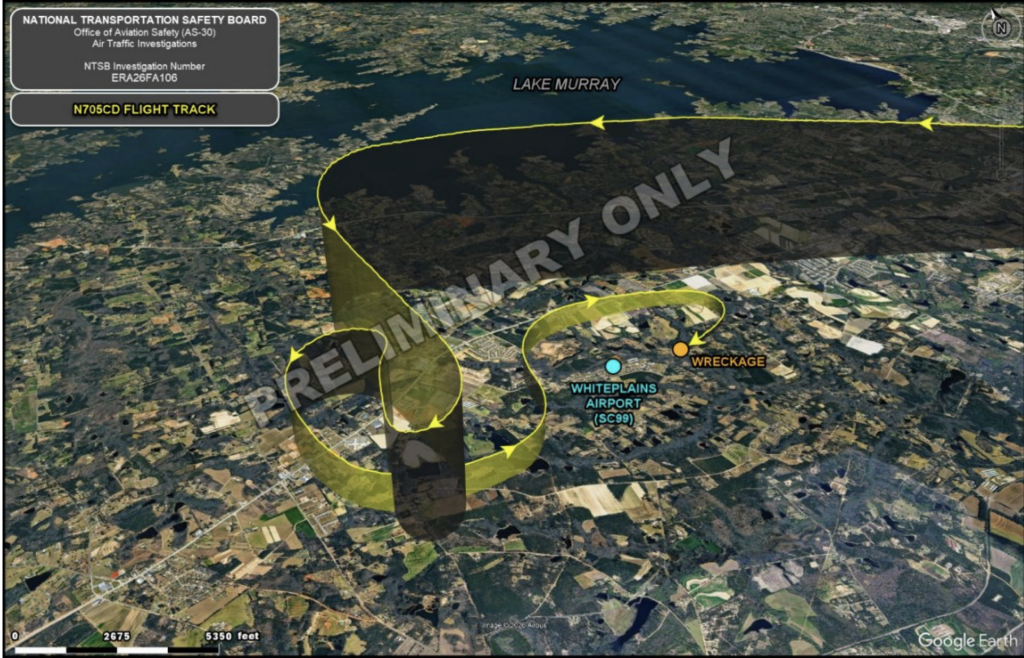
Glide path of the accident airplane from the NTSB preliminary report (above), and (below) from the Cirrus Owners and Pilots Association
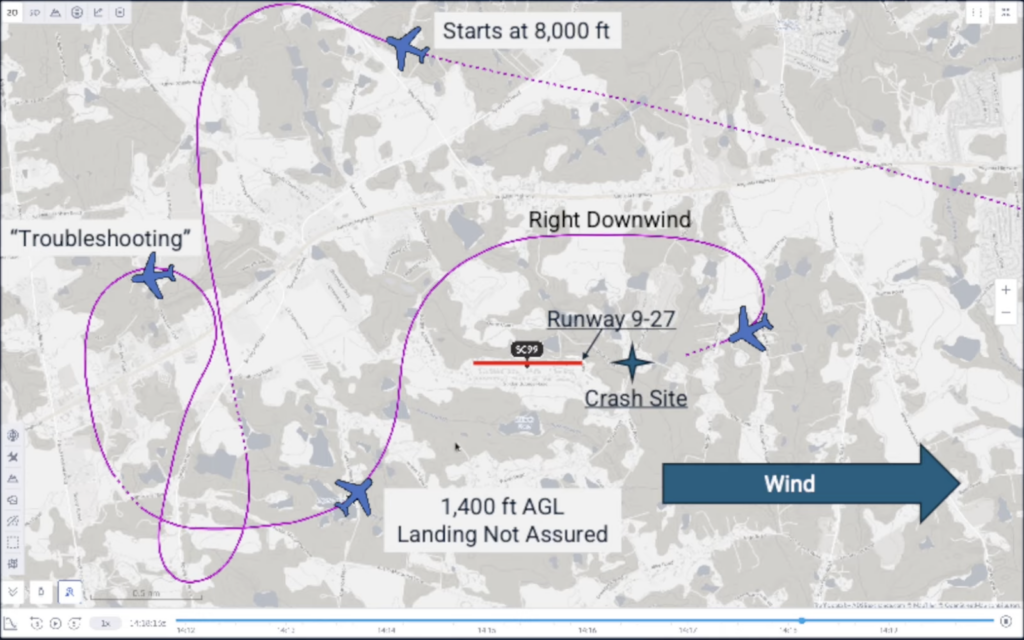
SC99 [is] a private airport community with a 3,000-ft-long paved runway 9/27 at an elevation of 524 ft. As the airplane flew past SC99, the pilot initiated a left turn toward the south while the airplane was descending through 6,400 ft msl. It remained on that track for about 2 miles before making a right teardrop turn toward the northeast, followed by a left teardrop turn to the south (see figure). The turning maneuvers were all conducted about 1 1/2-mile west of the airport before the pilot flew toward the airport and joined the right downwind leg of the traffic pattern for runway 27 at 1,600 ft msl (1,100 agl) and 120 kts groundspeed.
Home security cameras captured the airplane making a steep right turn from the base leg of the traffic pattern to the final approach leg, and the associated audio was consistent with the propeller windmilling without engine power. The camera captured the airplane when it was about 1,290 ft msl and 81 kts groundspeed (when correlated with the ADS-B data). Nearing the end of the turn, while on final approach, the airplane’s altitude had decreased to 1,090 ft msl and the groundspeed decreased to 73 kts. The airplane’s last ADS-B-observed position was recorded as it descended through 790 ft msl (about 300 ft agl), at 70 kts groundspeed, and about 2,100 ft east of the runway 27 threshold. Shortly after, the airplane impacted the top of 65-ft-tall pine trees about 1,000 ft from the runway threshold. The airplane rolled inverted and impacted a level gravel road before coming to rest against trees.
This is another case in which we should consider the wisdom of proceeding direct to the airport and entering a descending glide using the High Key/Low Key orientation method discussed in recent FLYING LESSONS reports. As mentioned in previous Debriefs it takes practice, both initially and as part of routine recurrent training, to develop and retain the judgment needed to safely and accurately fly this power-off descent.
This is the Cirrus crash my very patient reader Mike Dolin referenced after the February 12 LESSONS when he wrote:
You might pick up on the Bonanza crash in Georgia [that was indeed the motivation of my February 12 report], but there was another. A Cirrus crashed going into a private strip in Northern South Carolina yesterday. Whiteplains, SC is a private strip, just west of Columbia, SC. I don’t see an identifier on the sectional chart.
The report I got said, departed Decatur, AL at 8000’, lost power and decided to land at Whiteplains. The opinion of the pilot sending the message – “Did everything wrong. Pilot survived, passenger died.” One might wonder, why not pull the chute?
…so what happened to the Bonanza engine? News reports are so sketchy and inaccurate.
Reader Mike added:
The more info that trickles in the more I want to know. Is that the same engine as on the [G]36? Are there more details on the G36 accident?
If we ever know the precise cause and failure sequence of the engine in either the G36 or SR22 accident, it won’t be for a year or more before we have access to the final NTSB Probable Cause reports. The Cirrus had a normally aspirated Continental IO-550N engine rated at 310 horsepower at sea level, similar to but not identical to the IO-550B installed on G36s. Since your email you’ve seen the LESSONS I derived from it and a link to the NTSB preliminary report…which tells us the Bonanza pilot reported a propeller overspeed, which is a result of massive loss of engine oil that in turn suggests a catastrophic mechanical engine failure that penetrates the engine case.
But the heart of your question, I believe, is this:
One might wonder, why not pull the chute?
Good question. I recall speaking with some experienced U.S. Air Force instructors and safety officers many, many years ago who told me the hardest thing to ingrain in military trainer and tactical fighter pilot training is when to punch out. Pilots tend to be goal- and adrenalin-driven personalities (military pilots even more so). We all want to be problem-solvers; we all want to save the day, and save the airplane. To eject is to admit that you can’t recover, that your skills aren’t enough to save the day. It’s not giving up, it’s choosing the path of survival. But it is apparently very hard to instill a culture in which pulling the ejection seat handles when called for is an easy, almost automatic decision.
Cirrus pilots can take advantage of factory and owner’s group training that teaches when to “pull the red handle” to activate the Cirrus Airframe Parachute System (CAPS)—the whole airplane parachute. Cirrus pilots can find opportunities to practice CAPS decision-making in realistic scenarios flown in airplane-specific Flight Training Devices (“simulators”), including this new program free from the Cirrus factory that was announced just this week. But even the most dedicated civilian pilot won’t be able to put in the time and practice that military instructors find necessary to make ejection an acceptable and sometimes preferable option in the face of danger. Pilots with whole-airframe ballistic recovery parachutes need to be thinking constantlyabout when (and when not) to commit to the canopy to be ready to exercise the option without hesitation when needed.
I’ve taken some Cirrus classroom and simulator training, including exercising the CAPS option. I know that the Cirrus Owners and Pilots Association (COPA) teaches that, following engine failure, the pilot should attempt to glide to the best option available within gliding range, but that if not in a position to land when passing through 2000 feet AGL to “pull the red handle” and make the rest of the descent under canopy.
I suspect most pilots, however, finding themselves 2000 feet AGL a mile and a half from a runway after having successfully glided to that point, will feel a strong urge to continue the glide to a landing. They may feel they are in a position to land, and not commit to CAPS deployment. It’s the goal orientation and the adrenalin talking.
What might you try to do if you don’t have the option of a parachute? The lives that are lost from engine failures—and unexpectedly, most inflight engine failures are survived—often come from last-second maneuvering to try to align with something other that what appears to have been the target touchdown zone, or stalls when attempting to stretch a glide that didn’t work out precisely as planned. In either case landing straight ahead with wings level, under control at the slowest safe speed uses the airplane’s structure to protect you and your passengers, giving you the best chances for survival.
But let’s let the expert instructors from COPA answer your question—which it does in this video about the South Carolina Cirrus crash: First Takes: Engine Failure at 8,000 Feet: Why CAPS Wasn’t Pulled and What Every Cirrus Pilot Must Learn.
Thank you, Mike, for your questions and your patience while I got back to addressing them.
Questions? Comments? Supportable opinions? Let us know at [email protected].

Debrief
Readers write about recent LESSONS:
One element we’ve discussed in the case of a recent double-fatality engine failure accident is the Normalization of Deviance. In his April 1, 2026 Vectors for Safety instructor/author Gene Benson delves deeper into this concept, applying it to three aircraft accidents. It’s worth your time to read.
Reader John Smith takes us back to the February 5 FLYING LESSONS with his experience and advice:
I used to fly Twin Otters for a regional airline. The Otters had three slip indicators and no two of them ever agreed. So, I would suggest that the slip indicators should be calibrated by leveling the aircraft laterally and setting the position of the turn and slip so that the ball is centered. In fact, it should be checked on a regular basis such as during annual inspection.
The airplane I most frequently fly has three slip/skid indicators: a true “ball in a liquid-filled tube” on an electric gyroscope backup attitude indicator, an electronic representation of the classic slip/skid ball on a second, digital backup attitude indicator, and the “horizontal line under a triangle” at the top of a “glass cockpit” Primary Flight Display. The two “balls” agree with each other and my “feel” when flying the airplane, while the hard-to-read horizontal line always indicates the need for a little more right rudder than the other two (and my “feel”). I use the two that agree and ignore the small bar-and-triangle presentation, which I’ve always found harder to scan and interpret anyway. I agree that slip/skids should be checked periodically, especially those that are artificially created. Thanks, John.
Reader/instructor Jeff Edwards responds to the March 19 discussion of the “high key/low key overhead spiral” engine-out glide technique:
I learned this technique from my first experience in the [American Bonanza Society’s] BPPP program and taught it there for many years. Now with LOBO [Lancair Owners and Builder Organization, of which Jeff was a founding member] I teach it at every opportunity. I have had two pilots I taught use it in real life and both walked away. You cannot practice this procedure enough.
Thank you, Jeff.
A reader who asked to remain anonymous adds:
When practicing power-off 180 I think it is not realistic practice when a pilot uses his ingrained tendency to chop power abeam the numbers and/or aims for the numbers or thereabouts on final. The goal is to touchdown with enough runway behind you avoid landing short. If it’s a 3000′ runway and you have to exit and taxi back for your next circuit, so be it.
The Power Off 180 is a maneuver taught for and evaluated on the FAA Commercial flight test. It’s commonly presented to Private Pilot candidates not as a checkride maneuver itself, but as a presentation of engine failure on downwind in the airport traffic pattern. It’s essentially the segment of that overhead spiral mentioned above from the Low Key point to touchdown, assuming this was practice to a landing on a runway.
I agree for the needs to aim for somewhere other than “the numbers” or the very beginning of the runway (or field) surface, for several reasons:
- To provide the margin for undershoot our anonymous reader highlights;
- To aid in obstacle clearance as you near the runway; and
- In retractable gear airplanes, to account for the added rate of descent created by gear extension on short final, which will dramatically alter your glide path if you elect to use the gear in a for-real emergency and/or when you (hopefully) extend it during practice.
When I discuss and present engine-out landings using the overhead spiral or its low-key-to-touchdown phase I suggest the pilot use the Touchdown Zone indicators 1000 feet from the runway threshold as the landing target, if the runway is so marked, or no closer to the threshold than the second runway stripe without such markings or if the runway is quite short. An overhead spiral or a Power Off 180 is flown essentially as a turn around that point until you make adjustments for wind and approach glidepath management on what will be a short final approach. Thank you, anonymous.
More to say? Let us learn from you, at [email protected].

Share safer skies. Forward FLYING LESSONS to a friend.
Please help cover the ongoing costs of providing FLYING LESSONS through this
secure PayPal donations link. Or send a check made out to Mastery Flight Training, Inc. at 247 Tiffany Street, Rose Hill, Kansas USA 67133. Thank you, generous supporters.
Thank you to our regular monthly financial contributors:
Steven Bernstein, Montclair, NJ. Robert Carhart, Jr., Odentown, MD. Greg Cohen, Gaithersburg, MD. John Collins, Martinsburg, WV. Dan Drew. Rob Finfrock, Rio Rancho, NM. Norman Gallagher. Bill Griffith, Indianapolis, IN. Steven Hefner, Corinth, MS; Ellen Herr, Ft Myers, FL. Erik Hoel, Redlands, CA. Ron Horton. David Karalunas, Anchorage, AK. Steve Kelly, Appleton, WI. Karl Kleiderer. Greg Long, Johnston, IA. Rick Lugash, Los Angeles, CA. Richard McCraw, Hinesburg, VT. David Ovad, Resiertown, MD. Steven Oxholm, Portsmouth, NH. Brian Schiff, Keller, TX. Paul Sergeant, Allen, TX. Paul Uhlig, Wichita, KS. Richard Whitney, Warrenton, VA. Jim Preston, Alexandria, VA. Johannes Ascherl, Munich, Germany. Bruce Dickerson, Asheville, NC. Edmund Braly, Norman, OK. Steven Hefner. Lorne Sheren, New Vernon, NJ. “The Proficient Pilot,” Keller, TX. Kynan Sturgiss, Hereford, TX. Bluegrass Rental Properties, LLC, London, KY. John Foster. Joseph Victor, Bellevue, WA. Chris Palmer, Irvine, CA. Barry Warner, Yakima, WA. Todd LeClair, Cadiz, KY. Jim Hopp, San Carlos, CA. Adrian Chapman, West Chester, PA. Ed Stack, Prospect Heights, IL. Robert Finley, Dubois, Wyoming. Robert Finley, John Kinyon, Lawrence Copp, V. Andrew Smith, Kevin Echols. Claude Bundrick, Shreveport, LA. John Croft, Upper Marlboro, MD.
Thank you to these 2026 donors:
Robert Sparks, Mark Sletten, Thomas Jaszewski, Douglas Olson, David Field, Michael McRobert, Wayne Colburn. Albert Chaker, Textron Aviation Employees Flying Club, Denny Southard, Henry Fiorentini
NEW THIS WEEK: Thomas Fankhauser, Rob Humble
Pursue Mastery of Flight®
Thomas P. Turner, M.S. Aviation Safety
Flight Instructor Hall of Fame Inductee
2021 Jack Eggspuehler Service Award winner
2010 National FAA Safety Team Representative of the Year
2008 FAA Central Region CFI of the Year
FLYING LESSONS is ©2026 Mastery Flight Training, Inc. For more information see www.thomaspturner.com. For reprint permission or other questions contact [email protected].