

Topics this week include: >> The Big Four >> Slow down and do the right thing >> Positive pessimism

FLYING LESSONS uses recent mishap reports to consider what might have contributed to accidents, so you can make better decisions if you face similar circumstances. In most cases design characteristics of a specific airplane have little direct bearing on the possible causes of aircraft accidents—but knowing how your airplane’s systems respond can make the difference in your success as the scenario unfolds. So apply these FLYING LESSONS to the specific airplane you fly. Verify all technical information before applying it to your aircraft or operation, with manufacturers’ data and recommendations taking precedence. You are pilot in command and are ultimately responsible for the decisions you make.
FLYING LESSONS is an independent product of MASTERY FLIGHT TRAINING, INC.
Pursue Mastery of Flight®
This week’s LESSONS
When does an emergency not require instant action?
A NASA WB-57F high altitude research aircraft—a very high-altitude version of an early 1950s jet bomber that itself was a modification of a British design—suffered a landing gear malfunction that the crew could not resolve in flight. A local news station documented the planned gear up landing at Houston, Texas.
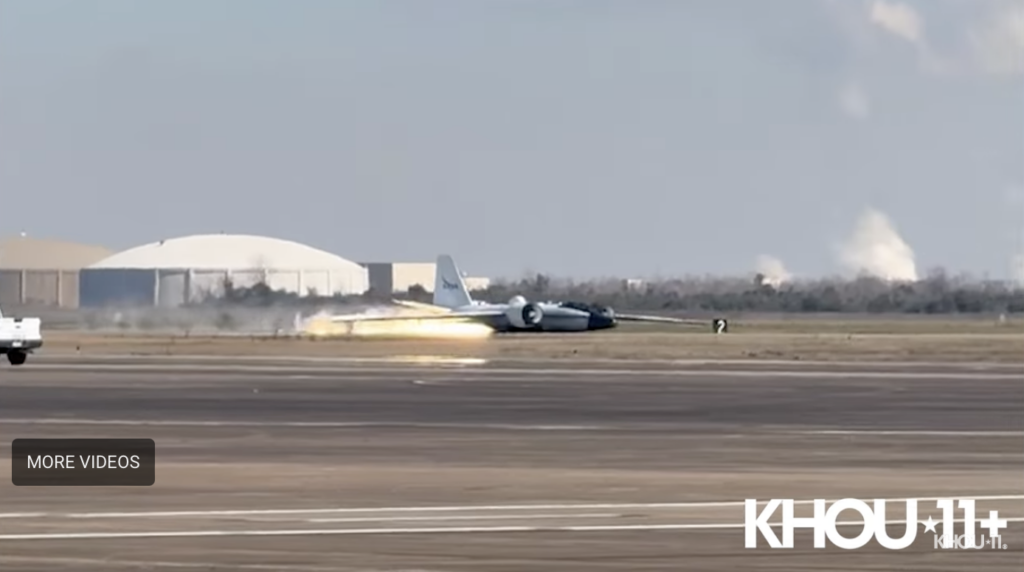
Click the image to view the video
When we train on emergencies we tend to focus on the Big Four: engine failure, engine fire, electrical fire and—in pressurized airplanes—rapid decompression. Each of these scenarios requires a swift, precise and correct response, with no time to look them up or reference a printed checklist. You must memorize the procedure steps and practice them frequently enough you know what to do when the need arises while under the heavy stress of the event.
Some of these responses drive the requirement for a follow-on procedure like emergency descent or maximum glide that itself demands a rapid response from memory.
But there is a whole class of emergencies that do not require an immediate, memorized response. Essentially anything that is not one of the Big Four not only gives you time to reference the emergency checklist, it demands that you take the time to do so. Like any other checklist action, this ensures you do everything you need to do and—just as important in an abnormal situation—you don’t do anything you should not do. You need to respond, but it must be a measured response—correct for the circumstances.
Think, for a moment, about electrical failure. If you detect a failure of your electrical charging system, the alternator or generator, there are scenarios where the rapid flip of a switch might cause more damage as possibly out-of-tolerance electrical flow is restored to vital equipment. Some avionics seem to be especially susceptible to damage from a spike in electrical power.
Instead, upon noting the electrical issue open up the Pilot’s Operating Handbook (POH) or Airplane Flight Manual (AFM) and locate the applicable checklist. This ensures you perform the actions that are correct for that specific airplane, and do nothing that might make matters worse. Remember to use the POH/AFM Supplement for any changes to the basic checklist as a result of modifications to the airplane.
Some POHs and AFMs make the distinction between Emergency and Abnormal Procedures checklists. For those that don’t, review your checklists and see which truly require an immediate, memorized response to save lives and limit damage. You’ll probably narrow it down to that type’s equivalent of the Big Four scenarios. For all others, know where the checklist is and what it directs you to do. But vow to take your time, reference the checklist and then perform the actions if you ever find yourself using the checklist for real.
Not all situations are directly addressed by an emergency or abnormal checklist. In those cases do the best you can using your systems knowledge and elements of the checklists you do have. This is a case where it’s even more important to take your time to do things right. In most abnormal situations you have the opportunity to review the checklist several times before you begin to act. I expect the highly trained NASA test pilots in the WB-57 reviewed the Landing With Gear Retracted and Emergency Evacuation checklists several times before they lined up for final approach in front of the cameras at Houston.
Just because a situation isn’t a Big Four event or is served by an abnormal and not an emergency checklist does not mean the scenario itself is not an emergency. Work your way through it with a measured response. If the aircraft is no longer in conformance with its Type Certificate or applicable Supplemental Type Certificates then by nature the flight has entered an unairworthy and therefore emergency condition. Perform the correct actions, then declare an emergency to get the priority handling and ground responders you may need.
Declaring an emergency also puts you in a mindset where you get the aircraft on the ground as soon as safely possible and helps you fight the temptation to press on in an unairworthy aircraft.
Even if the situation is straightforward, take your time and use the checklist. This is an advanced version of the World War II instructional advice to “wind the clock” (a mechanical clock on the instrument panel in that era) as a way of slowing down and doing the right thing.
Questions? Comments? Supportable opinions? Let us know at [email protected].

Debrief
Readers write about recent LESSONS:
Highly experienced tailwheel and aerobatic instructor and son-of-a-Spitfire-pilot reader Anthony Johnstone writes about last week’s LESSONS:
Hi Tom,
The Legend Cub fuel exhaustion accident struck a chord with me. Quite a few years back I gave some aerobatic dual to a guy from Tulsa [Oklahoma] (I was based in Winfield [Kansas] at the time) in his personal Super Decathlon. He fueled up and headed home, about a 45 minute flight. I went home. Shortly after he called me and asked if I could go back the airport to see if I could find a missing fuel cap. I drove around everywhere that he had been but didn’t find it.
I called him back and we discussed what happened. He had self-fueled with about 30 gallons total and thought he had left the right fuel cap on the wing. On approach to KRVS in Tulsa he glanced at the fuel gauges (in the wing root of the Decathlon) and was startled to see that the left tank was reading empty, the right tank under 1/4.
The tanks have a crossfeed pipe above the windshield which allows fuel levels to equalize. There is no actual fuel selector, just a firewall shutoff valve. The fuel goes to a header tank in the cockpit which is the inverted fuel system. This is fed from the left tank.
What happened here is that the missing right fuel cap allowed fuel to siphon from the left tank as well as the right. He lost about 30 gallons in that short flight, and in a high wing aircraft you will never notice.
My other experience was with a Cessna 182 heading to Colorado for mountain flying training. The aircraft came from Independence [Kansas] with an instructor and another pilot to pick me up enroute in Wichita [Kansas]. We met at your home base (Wichita Jabara) in early morning darkness. The aircraft had been fully fueled and had flown about 35 minutes, [and we] should have [had] plenty of fuel to reach our first planned stop at Lamar, Colorado. We did a preflight walkaround in the dark and noticed fuel staining on the right wing. The fuel cap gasket was fractured and the tank had leaked about 15 gallons in that short flight. Fortunately I was able to drive over to ICT [Wichita’s commercial airport and home to Cessna Aircraft] and get a new cap. f we hadn’t noticed that leak (would have been fairly easy to do in the dark), we likely would have run out of fuel somewhere over western Kansas. This was a G1000 aircraft, and the fuel totalizer (which only reads fuel that has gone to the engine) would have told us we still had 20-30 gallons aboard as we were gliding down to an off-airport landing!
Thanks for reinforcing the LESSON to employ “positive pessimism” with the added “punch” or your experience, Tony.
Our frequent Debriefer/student pilot [I think still a student pilot] who wishes to remain anonymous also wrote:
Most CFIs are loathe to pull power when the student is completely unaware, thus removing the startle factor from the lesson. We need to experience startle factor to appreciate how much altitude we drop when it isn’t an exercise.
On another point, I’ve been reading about the return to the “Stick and Rudder” school of teaching that has been updated by Rich Stowell and others. His Learn to Turn book (free) has me thinking about turns and loads in a way that is more helpful for prevention and recovery, than mere memorizing what to do. Learning until it becomes intuitive is a way of conditioning that will not require precious loss of altitude before correct action is taken.
The accident (fuel cap and fuel starvation) you shared is another form of “get there-itis.” that prevented a renewed preflight of the exterior of the plane, after the wing was used as a viewing stand. Knowing human nature, I suggest the airport was complicit. Their announcement thatonly the first four planes ready to depart [could go] caused the scramble and rush contributing to the death of the pilot.
Unless the greater risk of delaying departure is there (i.e. a bear running at me), why go into flight mode?
Great wisdom from a low-time pilot. Thank you, anonymous.
More to say? Let us learn from you, at [email protected].

Share safer skies. Forward FLYING LESSONS to a friend.
Please help cover the ongoing costs of providing FLYING LESSONS through this secure PayPal donations link. Or send a check made out to Mastery Flight Training, Inc. at 247 Tiffany Street, Rose Hill, Kansas USA 67133. Thank you, generous supporters.
Thank you to our regular monthly financial contributors:
Steven Bernstein, Montclair, NJ. Robert Carhart, Jr., Odentown, MD. Greg Cohen, Gaithersburg, MD. John Collins, Martinsburg, WV. Dan Drew. Rob Finfrock, Rio Rancho, NM. Norman Gallagher. Bill Griffith, Indianapolis, IN. Steven Hefner, Corinth, MS; Ellen Herr, Ft Myers, FL. Erik Hoel, Redlands, CA. Ron Horton. David Karalunas, Anchorage, AK. Steve Kelly, Appleton, WI. Karl Kleiderer. Greg Long, Johnston, IA. Rick Lugash, Los Angeles, CA. Richard McCraw, Hinesburg, VT. David Ovad, Resiertown, MD. Steven Oxholm, Portsmouth, NH. Brian Schiff, Keller, TX. Paul Sergeant, Allen, TX. Paul Uhlig, Wichita, KS. Richard Whitney, Warrenton, VA. Jim Preston, Alexandria, VA. Johannes Ascherl, Munich, Germany. Bruce Dickerson, Asheville, NC. Edmund Braly, Norman, OK. Steven Hefner. Lorne Sheren, New Vernon, NJ. “The Proficient Pilot,” Keller, TX. Kynan Sturgiss, Hereford, TX. Bluegrass Rental Properties, LLC, London, KY. John Foster. Joseph Victor, Bellevue, WA. Chris Palmer, Irvine, CA. Barry Warner, Yakima, WA. Todd LeClair, Cadiz, KY. Jim Hopp, San Carlos, CA. Adrian Chapman, West Chester, PA. Ed Stack, Prospect Heights, IL. Robert Finley, Dubois, Wyoming. Robert Finley, John Kinyon, Lawrence Copp, V. Andrew Smith. Kevin Echols
Thank you to these 2026 donors:
Robert Sparks, Mark Sletten, Thomas Jaszewski, Douglas Olson, David Field, Michael McRobert, Michael Morrow, Peter Baron
Thanks also to these donors in 2025:
N. Wendell Todd. David Peterson. Jay Apt. Gilbert Buettner. David Larsen, Peter Baron, Glen Yeldezian, Charles Waldrop, Ian O’Connell, Mark Sletten, Lucius Fleuchaus. Thomas Jaszewski. Lauren McGavran. Bruce Jacobsen, Leroy Atkins, Coyle Schwab, Michael Morrow, Lew Gage, Panatech Computer (Henry Fiorentini), Dave Buetow, Ken Vernmar, Dave Wacker, Bill Farrell, David Miller, Daniel Norris, Robert Sparks, Bill Cannon, David Yost, Don Bowles. Ed Shapiro, Mark Kolesar, William Weber, Anonymous Oshkosh donor, Robert Lough, Martin Sacks, Denny Southard, John Owen, Wayne Mudge, Dale Bleakney, Rod Partlo, Kevin O’Halloran, Joseph Montineri, David Kenny, Boyd Spitler, George Stromeyer, Greg Hill, Phil Parham, Arthur Utay, Lawrence Peck, Glenn Beavers, Richard Erler, Lorne Sheren, Tad Santino, Kenneth Bacow, Joseph Stadelmann, Randy Starbuck, Robert Dunlap, Patrice Kaplowitz
Two 2025 donations: John Teipen, Denny Southard, Wayne Colburn, Andy Urban, Timothy Schryer, Stu Spindel, SABRIS Aviation/Dave Dewhirst
Three 2025 donations: John Whitehead
Pursue Mastery of Flight®
Thomas P. Turner, M.S. Aviation Safety
Flight Instructor Hall of Fame Inductee
2021 Jack Eggspuehler Service Award winner
2010 National FAA Safety Team Representative of the Year
2008 FAA Central Region CFI of the Year
FLYING LESSONS is ©2026 Mastery Flight Training, Inc. For more information see www.thomaspturner.com. For reprint permission or other questions contact [email protected].