

Topics this week include: >> Spiraling in >> One way out >> OpSpecs for the masses

FLYING LESSONS uses recent mishap reports to consider what might have contributed to accidents, so you can make better decisions if you face similar circumstances. In most cases design characteristics of a specific airplane have little direct bearing on the possible causes of aircraft accidents—but knowing how your airplane’s systems respond can make the difference in your success as the scenario unfolds. So apply these FLYING LESSONS to the specific airplane you fly. Verify all technical information before applying it to your aircraft or operation, with manufacturers’ data and recommendations taking precedence. You are pilot in command and are ultimately responsible for the decisions you make.
FLYING LESSONS is an independent product of MASTERY FLIGHT TRAINING, INC.
Pursue Mastery of Flight®
This week’s LESSONS
From an NTSB preliminary report:
On October 6, 2025, about 1514 central daylight time, a Cessna 210B airplane, N9627X, was destroyed when it was involved in an accident near Parkin, Arkansas. The pilot and two passengers were fatally injured.
The flight departed from Lakefront Airport (KNEW), New Orleans, Louisiana, about 1305 [local time], and flew on an instrument flight rules flight plan. The flight proceeded north toward the intended destination of Jonesboro Municipal Airport (KJBR), Jonesboro, Arkansas, and climbed to a cruise altitude of 10,000 feet. About 1500 Memphis Approach instructed the pilot to descend and maintain 4000 feet. The flight was about seven miles west-southwest of Tunica, Mississippi, at that time and appeared to be on a direct course to KJBR. About nine minutes later the pilot levelled off at 4000 feet. The flight was handed off to Memphis Center.
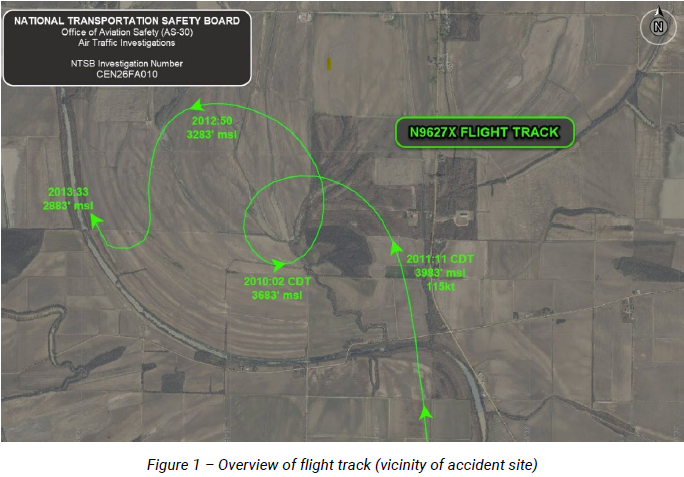
About 1511:07 [local time], the airplane entered a left turn. The airplane subsequently completed 1-1/2 full 360° turns until it was oriented on a southbound heading. Altitude decreased to about 3300 feet. About two seconds [sic] later, at 1513:12 [local time], the airplane entered a right turn and appeared to remain in that turn until the final data point. The final ADS-B data point was recorded at 1513:33 [local time], and the airplane was on an approximate north heading at that time at about 2900 feet.
The accident site was aout 180 yards southwest from the final ADS-B data point at an elevation of about 200 feet. The main wreckage consisted of the fuselage, vertical stabilizer, rudder, wings, engine, and propeller. The aileron and flap remained attached to the left wing. The flap remained attached to the right wing. The outboard portion of the right wing was fragmented consistent with a right-wing low impact. The right aileron was separated from the wing and the outboard portion came to rest about 50 yards from the main wreckage. The right horizontal stabilizer with elevator attached was separated from the fuselage and came to rest 45 yards from the main wreckage. The left horizontal stabilizer was separated from the fuselage, and the left elevator was separated from the stabilizer. Both were recovered in the vicinity of the main wreckage.
A preliminary airframe examination revealed that the forward fuselage was separated and fragmented. The cockpit and cabin areas were compromised. The engine with the propeller attached was separated at the engine mounts. The fuselage was deformed along the entire length. Flight control continuity was established to the extent possible. Specifically, elevator control continuity was confirmed from the cockpit torque tube to the aft fuselage. Rudder control continuity was confirmed from the cockpit rudder pedals to the rudder bellcrank. Aileron control continuity was confirmed from each wing bellcrank to the wing roots; although, the left aileron direct cable remained attached to the cockpit control column chain.
Examination noted damage to the engine assembly consistent with impact forces. Internal engine and accessory section continuity were observed during crankshaft rotation. Cylinder compression and suction were obtained at each cylinder. The left magneto provided a spark across all six leads. The right magneto provided a spark across three of the six leads. The engine induction and exhaust ducting were deformed consistent with impact forces. The engine-driven fuel pump was unremarkable, and the drive coupling was intact. The oil pump was separated from the engine case. Disassembly revealed the impellers and drive shaft were intact. The vacuum pump remained secured to the engine and appeared intact. The drive coupling was intact and rotated under hand pressure. Disassembly revealed that the vanes were intact.
The propeller remained attached to the engine, and the hub appeared to be intact. All three blades were retained by the hub. Blade A appeared intact. Blade B was bent aft about 90° over the entire span. The blade leading edge exhibited several leading-edge gouges. Blade C was bent aft about 80° near the root and exhibited small leading-edge gouges.
Marginal visual flight rules (MVFR) and IFR weather conditions prevailed in the vicinity of the accident site. Delta Regional Airport (KDRP), located 12 miles southwest from the accident site, reported 0.25 statute mile visibility in heavy rain and mist, and a broken ceiling at 600 feet at 1515 [one minute after impact]. West Memphis Municipal Airport (KAWM), located 19 miles east-southeast of the accident site, reported visibility of 10 sm, scattered clouds at 1500 feet and overcast ceiling at 2400 feet 1453 [21 minutes before impact]. Jonesboro Municipal Airport (KJBR), the intended destination located 36 miles north of the accident site, reported 5 sm visibility in light rain and mist, and a broken ceiling at 600 feet at 1453 [21 minutes before impact].
Something terrible happened, quite quickly. The preliminary report suggests the engine was producing power and the airframe impacted intact, the airframe breaking apart when it hit with a few lighter parts being scattered but not in a way indicative of an inflight break-up. About two minutes after leveling from the descent at 4000 feet and shortly after being instructed to change frequencies to Memphis Center, the airplane spiraled left, reversed direction and spiraled right to impact.
Local news adds more details:
Cross County Sheriff David West said the three men flew from Poinsett County to Louisiana on a hunting trip. On their way back, they ran into a storm, lost their way, and crashed.
Flightaware.com captures often do not accurately show the location of precipitation echoes at the time a flight ends, but the record suggests areas of moderate and heavy precipitation were in the general area at the time of the crash, and the altitude and speed records suggest turbulence during the descent. METAR data cited by the NTSB is consistent with a stormy day affecting localized areas differently. I’m sure the NTSB will focus closely on weather, including what the pilot should have been able to know, as it investigates this tragedy.
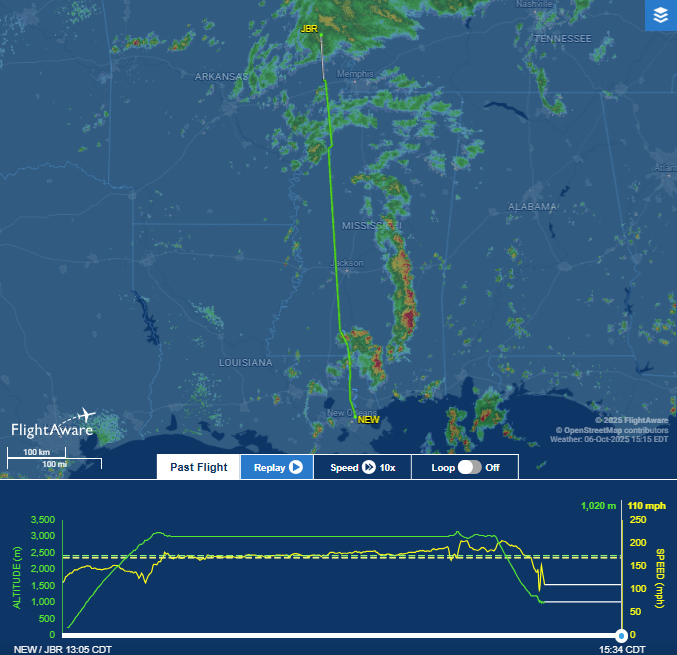
What might we learn with the limited information available?
- Areas of precipitation, even moderate to heavy echoes, do not always mean thunderstorms and turbulence. In general, however, reflectivity plotted as yellow or red (or more) on radar correlate to extreme hazard. If lightning discharge activity is plotted even green precipitation echoes are dangerous.
- Thunderstorms don’t always mean instrument meteorological conditions (IMC). Especially in the Great Plains where I live, it’s not unusual at all for airports to report MVFR (marginal VFR) or VFR when thunderstorms are nearby. Watch for notes about lightning visible from the airport.
- METARs and TAFs describe weather within five statute miles (4.4 nautical miles) of the reporting point. Conditions reported as VC, in the vicinity, are between five and 10 sm (8.7 nm) from the reporting point. “Distant” is anything visible that is at least 10 sm away.
- METARs and TAFs, then, describe localized weather only. You’ll need to look at other observations and forecasts to see the big picture.
- A steep spiral is the natural outcome for a pitch-stable airplane at banks into the realm of the overbanking tendency. The proper pilot response is to level the wings in a rudder- coordinated maneuver while reducing power to resist a nose-up trim response and pushing forward on the elevator control as much as necessary to prevent pitching up into a stall. Practice spiral entries and recoveries with an instructor, visually and “under the hood,” so you won’t drive the airplane into a spiral in the other direction as you attmpt to recover.
It might be that the pilot lost control in turbulence, and perhaps overcorrected in a way that reversed the direction of turn and could not recover before impact. It could be that an autopilot, if installed, malfunctioned, or that it disengaged and the pilot did not realize it was no longer controlling the airplane. The pilot may have been incapacitated, perhaps even knocked unconscious if turbulence slammed his head into the ceiling or against the side window. Something as simple as changing frequencies combined with other factors might have led to loss of control, or incorrectly changing frequencies may have introduced and combined with other distractions.
The METAR data alone looks quite acceptable for a rated-and-current instrument pilot flying a well-equipped airplane. I flew in lower weather than that last weekend. But airport reports are pinpricks in the overall weather picture. There’s a lot more to consider. And if the risk is acceptable, tighten down your seat belt and shoulder harness to guard against becoming incapacitated if you hit your head.
Readers, what other LESSONS does this very preliminary report suggest to you?
Questions? Comments? Supportable opinions? Let us know at [email protected].

Debrief
Readers write about recent LESSONS:
Frequent Debriefer Tom Black writes about last week’s Debrief:
I definitely agree with Dale Bleakney’s flight instructor about not just icing but any situation while flying. For a year my Chief Engineer at Wright-Patterson AFB was a retired USAF pilot. He flew two combat tours in F-105s in Vietnam and was one of the early high-time F-15 pilots. He had also served as a flying safety officer for several USAF fighter squadrons. When that kind of experience speaks, you listen. He had a philosophy that in ANY situation in flying (even CAVU) you need to have at least two viable ways to get out of the situation should any adverse issue develop. He used to say, “When you’re down to only one way out, you’re dead.”
That statement has stuck with me. I have adopted his philosophy in my own flying and it has really helped me with evaluating risks and making decisions. Before venturing into any flying situation I ask myself, “What is my primary escape plan, and what is my alternate escape plan?” If I can’t clearly define both, I don’t go into whatever the situation is.
Wise strategy, Tom. Thanks for teaching it to us.
Another frequent Debriefer and FLYING LESSONS supporter John Whitehead address last’s week’s LESSON on single-pilot emulation of multipilot crew interaction:
In Japan, many trains are operated by a single operator. After a series of train accidents, cameras and new procedures were employed. The cameras are focused on the train operator (from behind so a forward view was available) such that they can see his control panel and his actions. Coming up to a curve that requires slowing down means there is likely a “reduce speed” sign prior to the curve. The operator is required to point at the sign as a means of reinforcement, connecting the brain and eyes. These actions are recorded by the camera. Accidents dropped dramatically.
As we scan instruments (too quickly some time) we can see it, yet the brain doesn’t interpret that information or the interpretation is delayed. Slowing down and pointing or even stating out loud what the instrument says seems to help the brain consume the conformation better. Speaking out loud can be overdone. But there are times when I submit it is appropriate. I try to always state out loud, “Gear Down – Flaps Full” at the appropriate time on final. You can’t always point if your hands are full with the throttle and control wheel. Each pilot has to decide what is right for him/her. My takeaway is to learn when to slow down, when to point and when to speak out loud. As I said, it can be overdone which leads to not doing it consistently. Each has its value so explore what is right for you. Then have the discipline to do it every time.
You’ve got me thinking, John—the possibility of developing guidance and training for single-pilot operators on techniques for using callouts and physical pointouts in addition to cockpit flows and checklists, with a method for pilots to determine what works best for them and objectively measure the effectiveness of their choice. Perhaps I’ll add that to my retirement projects list. Thanks for relating your knowledge of how Japanese railroads have improved single-operator safety.
Reader, simulator instructor and retired jet pilot Charles Llyod adds:
“Almost been there but didn’t let the Pilot Flying do that” is a similar situation at NetJets. This day our destination was Hilton Head Island, South Carolina (KHXD). I was the Captain (not flying) with a new FO [First Officer] just released to the line out of IOE (Initial Operating Experience). He came from a regional carrier. As we approached final I mentioned that we seemed to be high and fast. We were Ref plus 10 in a Citation Excel headed for (as I recall) in those days a 4,500 x 75 foot runway. You needed to do things on ref[erence speed] and glide path. I saw no corrective action as we went gear down, “Before Landing Checklist,” and made a second call for Ref plus 10 and high – still no correction.
Finally, I said “Go around” calmly. Still above 500 feet I could imagine running through the pine trees at the end of this short runway that was at our Ops Spec minimum length for this aircraft. I immediately in my Marine parade deck voice called “GO AROUND!” The FO finally responded.
Yes, I could have said “My Controls.” But as a former training captain, I wanted to give this new FO time to get us out of there. In the NetJets Ops Manual, the Go Around call was a “Get out of jail free card.” No matter who made the call. Just do it and talk about it later. Headquarters was not going to second guess your call.
On the downwind leg I asked why he did not go around on the first call. Didn’t he believe what he was told about Go Arounds in Indoc? His response was “No,” because at his previous airline if you went around both crew members had to write a report to the chief pilot. No one wanted to do that. This encouraged a unsafe culture.
The second approach was flown perfectly. When we got on the ground we had a very serious discussion about how this was done per our Ops Manual.
Whether you are a crew with an huge Ops Spec manual [or] a single pilot operation, you need rules. In a single pilot flight operation you can develop standards for operations and duty time in your easy chair at home – not in the cockpit. Then write them down.I had my own duty time plus approaches rule for GA flying. So, I didn’t fudge one foot on an approach or nanosecond on duty time.
Operations Specifications (OpSpecs) are operator-specific rules approved by regulators and carrying the force of regulation for air carrier certificate holders (in the U.S., Parts 135 and 121 operations). The pilot who does not have a specially-approved OpSpec document, Parts 61 and 91 of the Federal Air Regulations (or their international equivalents) are our OpSecs. Add other personal limits such as duty day limits—I use 14 hours from alarm clock to engine shutdown—and you have a personal code of conduct that frames your response to challenging conditions and gives you an objective standard to more easily make go/no-go decisions. Thanks for relating your experience, Charles.
My frequent Debriefer and anonymous student pilot wraps it up this week:
This is a question about your guidance of “being at the target speed as you crossthat mythical 50-foot obstacle.” I understand Vx, also short field take off/landing, but you refer to this as mythical. Is there a link you can provide that explains this more fully?
I only say “mythical” because performance charts—takeoff and landing—are based on target speeds for crossing a 50-foot obstacle, while real-world obstacles are rarely 50 feet tall. The FAA’s Airplane Flying Handbook has this to say about Maximum Performance takeoffs:
After becoming airborne, the pilot will maintain a wings-level climb at VX until all obstacles have been cleared, or if no obstacles are present, until reaching an altitude of at least 50 feet above the takeoff surface. [emphasis added]
As an example, the Short Field takeoff and landing charts both specify a speed to fly at 50 feet above the runway:
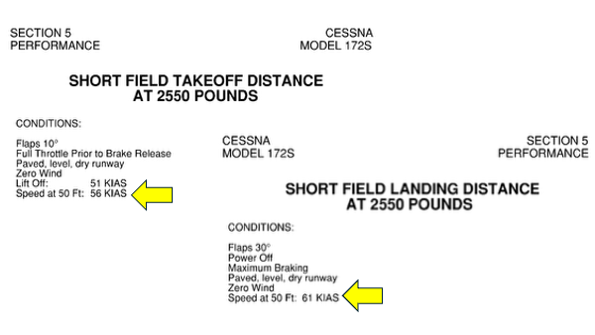

The C172S handbook—like most POHs—provides data for short field operations but no charts for “normal” takeoffs or landings.
My point is that maximum performance calls for attaining the appropriate reference speed as you cross an obstacle or, in the absence of a significant obstacle, at 50 feet above ground. Other than that “the book” gives no specific guidance on speeds or altitudes for takeoffs and landings.
More to say? Let us learn from you, at [email protected]

Share safer skies. Forward FLYING LESSONS to a friend.
Please help cover the ongoing costs of providing FLYING LESSONS through this secure PayPal donations link. Or send a check made out to Mastery Flight Training, Inc. at 247 Tiffany Street, Rose Hill, Kansas USA 67133. Thank you, generous supporters.
Thank you to our regular monthly financial contributors:
Steven Bernstein, Montclair, NJ. Robert Carhart, Jr., Odentown, MD. Greg Cohen, Gaithersburg, MD. John Collins, Martinsburg, WV. Dan Drew. Rob Finfrock, Rio Rancho, NM. Norman Gallagher. Bill Griffith, Indianapolis, IN. Steven Hefner, Corinth, MS; Ellen Herr, Ft Myers, FL. Erik Hoel, Redlands, CA. Ron Horton. David Karalunas, Anchorage, AK. Steve Kelly, Appleton, WI. Karl Kleiderer. Greg Long, Johnston, IA. Rick Lugash, Los Angeles, CA. Richard McCraw, Hinesburg, VT. David Ovad, Resiertown, MD. Steven Oxholm, Portsmouth, NH. Brian Schiff, Keller, TX. Paul Sergeant, Allen, TX. Paul Uhlig, Wichita, KS. Richard Whitney, Warrenton, VA. Jim Preston, Alexandria, VA. Johannes Ascherl, Munich, Germany. Bruce Dickerson, Asheville, NC. Edmund Braly, Norman, OK. Steven Hefner. Lorne Sheren, New Vernon, NJ. “The Proficient Pilot,” Keller, TX. Kynan Sturgiss, Hereford, TX. Bluegrass Rental Properties, LLC, London, KY. John Foster. Joseph Victor, Bellevue, WA. Chris Palmer, Irvine, CA. Barry Warner, Yakima, WA. Todd LeClair, Cadiz, KY. Jim Hopp, San Carlos, CA. Adrian Chapman, West Chester, PA. Ed Stack, Prospect Heights, IL.
Thanks also to these donors in 2025:
N. Wendell Todd. David Peterson. Jay Apt. SABRIS Aviation/Dave Dewhirst. Gilbert Buettner. David Larsen, Peter Baron, Glen Yeldezian, Charles Waldrop, Ian O’Connell, Mark Sletten, Lucius Fleuchaus. Thomas Jaszewski. Lauren McGavran. Bruce Jacobsen, Leroy Atkins, Coyle Schwab, Michael Morrow, Lew Gage, Panatech Computer (Henry Fiorentini), Andy Urban, Stu Spindel, Dave Buetow, Ken Vernmar, Dave Wacker, Bill Farrell, David Miller, Daniel Norris, Robert Sparks, Bill Cannon, David Yost, Don Bowles. Ed Shapiro, Mark Kolesar, William Weber, Anonymous Oshkosh donor, Robert Lough, Martin Sacks, Timothy Schryer, John Owen, Wayne Mudge, Dale Bleakney
Two 2025 donations: John Teipen, John Whitehead, Denny Southard, Wayne Colburn
NEW THIS WEEK: Rod Partlo
Pursue Mastery of Flight®
Thomas P. Turner, M.S. Aviation Safety
Flight Instructor Hall of Fame Inductee
2021 Jack Eggspuehler Service Award winner
2010 National FAA Safety Team Representative of the Year
2008 FAA Central Region CFI of the Year
FLYING LESSONS is ©2025 Mastery Flight Training, Inc. For more information see www.thomaspturner.com. For reprint permission or other questions contact [email protected].