
Topics this week: >> On strike >> What would you do? >> Swiss chains

FLYING LESSONS uses recent mishap reports to consider what might have contributed to accidents, so you can make better decisions if you face similar circumstances. In most cases design characteristics of a specific airplane have little direct bearing on the possible causes of aircraft accidents—but knowing how your airplane’s systems respond can make the difference in your success as the scenario unfolds. So apply these FLYING LESSONS to the specific airplane you fly. Verify all technical information before applying it to your aircraft or operation, with manufacturers’ data and recommendations taking precedence. You are pilot in command and are ultimately responsible for the decisions you make.
FLYING LESSONS is an independent product of MASTERY FLIGHT TRAINING, INC.
Pursue Mastery of Flight®
This week’s LESSONS
As reported in my Beech Weekly Accident Update this week, an FAA preliminary report states:
9/25 1825Z (1425 local Thursday afternoon): A Be35 “struck a bird” in cruise flight near Quinton, Virginia resulting in “damage to the windshield and avionics.” The pilot and passenger suffered “minor” injuries and the airplane “substantial” damage. N17827 (D-10015) is a 1977 V35B.
(“Bird strike”; “Substantial damage”)
Hoping the information might be helpful to other pilots, the pilot of this aircraft contacted me a few days later to add:
I had the most exciting day in my aviation career Thursday afternoon. I was going to lunch with a friend in my V35B and was leveling at 2,000 feet when we hit a vulture. The bird came right through the windshield and gave us both numerous lacerations, and fractured my wrist. The glare shield flipped up, mostly blocking our forward view. We landed safely at W96 [New Kent County Airport, Quinton, Virginia] about five minutes later and went to the ER via ambulance.
Post-landing pictures the pilot sent are impressive and frightening.
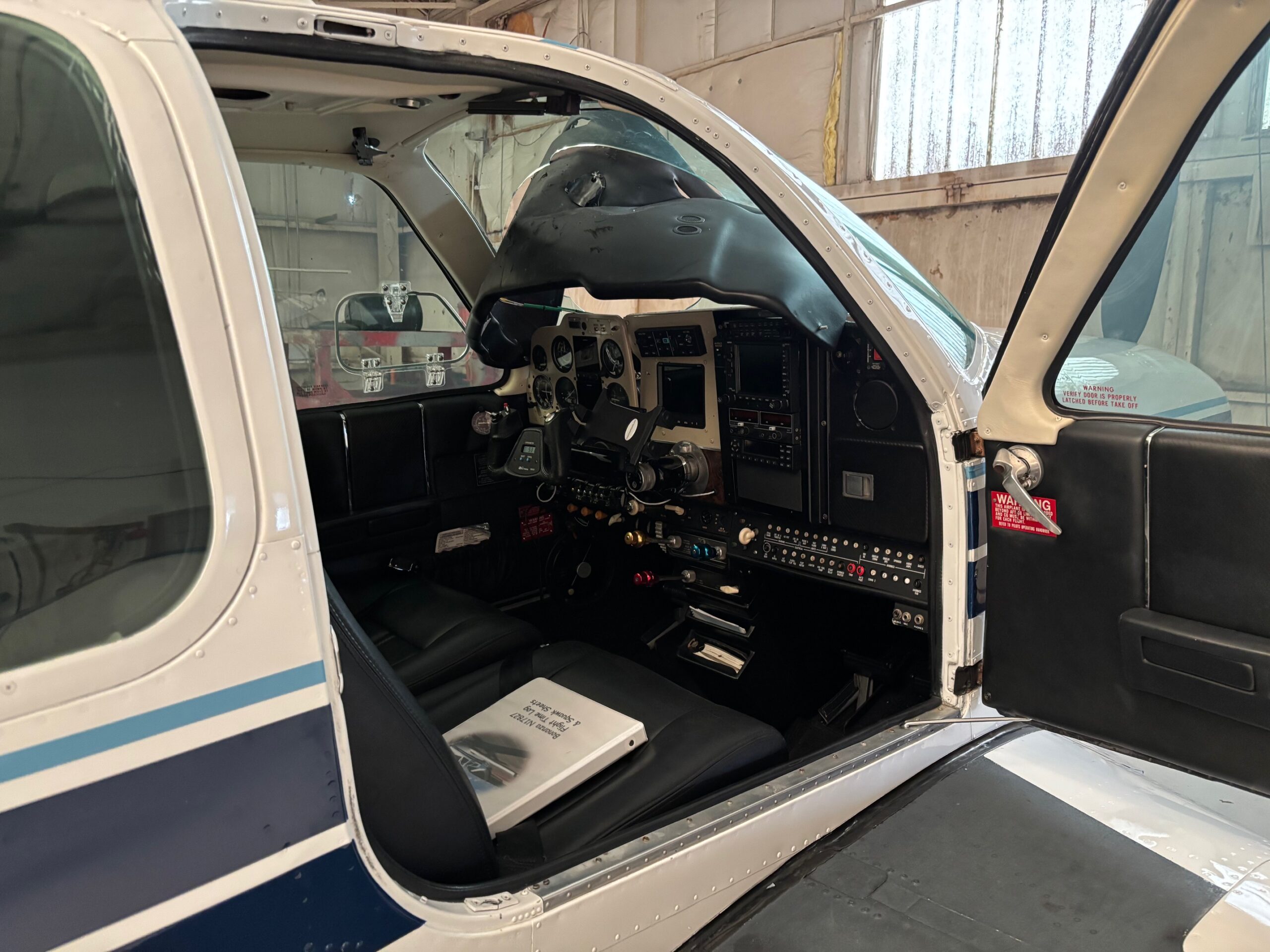
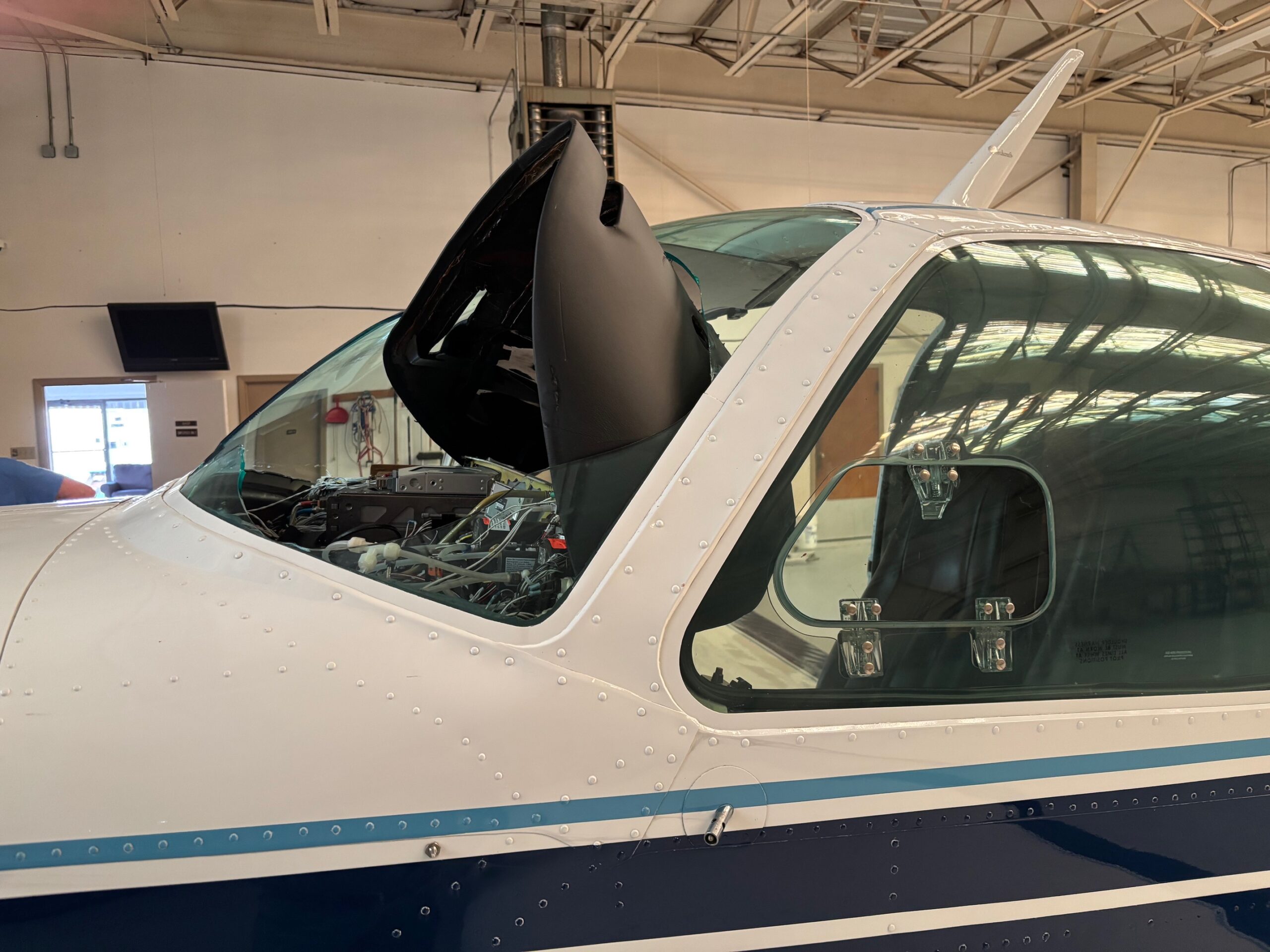

Imagine you’re flying along when suddenly what must sound like an explosion happens right before your eyes, followed instantaneously by the rushing roar of 130 or 150 knots of wind blasting straight into the cabin. You don’t know immediately how to respond. You might not be able to see or hear clearly, if at all.
As the first shock begins to wear off you become aware of severe pain from unknown injuries. Your attention turns to passengers, wondering how badly they are hurt. They may be screaming or interfering with the flight controls in panic. You don’t know if the airplane will still fly, or if you can fly it. This would have to be one of the scariest and most disorienting things that can happen in an airplane.
The pilot tells me he will relate his full story once he’s able to see better and makes progress on his recovery. That will give us all the benefit of his experience should we ever have a cabin-penetrating bird strike in flight.
While we wait, I’d like your first reactions. Put yourself in that pilot’s seat and consider how you might:
- Initially react to the sudden impact?
- Prioritize your actions?
- Minimize or even partially reverse the effects of the bird strike?
- Assess your ability to fly the airplane?
- Assess the airplane’s ability to fly?
- Address injured and/or panicked passengers?
- Aviate, navigate and communicate to a landing?
Send your answers. I’ll report your responses. We’ll see trends if emerge and/or ideas arise others might not have considered.
Great job overcoming the challenges, pilot. I hope you recover quickly and return to the air soon.
Questions? Comments? Supportable opinions? Let us know at [email protected].

Debrief
Readers write about recent LESSONS:
Reader, instructor and FAASTeam member Gary Palmer writes about last week’s LESSONS stemming from a trends analysis of the previous two weeks’ mishap reports:
I am not sure the data you work from provides this, I have noticed a number of training aircraft that are fixed gear land hard and have nose wheel failure. That might be the loss of control upon landing or hard landing. I wonder about this because it may happen more on some trainer types than others, which provides a useful insight. Armed with your 2 weeks of data:
1- I’m happily not flying RG [retractable gear airplanes].
2- I’ll remain observant of my take-off abort conditions, which I brief prior to each departure.
3- Maintain sterile cockpit and focus while taking off
4- Maintain speed control while landing
Thank you for the reminder.
I do see a lot of nose gear collapse reports for fixed-gear training-type aircraft. I agree that’s likely the result of hard landings. A “hard landing” is usually really “flaring too high” and entering an incipient stall from a few feet above the surface. Most airplanes will naturally pitch downward when the wing stalls, setting it up for a hard impact on the nosewheel…and nose gear collapse. I’ve not run any real analysis of the numbers of such mishaps, and details are usually scarce. But I suspect you’re right. Regarding your four items, that’s the sort of takeaway I was looking for from reporting on the recent mishap trends. You don’t have to shy away from retractable gear aircraft, but if you fly them there are additional mitigations you must master. Your other three points apply to everyone. Thank you, Gary.
Reader Randy Starbuck adds:
Thanks for asking. I can remember the “Swiss cheese” safety poster hanging on the walls at FlightSafety. You remember it. The poster illustrates that an accident happens when multiple “holes” (weaknesses) in different layers of a safety system momentarily align. A single error or flaw is not enough to cause a disaster; multiple safeguards must fail simultaneously.
The Swiss cheese model of accident causation essentially says there are risks at every level in flying, each represented by a “hole” in a layer of “cheese.” We can actively mitigate most risks and miss the hole in a given layer—we’ve evaded that particular hazard. Many times we simply get lucky and miss a hole. Or we may fly through a hole and proceed to the next slice of Swiss cheese, and stop the process of accident causation there. Sometimes, however, our mitigations fail or our luck simply runs out and “the holes line up” such that we fly through all the holes to an accident. The type and severity of that mishap also depends on our mitigations and our luck.
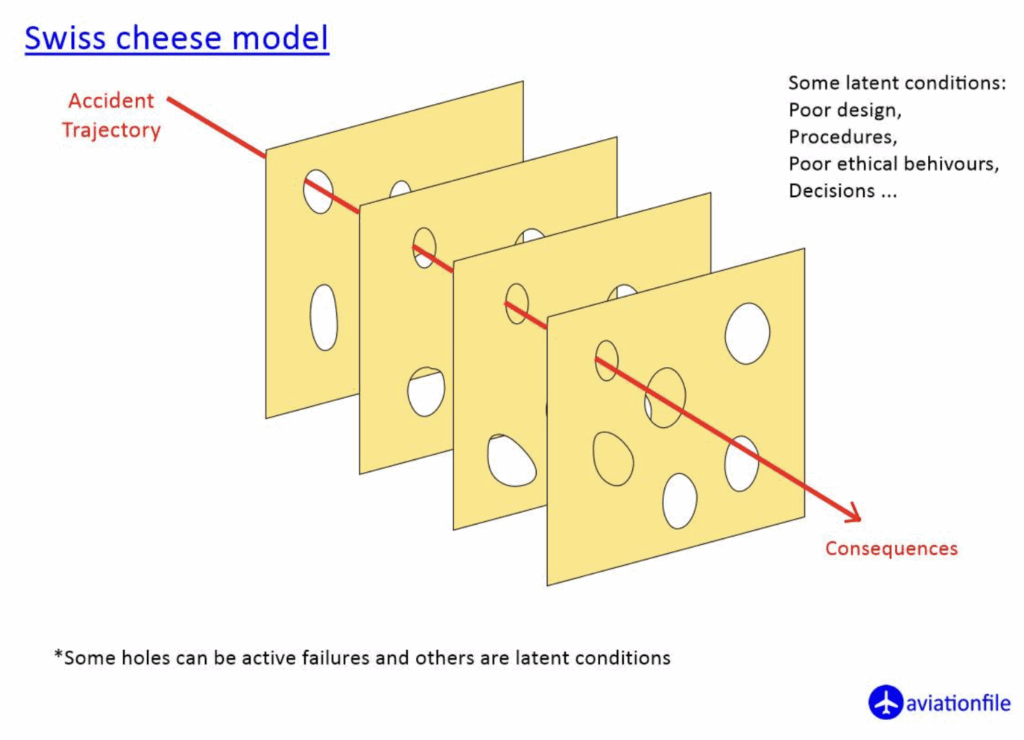
This is closely related to error chains and error chain analysis. The error chain model follows the maxim that a chain is only as strong as its weakest link. Each link is the result of aircraft design, human factors including decision making, and environmental factors. If mitigations for that link are sufficient then the chain holds and no mishap occurs. A single “weak link,” however, can break the chain and result in an accident. The error chain (or as I’ve described it at times, the “decision chain”) describes a situation in which there is one catastrophic decision or action that causes an accident. I think the Swiss cheese model better describes most accident scenarios because accidents are often the result of a number of smaller decisions, actions or other factors that cumulatively overcome our mitigation efforts. Readers, what do you think? Thank you, Randy.
Reader Matt Becker responded to a FLYING LESSONS report a few months back with this pithy comment I’ll close with this week:
There were so many holes in this one there was hardly any cheese left at all.
I hope I never do something that makes people say the same about me! Thank you, Matt.
More to say? Let us learn from you, at [email protected]
Share safer skies. Forward FLYING LESSONS to a friend.
Please help cover the ongoing costs of providing FLYING LESSONS through this secure PayPal donations link. Or send a check made out to Mastery Flight Training, Inc. at 247 Tiffany Street, Rose Hill, Kansas USA 67133. Thank you, generous supporters.
Thank you to our regular monthly financial contributors:
Steven Bernstein, Montclair, NJ. Robert Carhart, Jr., Odentown, MD. Greg Cohen, Gaithersburg, MD. John Collins, Martinsburg, WV. Dan Drew. Rob Finfrock, Rio Rancho, NM. Norman Gallagher. Bill Griffith, Indianapolis, IN. Steven Hefner, Corinth, MS; Ellen Herr, Ft Myers, FL. Erik Hoel, Redlands, CA. Ron Horton. David Karalunas, Anchorage, AK. Steve Kelly, Appleton, WI. Karl Kleiderer. Greg Long, Johnston, IA. Rick Lugash, Los Angeles, CA. Richard McCraw, Hinesburg, VT. David Ovad, Resiertown, MD. Steven Oxholm, Portsmouth, NH. Brian Schiff, Keller, TX. Paul Sergeant, Allen, TX. Paul Uhlig, Wichita, KS. Richard Whitney, Warrenton, VA. Jim Preston, Alexandria, VA. Johannes Ascherl, Munich, Germany. Bruce Dickerson, Asheville, NC. Edmund Braly, Norman, OK. Steven Hefner. Lorne Sheren, New Vernon, NJ. “The Proficient Pilot,” Keller, TX. Ed Stack, Prospect Heights, IL. Kynan Sturgiss, Hereford, TX. Bluegrass Rental Properties, LLC, London, KY. John Foster. Joseph Victor, Bellevue, WA. Chris Palmer, Irvine, CA. Barry Warner, Yakima, WA. Todd LeClair, Cadiz, KY. Jim Hopp, San Carlos, CA. Adrian Chapman, West Chester, PA.
Thanks also to these donors in 2025:
N. Wendell Todd. David Peterson. Jay Apt. SABRIS Aviation/Dave Dewhirst. Gilbert Buettner. David Larsen, Peter Baron, Glen Yeldezian, Charles Waldrop, Ian O’Connell, Mark Sletten, Lucius Fleuchaus. Thomas Jaszewski. Lauren McGavran. Bruce Jacobsen, Leroy Atkins, Coyle Schwab, Michael Morrow, Lew Gage, Panatech Computer (Henry Fiorentini), Andy Urban, Stu Spindel, Dave Buetow, Ken Vernmar, Dave Wacker, Bill Farrell, David Miller, Daniel Norris, Robert Sparks, Bill Cannon, David Yost, Don Bowles. Ed Shapiro, Mark Kolesar, William Weber, Anonymous Oshkosh donor, Robert Lough, Martin Sacks, Timothy Schryer
Two 2025 donations:
John Teipen, John Whitehead, Denny Southard, Wayne Colburn
Pursue Mastery of Flight®
Thomas P. Turner, M.S. Aviation Safety
Flight Instructor Hall of Fame Inductee
2021 Jack Eggspuehler Service Award winner
2010 National FAA Safety Team Representative of the Year
2008 FAA Central Region CFI of the Year
FLYING LESSONS is ©2025 Mastery Flight Training, Inc. For more information see www.thomaspturner.com. For reprint permission or other questions contact [email protected].