
Topics this week include: >> Know your clouds >> The honor system >> Trust with their lives

FLYING LESSONS uses recent mishap reports to consider what might have contributed to accidents, so you can make better decisions if you face similar circumstances. In most cases design characteristics of a specific airplane have little direct bearing on the possible causes of aircraft accidents—but knowing how your airplane’s systems respond can make the difference in your success as the scenario unfolds. So apply these FLYING LESSONS to the specific airplane you fly. Verify all technical information before applying it to your aircraft or operation, with manufacturers’ data and recommendations taking precedence. You are pilot in command and are ultimately responsible for the decisions you make.
FLYING LESSONS is an independent product of MASTERY FLIGHT TRAINING, INC.
Pursue Mastery of Flight®
This week’s LESSONS
I still have a lot of your great insights in my inbox, and after very busy week and weekend that kept me away from this effort, let’s again go straight to the Debrief.
Questions? Comments? Supportable opinions? Let us know at [email protected].

Debrief
Readers write about recent LESSONS:
In last week’s Debrief I discussed reader Arthur Utay’s experience with flight in turbulence that he wrote in response to the previous week’s LESSONS. After reading my discussion Art writes:
You wrote:
“Like most pilots (myself included) you likely overestimate the severity of turbulence”
Yup, you nailed it. Per the chart, my experiences are firmly in the “light” category. Thanks for the clarification.
I expected that was the case, Art. Thanks for prompting the opportunity to address yet another issue that receives little to no attention in most flight training.
Reader Peter Gottlieb adds:
I have flown through yellow areas [of radar precipitation returns] many times without any issues. The reason is that I was flying over the cloud layers being picked up on radar. I wasn’t flying all that high, 10-13,000 feet. Weather is three dimensional and in my case each time I could see quite far ahead above the cloud layer and the flights were smooth. Like you said, you have to know the cloud situation. I won’t fly through anything but the smallest CB [cumulonimbus] clouds even if they only show green as it’s just too uncomfortable.
Another example of my point. Thank you, Peter.
Reader Gary Palmer writes about the October 30 LESSONS that started this discussion:
As always, an interesting article and a good few lessons to be learned. In your “It might be…” you state at the end you say “It could be that an autopilot, if installed, malfunctioned, or that it disengaged and the pilot did not realize it was no longer controlling the airplane.”
I would wager, and I typically am not a gambler, that there was an autopilot and it was used in flight. My basis is simply (and only) the flatline altitude and speed he held for most of the trip. You mention some weather, but to hold altitude this stable is usually the work of an autopilot. IF I am right, the autopilot phase ended with a pitch up, thus the climb. The pilot may have noticed the climb and tried to get things back, thus a pitch down and descent. A little more of this may have been enough to distract and allow the spin happen.
I know that for a very little data, I am reading a lot into it. I have experienced my autopilot (STEC-50) self-disconnecting which resulted in a sudden pitch change. Different autopilots act different, but in IMC it would be a distraction. You may also be right that the AP may have disengaged and the pilot was unaware for a while.
My additional LESSON is a reminder to trust but always verify the autopilot is doing as anticipated and be prepared to disengage if you have to figure out what’s happening. Scan should include the scoreboard [the autopilot mode annunciator panel]. Thanks Tom!
Thank you, Gary. Good insights.
Reader “Captain Bob” opines on one possible factor in the crash that “precipitated” the October 30 LESSONS:
Connecting the dots from the details within your FLYING LESSONS for October 30, 2025, I discovered this: [link to pilot registry information]. It’s bad enough that pilots continue flying via thegigantic BasicMedloophole when their Special Issuance expires. Here we have an outright shameless SCOFFLAW doing so and for that past 4.5 years. We are the Fox guarding our own Chickens when it comes to 61.23 compliance.
We may not yet know what caused or even contributed to this tragedy with any degree of reasonable certainty but we certainly know when a pilot willfully disregards a regulation intended to, at the very least, protect us from ourselves.
I don’t suppose his passengers had any idea what they were getting themselves into when they went along for the ride. Now their survivors are in for a painful ‘other shoe to drop‘ when they discover that the pilot probably had NO liability insurance coverage in effect on that day.
I acknowledge your good intentions with: What might we learn with the limited information available? Perhaps the best takeaway thus far is to point out theindisputable result of thumbing one’s nose at and one-gun saluting regulatory compliance. Simple things like: The general nuisance to public safety; Imagine the carnage if that airplane had come down on top of a school yard full of children at 3:14pm on a Monday. Also, what sort of hit will we will all take to the cost of our own insurance going forward ? It really does not matter to me, in the present, what caused this tragedy.
All that should matter to any of us is that the pilot had no business flying himself and clueless passengers anywhere in which case this tragedy never would have occurred to begin with. Please point out that angle of the story to your audience as a valuable teachable moment…in the present.
The specific personal information Bob linked from the FAA Pilot Registry includes this pilot history:

Third class medical certificate issued in April 2020 with two waivers: one requiring the pilot to wear corrective lenses, and the other—not stipulated in the record—stating the medical certificate was “not valid for any class after 4/30/2021.”
Something about the medical as issued limited the pilot to one year on a medical certificate that, at that pilot’s age (65), should have been valid for 24 months (two years). Clearly it was a Special Issuance granted after review of some previous, unstated medical condition. The record also shows no date of BasicMed course date or medical exam—no evidence the pilot participated in BasicMed at all. From this scant information it appears the pilot may have done nothing to renew his medical compliance after expiration of the one-year-limited 3rd Class certificate. Unless more information exists that is not reflected in the FAA Airman Registry, the pilot may have been intentionally noncompliant with the medical requirements for exercising a pilot certificate.
Interestingly, the most recent pilot certificate was issued in 2022, after the evidence shown here suggests the pilot may have been noncompliant. Certainly the examiner for this pilot’s Instrument rating would have looked at the applicant’s medical certificate or BasicMed records (if the pilot flew under BasicMed) as part of the IFR Practical Test. And doesn’t the online Practical Test application crosscheck medical certification or BasicMed compliance? This suggests that perhaps the pilot was compliant but the airman registry was not updated in five years, perhaps through BasicMed, or else it says something about the state of regulatory cross-check in the pilot examination process.
When BasicMed became law one stipulation was that FAA was required after five years to conduct an evaluation of accident rates among BasicMed pilots and those in similar aircraft types involving pilots holding traditional FAA 3rd Class medical certificates. That study was completed in 2021 and found no significant difference between the two records. Specifically the report concludes:
The differences in overall and fatal accidents were not statistically significant. No statistically significant differences were found when multiple age subgroups were compared. Also, logistic regression models adjusted for relevant confounders revealed no significantly elevated accident ORs [odds ratios] between the BasicMed and third-class certified pilot groups overall.
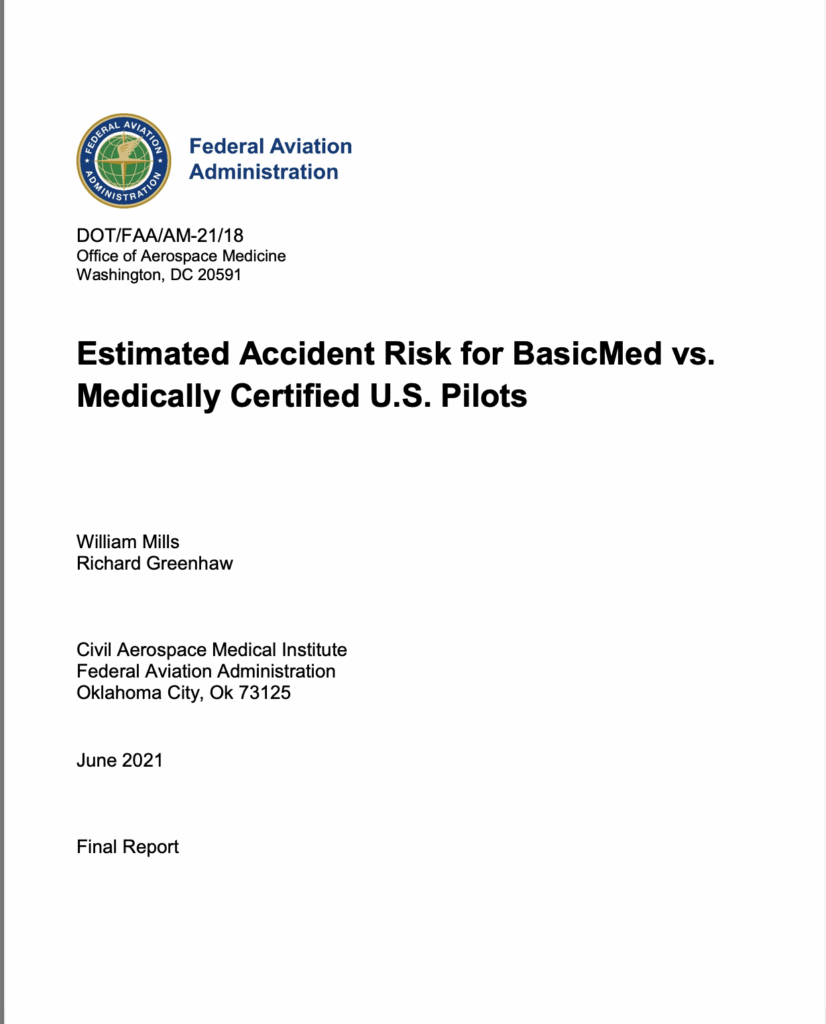
In other words, BasicMed is just as good as an FAA 3rd Class medical as far as accident and fatal accident rates are concerned. But neither protects passengers or the people around and over which they fly if a pilot is intentionally noncompliant with either medical credential and doesn’t get caught. For as long as I’ve been instructing (37 years) there’s been talk of a fairly large number of pilots who were noncompliant both with medical and Flight Review regulations. Do such pilots exist, and do they represent a larger percentage of accident pilots than those in compliance? I’d like to see an FAA study on that!
I really feel what Bob wrote here:
I don’t suppose his passengers had any idea what they were getting themselves into when they went along for the ride.
We have an awesome responsibility to unknowing passengers and all who depend on them to uphold no less than the minimum standards of certification, currency and compliance. I hope my readers hold themselves to an even higher standard. Captain Bob’s primary premise is the impact on compliance with medical requirements on the passengers that trust us with their lives with no idea whether the pilot is fit to fly, including the need to objectively self-evaluate and, if required, self-ground before every flight. This became even more important with the recently revised Sport Pilot rules that permit pilots to fly a good percentage of the general aviation fleet without ever passing a medical examination more stringent that that required to earn a U.S. state-issued driver’s license. We are indeed foxes guarding the henhouse. Or, having recently watched many movies with my three-year-old granddaughter, we’re Great White sharks telling ourselves, “fish are friends, not food.”

Ultimately for most pilots everything surrounding fitness for flight is done on the honor system.
I’d expand this concern to pilots who are not compliant with recurrent training or simply rusty because of lack of proficiency with the aircraft and its equipment (primarily, avionics) and/or recent experience in the operation being flown—a topic taken up by our next Debriefer. Thanks, Bob.
Frequent Debriefer, instructor and accident investigator Jeff Edwards contributes another viewpoint:
My research on similar accidents revealed that pilots were not maintaining their instrument hand flying skills. Instrument pilots flying autopilot equipped aircraft spend a majority of the time on autopilot which decreases their instrument proficiency. In scenarios like this accident, once the autopilot is disengaged, control is lost shortly after. Pilots should train to IPC standards often before undertaking flights in IFR or MVFR conditions.
My instructional experience supports your conclusion. When conducting instrument training or Proficiency Checks I conform the pilot can hand-fly the airplane to Instrument Rating standards and also have the pilot fly an autopilot-coupled approach, missed approach and hold to ensure mastery of the aircraft in both automated and manual modes. I recently flew a trip in IFR to LIFR conditions and intentionally hand-flew one entire leg (roughly one hour) manually (using the flight director) including a real-world holding pattern entry and an approach to about 200 feet above minimums—part of maintaining my personal proficiency. It builds great confidence knowing I can keep myself to that level, and great humility when I recall that is the minimum standard required to earn IFR privileges in the first place. Thank you, Jeff.
Dive Bomber Descent
Reader Art Utay is back with a question. I’ve not experienced this, but most of my flying is in the middle of the country. Read Art’s question and let us know if you have any similar experience:
I’m curious to know if you or your readers have experienced the following:
For as long as I’ve been flying IFR (40+ years), ATC has always given me descent clearances consistent with the aircraft I’d be flying. For my F33A Bonanza, this descent has been in the 600-750 foot per minute range, allowing me to descend and slow the plane down to my target approach speed before the FAF. So, if I needed to lose 5000 feet in altitude, ATC would start me down at the appropriate distance from the fix. All in all, it was smooth and predictable.
For the past 5 or 6 months, ATC has been holding me at altitude until I’m so close to the fix that the descent becomes (in my mind) excessive, meaning I’m coming down at 1300 to 1500 fpm or more. As you can imagine it really can screw up the stabilized approach concept. Alerting ATC that I need to get lower sooner yields a response like, “I’ll have lower for you in 10 miles…”
Normally, I slow the plane down to my ABS-recommended target speed of 105-110 knots before the FAF, at which point I lower the gear and fly the approach. Previously, I would descend at an IAS of 140 knots or so, (working the throttle down to 15 inches MP) with plenty of time to slow the plane before beginning the approach. Lately, I’m having to drop the gear at TOD [Top of Descent], even with the throttle pulled way back and the prop and mixture forward to arrive at the FAF at target altitude, although at a significantly faster speed.
I’ve experienced this issue at multiple airports across the eastern US, so it isn’t a local issue.
Readers, have you noticed a similar trend? Readers who are Air Traffic Controllers, can you provide some insights? Please send your thoughts.
For the Turbine Crowd
Reader/instructor John Galuski asks:
What was the outcome of the Citation that had the frozen fuel outage. I know all survived but did they get her back in the air?
I don’t recall the specific incident to which you refer and could not find it online. John may be referring to engine failures in two Citation 550s in 2019 that resulted from fuel contamination with diesel exhaust fluid (DEF) that had been added to an icing inhibitor. AIN’s Matt Thurber wrote about these events, providing more details. If those are the events in question, both crews were able to land their jets safely.
Jet fuel freezing comes up this time of year but can be an issue year-round at typical turbine cruising altitudes. Here’s a good overview of the nature of jet fuel freezing, and mitigations.
Is this what you’re looking for, John? Of can you—or another reader—point me to accident reports for other events?
More to say? Let us learn from you, at [email protected]

Share safer skies. Forward FLYING LESSONS to a friend.
Please help cover the ongoing costs of providing FLYING LESSONS through this secure PayPal donations link. Or send a check made out to Mastery Flight Training, Inc. at 247 Tiffany Street, Rose Hill, Kansas USA 67133. Thank you, generous supporters.
Thank you to our regular monthly financial contributors:
Steven Bernstein, Montclair, NJ. Robert Carhart, Jr., Odentown, MD. Greg Cohen, Gaithersburg, MD. John Collins, Martinsburg, WV. Dan Drew. Rob Finfrock, Rio Rancho, NM. Norman Gallagher. Bill Griffith, Indianapolis, IN. Steven Hefner, Corinth, MS; Ellen Herr, Ft Myers, FL. Erik Hoel, Redlands, CA. Ron Horton. David Karalunas, Anchorage, AK. Steve Kelly, Appleton, WI. Karl Kleiderer. Greg Long, Johnston, IA. Rick Lugash, Los Angeles, CA. Richard McCraw, Hinesburg, VT. David Ovad, Resiertown, MD. Steven Oxholm, Portsmouth, NH. Brian Schiff, Keller, TX. Paul Sergeant, Allen, TX. Paul Uhlig, Wichita, KS. Richard Whitney, Warrenton, VA. Jim Preston, Alexandria, VA. Johannes Ascherl, Munich, Germany. Bruce Dickerson, Asheville, NC. Edmund Braly, Norman, OK. Steven Hefner. Lorne Sheren, New Vernon, NJ. “The Proficient Pilot,” Keller, TX. Kynan Sturgiss, Hereford, TX. Bluegrass Rental Properties, LLC, London, KY. John Foster. Joseph Victor, Bellevue, WA. Chris Palmer, Irvine, CA. Barry Warner, Yakima, WA. Todd LeClair, Cadiz, KY. Jim Hopp, San Carlos, CA. Adrian Chapman, West Chester, PA. Ed Stack, Prospect Heights, IL.
Thanks also to these donors in 2025:
N. Wendell Todd. David Peterson. Jay Apt. SABRIS Aviation/Dave Dewhirst. Gilbert Buettner. David Larsen, Peter Baron, Glen Yeldezian, Charles Waldrop, Ian O’Connell, Mark Sletten, Lucius Fleuchaus. Thomas Jaszewski. Lauren McGavran. Bruce Jacobsen, Leroy Atkins, Coyle Schwab, Michael Morrow, Lew Gage, Panatech Computer (Henry Fiorentini), Andy Urban, Stu Spindel, Dave Buetow, Ken Vernmar, Dave Wacker, Bill Farrell, David Miller, Daniel Norris, Robert Sparks, Bill Cannon, David Yost, Don Bowles. Ed Shapiro, Mark Kolesar, William Weber, Anonymous Oshkosh donor, Robert Lough, Martin Sacks, Denny Southard, Timothy Schryer, John Owen, Wayne Mudge, Dale Bleakney, Rod Partlo, Kevin O’Halloran
NEW THIS WEEK: Joseph Montineri, David Kenny
Two 2025 donations: John Teipen, John Whitehead, Denny Southard, Wayne Colburn
Pursue Mastery of Flight®
Thomas P. Turner, M.S. Aviation Safety
Flight Instructor Hall of Fame Inductee
2021 Jack Eggspuehler Service Award winner
2010 National FAA Safety Team Representative of the Year
2008 FAA Central Region CFI of the Year
FLYING LESSONS is ©2025 Mastery Flight Training, Inc. For more information see www.thomaspturner.com. For reprint permission or other questions contact [email protected].