

Topics this week include: >> Propeller drag >> Oil on the windscreen >> An instructor’s final LESSONS

FLYING LESSONS uses recent mishap reports to consider what might have contributed to accidents, so you can make better decisions if you face similar circumstances. In most cases design characteristics of a specific airplane have little direct bearing on the possible causes of aircraft accidents—but knowing how your airplane’s systems respond can make the difference in your success as the scenario unfolds. So apply these FLYING LESSONS to the specific airplane you fly. Verify all technical information before applying it to your aircraft or operation, with manufacturers’ data and recommendations taking precedence. You are pilot in command and are ultimately responsible for the decisions you make.
FLYING LESSONS is an independent product of MASTERY FLIGHT TRAINING, INC.
Pursue Mastery of Flight®
This week’s LESSONS
For the past few weeks we’ve been discussing pilot response, airplane performance and decision-making following engine failure in flight. This week’s LESSONS delve into catastrophic engine failure that includes massive loss of engine oil.
The first consideration applies to airplanes with controllable pitch propellers: drag from the propeller. Emergency checklists for a few airplane types direct the pilot to put the propeller control in the low RPM position for maximum glide performance. The American Bonanza Society includes a video of the effect of reducing RPM on glide performance in this YouTube video.
Pilots of other types with controllable pitch propellers—such as Cessna 182s—that do not include this guidance in their Pilot’s Operating Handbook (POH) or Airplane Flight Manual (AFM) tell me they’ve experimented and found “pulling the prop” noticeably improves glide performance in those types as well. It’s as close as most single-engine airplanes get to feathering a propeller when an engine quits on a twin—reducing propeller drag as much as possible.
But what, I’m often asked, if the oil loss prevents changing the propeller speed? Most controllable propellers on single-engine airplanes use engine oil to change propeller pitch and therefore RPM. In most of these, adding oil to the propeller dome reduces RPM and removing oil from the propeller dome increases RPM within that propeller’s governing range. If the engine fails from a catastrophic loss of oil (or oil is lost because of whatever causes the failure) you won’t be able to “pull the prop” to low RPM. In fact, RPM may increase from loss of oil to beyond its RPM limit—a “propeller overspeed.” Not only will the pilot not be able to reduce propeller drag, the drag may increase significantly.
My answer: If that happens the airplane will descend much more rapidly at Best Glide speed, and there’s nothing you can do about it. Best Glide speed still gets you the maximum available distance for altitude lost but that will be far less than “book”…or that the glide ring on your moving map display suggests. With catastrophic oil loss it’s possible that the engine will seize and the propeller will stop rotating at all. In that case you’d likely get better than book or glide ring performance as the drag of a full propeller disk becomes just the frontal drag from the blades. Again, there’s nothing you can do about it except maintain control and fly with whatever capability the airplane has remaining.
Of course, if you’re flying behind (or rarely, between) fixed-pitch propellers—and increasingly out-of-the-ordinary, electrically or even pneumatically controlled propellers—none of this applies to you. There’s another consideration that is potential to airplanes with nose-mounted combustion engines, however: a windshield covered with oil.
If oil loss obscures the windscreen your chances of a smooth touchdown decrease and there’s not much you can do about that either (I did an AI search for “oil obscured airplane windshield” and its main recommendations were to “avoid using windshield wipers” and not to “squirt windshield fluid”). Don’t give up, however. You may be able to blow some of the oil off your side of the windscreen by flying in a steep slip (realizing that will increase your rate of descent). Unless the oil loss was so great the side windows are covered too you can fly using peripheral vision with careful scans out the sides of the airplane—most taildragger pilots have to do that in a landing attitude regardless of power. Think Lindbergh landing the Spirit of St. Louis.
If you can control the airplane by reference to instruments that’s the way to go until you get close to the ground. Airspeed and attitude will take care of you. You may be able to call up some course guidance to direct you to the nearest airport. As you near the surface carefully transition to Landing Without Power speed if your POH/AFM provides such guidance, or to your usually short final speed (as appropriate for the flaps you use in this emergency) to minimize the vertical speed and also get forward speed as low as possible without stalling. It’s all to minimize impact forces.
Obviously if you can’t see out the front of the airplane success depends heavily on luck. Are you able to navigate electronically to an acceptable landing zone within your current glide range? Are there towers, wires, terrain, trees or other obstructions in your way? Are your passengers going to give you the space to do your best with what you’ve got, or will they become so much of a distraction that you can’t fly the airplane?
To maximize your chances, before touchdown tighten down your seat belts and shoulder harnesses. Touch down wings level, under control at the slowest safe speed and use the airplane’s structure to protect your passengers, and yourself.
Questions? Comments? Supportable opinions? Let us know at [email protected].

Debrief
Readers write about recent LESSONS:
I usually don’t name names of accident pilots and victims in FLYING LESSONS. I’ll make an exception this time because I knew the two who perished and have shared the podium several times with the pilot, and because our Debriefer mentions him by name.
One of the two accidents that prompted this ongoing discussion involved a highly experienced, award-wining and very well-known Bonanza/Baron instructor Ron Timmermans and his wife Barbara Zimmer. Both were integral to the operation of BPT, a piston Beech-focused flight training provider that has been in operation for 14 years. Most of the instructors in that company, including the accident pilot, have worked together in other training organizations for decades before that, so it’s a close group. True training professionals, the instructors have sought positive LESSONS from the preliminary details that they can teach their clients and practice themselves as a way of honoring their colleague and allowing him this final opportunity to positively affect the safety of pilots everywhere.
One of these instructors, FLYING LESSONS reader and retired Naval aviator and aircraft carrier captain Kent Ewing, offered this unsolicited LESSON that is valuable to pilots far beyond the Beech community. Kent writes the following, which I’ve not edited except as indicated in brackets for clarity:
DEAR Tom and Mastery contributors:
We—me and Hank [Canterbury, retired USAF general and past Thunderbirds demonstration pilot, another BPT leader and instructor]—teach the overhead high key and low key engine out technique at every BPT [event]. Initial customers for sure and most of the recurrent customers NEED IT as reinforcement and practice.
At our [recent] Lakeland [Florida] clinic after a moment of silence, I showed the YouTube video (Bonanza, Thanksgiving, Ewing) of my engine failure with a successful off airport landing, then we discussed Ron T’s mistakes with clarity and no Beechtalk BS!
- He was misled by earlier replacement of his propeller and previous RPM surging, codified by his texting to that very mechanic just prior to engine blow up.
- He might have left the oil cap off at the last stop. [That] explains the belly [oil] streaking over time, unknown by Ron.
- At the very time he was texting he should have pointed to [the nearby] Tyler [Texas] airport.
- When the engine blew 2 cylinders thru the case (unusual, me thinks) now he had oil visibility issues and the real emergency.
- [At this point] he should have pointed directly at the Echo Lake [Texas] airport [the runway very near the crash location], planning to land to the south versus his wide westerly arc and attempt to land to the north.
- High key would have been 2500 feet AGL, and if he did not have that height he modifies the overhead circling approach to leave the drag device [landing gear] up. If he had been at 1800 feet close abeam (low key) he could have used some flaps to slow down and on final if [the] field is made he could have put the gear down. The choice is how fast you are going when you reach the planet!!
In my engine out, I was lucky to reach the 90 degree point exactly 800 feet above the earth, whereupon I extended the gear and full flaps in order to slow down to touch down at 84 KTS on a downhill grass field. [My airplane] rolled into the trees at the end of the field at approximately 50 knots, missing almost all the trees. All three of us ate turkey dinner that night.
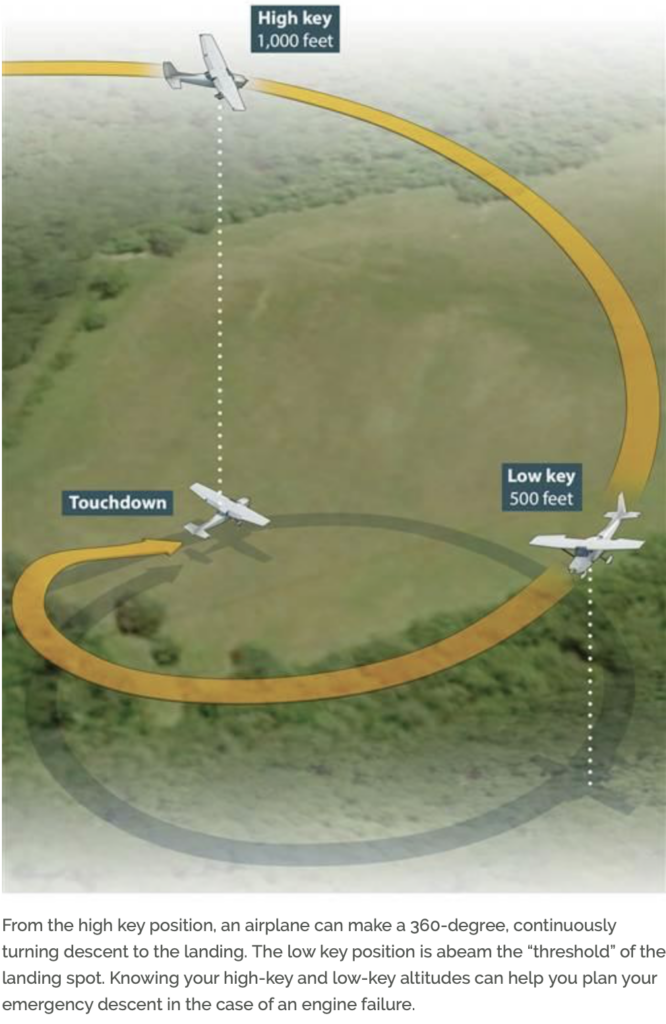
High and Low Key positions during an engine-out tight spiral to landing. The precise altitudes for high and low key vary by airplane type based on variations in glide performance from one aircraft to the next. Source: AOPA Flight Training
[BPT’s training] slides contain several good warnings:
- You no longer own the airplane [the insurance company does]. Fly to the nearest phone and order a new one (in spite of [your] and ABS’ attempts at preserving the fleet). If you are in a Cirrus (God forbid) you can order a new one while under the chute.
- “Fly the airplane as far into the crash as possible” –Bob Hoover
- Do not stop suddenly, [our slides] with appropriate numbers show the amount of energy needed to dissipate.
We finished up the hour with a thorough review of the overhead pattern, emphasizing how tight the turn is, and the tendency to fly a normal pattern vice a tight spiral turn. AND THE NEED TO PRACTICE IT OFTEN. Then on Saturday and Sunday we all went flying and I think it is safe to say everyone in a Bonanza practiced the High Key/Low Key overhead approach to an engine out landing.
Kent Ewing
Vice President
BPT INC
Excellent summation, Kent, and great LESSONS from this horrible event. One thing I’d add is securing baggage—it was apparently enough of a factor in the outcome that the NTSB Investigator in Charge took the very unusual step of contacting my employer to emphasize this with pilots only days after the accident.
Another concerns the propeller maintenance. I’ve heard from a couple of sources that add to what you wrote. The accident pilot had an ongoing propeller governing issue that he had been “chasing” with mechanics since installing a new propeller several months before the crash. Over time it might have been easy to become comfortable with the known anomaly—the normalization of deviance—and operate the airplane as if this was a minor irritant rather than an issue that (A) may have been rationalized away by a pilot instead of seeing the indications as a different and very real threat, or (B) been serious enough itself to eventually led to engine failure.
Kent, I remember flying high key/low key to an accuracy landing at Kerrville, Texas with you in the instructor’s seat during a San Antonio, Texas ABS Air Safety Foundation clinic many years ago. I agree about the need to practice this regularly—it’s something I’ve included in Bonanza training for 35 years, since my FlightSafety days. Thank you for adding your considerable experience to the discussion.
More to say? Let us learn from you, at [email protected].

Share safer skies. Forward FLYING LESSONS to a friend.
Please help cover the ongoing costs of providing FLYING LESSONS through this secure PayPal donations link. Or send a check made out to Mastery Flight Training, Inc. at 247 Tiffany Street, Rose Hill, Kansas USA 67133. Thank you, generous supporters.
Thank you to our regular monthly financial contributors:
Steven Bernstein, Montclair, NJ. Robert Carhart, Jr., Odentown, MD. Greg Cohen, Gaithersburg, MD. John Collins, Martinsburg, WV. Dan Drew. Rob Finfrock, Rio Rancho, NM. Norman Gallagher. Bill Griffith, Indianapolis, IN. Steven Hefner, Corinth, MS; Ellen Herr, Ft Myers, FL. Erik Hoel, Redlands, CA. Ron Horton. David Karalunas, Anchorage, AK. Steve Kelly, Appleton, WI. Karl Kleiderer. Greg Long, Johnston, IA. Rick Lugash, Los Angeles, CA. Richard McCraw, Hinesburg, VT. David Ovad, Resiertown, MD. Steven Oxholm, Portsmouth, NH. Brian Schiff, Keller, TX. Paul Sergeant, Allen, TX. Paul Uhlig, Wichita, KS. Richard Whitney, Warrenton, VA. Jim Preston, Alexandria, VA. Johannes Ascherl, Munich, Germany. Bruce Dickerson, Asheville, NC. Edmund Braly, Norman, OK. Steven Hefner. Lorne Sheren, New Vernon, NJ. “The Proficient Pilot,” Keller, TX. Kynan Sturgiss, Hereford, TX. Bluegrass Rental Properties, LLC, London, KY. John Foster. Joseph Victor, Bellevue, WA. Chris Palmer, Irvine, CA. Barry Warner, Yakima, WA. Todd LeClair, Cadiz, KY. Jim Hopp, San Carlos, CA. Adrian Chapman, West Chester, PA. Ed Stack, Prospect Heights, IL. Robert Finley, Dubois, Wyoming. Robert Finley, John Kinyon, Lawrence Copp, V. Andrew Smith, Kevin Echols. Claude Bundrick, Shreveport, LA. John Croft, Upper Marlboro, MD.
Thank you to these 2026 donors:
Robert Sparks, Mark Sletten, Thomas Jaszewski, Douglas Olson, David Field, Michael McRobert, Wayne Colburn. Albert Chaker, Textron Aviation Employees Flying Club
NEW THIS WEEK: Denny Southard
Pursue Mastery of Flight®
Thomas P. Turner, M.S. Aviation Safety
Flight Instructor Hall of Fame Inductee
2021 Jack Eggspuehler Service Award winner
2010 National FAA Safety Team Representative of the Year
2008 FAA Central Region CFI of the Year
FLYING LESSONS is ©2026 Mastery Flight Training, Inc. For more information see www.thomaspturner.com. For reprint permission or other questions contact [email protected].