

Topics this week include: >> All that pilot stuff >> When compliance isn’t possible. >> Stop talking about safety

This week’s LESSONS:
As promised last week, let’s catch up on reader insights and go straight to the Debrief.
Questions? Comments? Supportable opinions? Let us know at [email protected].

Debrief
Readers write about recent LESSONS:
Well-known airline pilot, instructor, author and podcaster Brian Schiff –a judge in this week’s Air Race Classic; follow the race teams here—writes about last week’s LESSONS that looked at 81 FAA-reported aircraft accidents over the prior two weeks:
I was thrilled to see the breakdown of accidents, incidents, and others you posted in your June 12 Mastery of Flight(R) email blast. This is what I have been trying to express to others who only want to measure the accident rate by considering only fatal accidents.
All pilots need to be aware of what is happening rather than feel a false sense of “my industry is the safest it has ever been.”
Please do this regularly, and I will share your information rather than try to reinvent the wheel and do it myself.
I’m glad and honored to help you toward our mutual goal, Brian. Flying is almost universally accident-free. But lack of accident does not itself mean the flight was conducted safely: you might just have been lucky. When accidents do occur it seems pilots are doing the same things over and over again—perhaps luck ran out. We can learn from history to avoid depending on luck.
Safety is not a strategy, it’s an outcome. We should stop talking about safety and focus on mastery and command, as I presented at Oshkosh several years ago.
Reader Robert Lough comments on the recent LESSONS about engine failures, lateral stability and spirals:
See below a message I sent to Nate Jaros on his very good book [Engine Out Survival Tactics: Fighter Pilot Tactics for General Aviation Engine Loss Emergencies]:
Hi Nate thank you for the safety contribution of your very good book. Over here in the UK we use the so-called constant aspect forced landing technique. It looks quite similar to the T-34 SFO described in your book. Once the aiming point (one third to a half into the selected landing site) has been assured, typically between low key and turning to final, gear and approach flaps would be extended, in sequence and landing flaps on final, bringing the aiming point forward to the beginning of the landing site. During the manoeuvre the aiming point would typically move across from the side to the forward windscreen maintaining a constant aspect. The actual ground track would look like the T-34 depiction [in your book]. Bank angle would be used within sensible parameters to maintain the constant aspect, typically between 15 and 35 degrees.
On bank angle your recommendation of 30 degrees is a good one, as this is typically a neutral lateral stability point for GA airplanes. Beyond 30~40 degrees you start to enter an area of negative lateral stability.
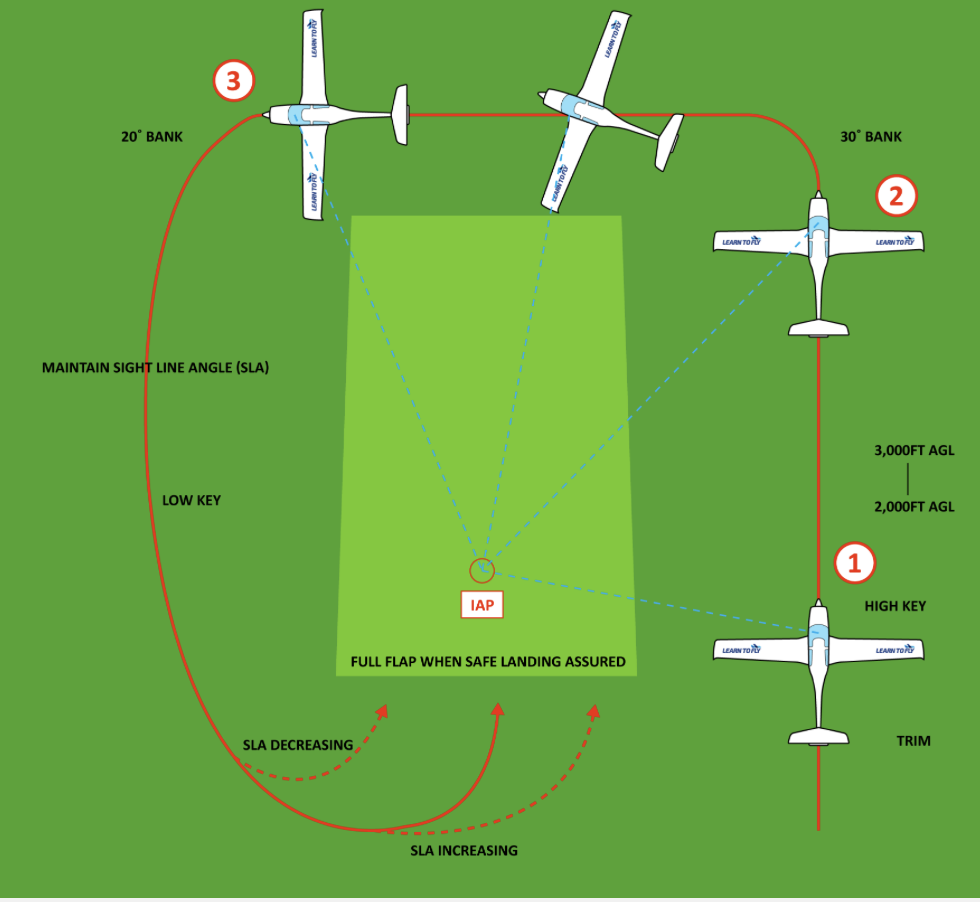
I’ve taught a similar overhead glide pattern since my FlightSafety International days in the early 1990s, modeled for the Beech Bonanza after the T-34 manual. We developed a technique for using drag and low power to safely practice glide performance in a single-engine equivalent of simulated zero thrust used in multiengine training. A demonstration of that technique is here.
As discussed in the April 24 Mastery of Flight(R), among other undesirable results banking steeply in an engine-out glide reduces the vertical component of lift, increasing the rate of descent. Bank too steeply to turn back toward the runway or some other landing zone and the rate of descent at glide speed will increase. You won’t get “book” glide performance or be reasonably assured of remaining aloft within a moving-map “glide ring” in a bank—these predictions assume wings-level flight. That’s one reason to gain experience with simulated engine-out glide under safe, controlled conditions: so you’ll have a feel for what it takes not only to glide straight ahead, but also so you’ll be able to predict the effect of maneuvering to a landing spot to better prepare you for the unlikely (but never 0%) chance you’ll have to do it. Thank you, Robert.
Reader Jarrett David responded to my request for descent planning techniques by turbine pilots:
Having flown a B[aron] 58 for several years all over the continental US, I recently stepped up to a turboprop, twin jetprop to be exact. [It’s a] very capable aircraft that still allows us to go into similar fields as the Baron so we often find ourselves going into locations that don’t have arrivals and TOD [Top of Descent] math already done for you. The big airports are easy as the STAR typically takes a lot of the guesswork out of it for us. But for the smaller locations, we end up having to do math while flying along, which usually isn’t good so I have found a way to dumb it down.
In turbines, we don’t typically think of waypoints in miles, but rather stick to the time method as things happen a bit faster. As you alluded to, we like to keep the turbines as high as possible for as long as possible as the fuel burn below FL180 can get hard on the wallet. Thus many turbine pilots will find a normal descent of 1500 fpm as ideal for passengers in the back [of pressurized aircraft] as we can slowly walk into that rate without many in the back even knowing. In doing so, it makes the math much simpleras you began to explain in your example.
If we are at FL210 for example [21,000 feet above sea level under standard conditions] and need to descend to 3000 feet for the terminal area, then that is a reduction of 18,000 feet or 12 minutes. The challenge is that 1500 in division is too hard so I usually use 3000 as for some reason 3 is nearly always divisible by the difference in altitude we are trying to achieve. Then simply doubling the 3 back gives me my time. This also allows me to drop all of the zeros from the equation, as again math is hard with all of that pilot stuff going on! So in this case that 18 / 3 = 6 x 2 = 12 minutes.
I will usually plot a waypoint on the GNS 10 miles or so before the field at 3000 and when it shows me 12 minutes to that point then I need to be going down. This formula works no matter what the winds are doing as it is all time based which accounts for that effort on all of the computer screens that we have these days. Again, much simpler for my little pilot pea brain.
The benefit of turbines is that we can chop the power to the engines without any ill effects that you might find in a piston, so it is common to be coming down the hill at almost flight idle. The challenge is that we often have to level off at 10,000 feet for a minute or so to get the airplane slowed down enough to not get a speeding ticket. Thus if it is a big descent as one described here, then I will add another minute or so to the descent profile and set the first bug at 10,000 feet as a reminder with the second bug to 3,000 feet if that is where we are cleared down to. So far it has worked out fairly well.
The added challenge comes into play when ATC treats us more like the Baron I was used to. As we are often coming out of the flight levels at a measly 300 knots instead of the 450 knots much of the jet traffic is doing. In that case, my motto is that if ATC is going to treat me like a piston then I am going to fly it like a piston and only descend at 500 fpm until requested to meet a crossing restriction. But the beauty of the formula is that it will work for 500 fpm descents as well for pistons if you think about it as time instead of mileage as well. In that case, I simply use a division of 1 instead of 3 for 1,000 fpm and then double it to get 500 fpm. For instance, 12,000 foot cruise down to 2000 foot pattern is likely realistic in many piston and turbine scenarios would be a difference of 10,000 feet, so 10 / 1 = 10 x 2 = 20 minutes. One could obviously drop the division by 1 part and simply multiply by 2 but I like to keep things as uniform and the same as possible for the small amount of brain power leftover to do so.
The one caveat to this entire scenario is that the descent airspeed should be kept the same, or very close, as cruise. This is where it gets a little tricky as there are speed limitations as well as airframe limitations at certain altitudes. It is a constant monitoring and smooth slow adjustment as the flight changes. The other trick that I have learned is that we will often put out the speedbrakes/gear/flaps as we go through the cloud layers so that we can blame the pitch change and bumps on the weather rather than the pilot flying technique. It builds confidence from the passengers in the back for future flights! But that is a story for another day.
Thanks for all that you do and I still greatly enjoy reading your posts as it still correlates a lot to different types of aircraft. More than many realize.
Thank you, Jarrett. I’ve been extremely fortunate to have learned from so many people like you and to be able to correlate ideas to operating aircraft in other performance ranges. I greatly appreciate your jet-fueled experience.
High performance and turbine instructor reader Brian Sagi adds:
On the topic of descent planning: Most modern navigators / GPS units can help with your descent planning. In a Garmin GTN 650/750 or an integrated panel such as the Garmin G1000, G2000 or G3000, a good practice is, once level at cruise, to add an altitude constraint at your destination airport. If you expect a straight-in, you can set the constraint to be at 0 feet ASL at the destination airport. (The unit will convert AGL to MSL for you.) If you expect to fly a pattern, select patten altitude (usually, 1,000 feet AGL). By configuring your vertical navigation (VNAV) profile, you can set your preferred descent, expressed in degrees or in feet per second. For a [piston] airplane, selecting a 500 fpm rate of descent works well. For a turbine aircraft, setting a 3° descent slope is common. Once you set your constraint, you will see a Top of Descent (TOD) point on your navigator’s map display. This is the point at which, if you start a descent at the profile you selected for your VNAV, you will arrive at your destination at your selected altitude. The more advanced panels will display a glide path to you as you approach the TOD point. Follow the glide path and you will arrive at the airport at your desired altitude. Descent planning can also be done in older GPS unit, such as the Garmin GNS 430.
Thank you for the reminder, Brian.
Frequent Debriefer Boyd Spitler continues:
Having flown a Twin Otter in passenger operations, I agree with your 500 fpm arrival plan [when] unpressurized. In jet equipment, the ideal is to maintain cruise as long as possible and then descend at idle power and maximum legal airspeed (arrival restrictions and 250 below 10,000 MSL) in order to minimize fuel burn. As you point out, complicated arrival procedures are troublesome, especially when cleared off the arrival to a shorter course to final.
All software capable of calculating a top of descent does so based on programmed track miles in the nav plan. If track miles change…typically to a more direct route…the aircraft is immediately above profile. Since maximum performance is already planned based on the longer route, it may not be possible to arrive at the initial approach fix at cleared speed and altitude. It is always appropriate to advise the controller as soon as it becomes clear that compliance using good operating procedure is not possible.
This may occur to any aircraft when expecting a downwind to the far end of a runway slab from approach control only to be offered the near end when switching to tower during a slow operations period. Best response is usually to thank the tower for the expedited handling but defer to the profile plan rather than attempt to stylishly embarrass yourself in VMC in front of everybody…safety notwithstanding.
In turboprop days (pressurized) and before FMS, it was regarded as desirable to set some easy math rate of descent, 1000 or 2000 fpm, using power to maintain airspeed, to comply with the clearance. Everything was simpler back then.
I’m going to wrap up this week’s LESSONS by repeating something you wrote above:
It is always appropriate to advise the controller as soon as it becomes clear that compliance using good operating procedure is not possible.
That’s great life advice in any context, not just descent planning. Thank you, Boyd.
More to say? Let us learn from you, at [email protected]

Share safer skies. Forward FLYING LESSONS to a friend.
Please help cover the ongoing costs of providing FLYING LESSONS through this secure PayPal donations link. Or send a check made out to Mastery Flight Training, Inc. at 247 Tiffany Street, Rose Hill, Kansas USA 67133. Thank you, generous supporters.
Thank you to our regular monthly financial contributors:
Steven Bernstein, Montclair, NJ. Robert Carhart, Jr., Odentown, MD. Greg Cohen, Gaithersburg, MD. John Collins, Martinsburg, WV. Dan Drew. Rob Finfrock, Rio Rancho, NM. Norman Gallagher. Bill Griffith, Indianapolis, IN. Steven Hefner, Corinth, MS; Ellen Herr, Ft Myers, FL. Erik Hoel, Redlands, CA. Ron Horton. David Karalunas, Anchorage, AK. Steve Kelly, Appleton, WI. Karl Kleiderer. Greg Long, Johnston, IA. Rick Lugash, Los Angeles, CA. Richard McCraw, Hinesburg, VT. David Ovad, Resiertown, MD. Steven Oxholm, Portsmouth, NH. Brian Schiff, Keller, TX. Paul Sergeant, Allen, TX. Paul Uhlig, Wichita, KS. Richard Whitney, Warrenton, VA. Jim Preston, Alexandria, VA. Johannes Ascherl, Munich, Germany. Bruce Dickerson, Asheville, NC. Edmund Braly, Norman, OK. Steven Hefner. Lorne Sheren, New Vernon, NJ. “The Proficient Pilot,” Keller, TX. Ed Stack, Prospect Heights, IL. Kynan Sturgiss, Hereford, TX. Bluegrass Rental Properties, LLC, London, KY. John Foster. Joseph Victor, Bellevue, WA. Chris Palmer, Irvine, CA. Barry Warner, Yakima, WA. Todd LeClair, Cadiz, KY. Jim Hopp, San Carlos, CA. Adrian Chapman, West Chester, PA
Thanks also to these donors in 2025:
John Teipen. N. Wendell Todd. David Peterson. Jay Apt. SABRIS Aviation/Dave Dewhirst. Gilbert Buettner. David Larsen, Peter Baron, Glen Yeldezian, Charles Waldrop, Ian O’Connell, Mark Sletten, Lucius Fleuchaus. Thomas Jaszewski. Lauren McGavran. Bruce Jacobsen, Leroy Atkins, Coyle Schwab, Michael Morrow, Lew Gage, Panatech Computer (Henry Fiorentini), John Whitehead, Andy Urban, Wayne Colburn, Stu Spindel, Dave Buetow, Ken Vernmar, Dave Wacker, Bill Farrell, David Miller, Daniel Norris, Robert Sparks, Bill Cannon, David Yost
NEW THIS WEEK: Don Bowles
Pursue Mastery of Flight(R)
Thomas P. Turner, M.S. Aviation Safety
Flight Instructor Hall of Fame Inductee
2021 Jack Eggspuehler Service Award winner
2010 National FAA Safety Team Representative of the Year
2008 FAA Central Region CFI of the Year
FLYING LESSONS is ©2025 Mastery Flight Training, Inc. For more information see www.thomaspturner.com. For reprint permission or other questions contact [email protected].