
Topics this week include: >> Everybody knows. >> Very stable >> Information…confirmed

FLYING LESSONS uses recent mishap reports to consider what might have contributed to accidents, so you can make better decisions if you face similar circumstances. In most cases design characteristics of a specific airplane have little direct bearing on the possible causes of aircraft accidents—but knowing how your airplane’s systems respond can make the difference in your success as the scenario unfolds. So apply these FLYING LESSONS to the specific airplane you fly. Verify all technical information before applying it to your aircraft or operation, with manufacturers’ data and recommendations taking precedence. You are pilot in command and are ultimately responsible for the decisions you make.
FLYING LESSONS is an independent product of MASTERY FLIGHT TRAINING, INC.
Pursue Mastery of Flight®
This week’s LESSONS:
Everybody knows
Just about everybody knows how to perform an obstacle takeoff in a Cessna 150 or similar light training aircraft. Set flaps, hold the brakes, add power, accelerate with elevator neutral until reaching the liftoff speed, raise the nose smartly to the VXattitude, clear the obstacle, retract flaps and lower the nose to climb speed. Right?
Read this NTSB final report:
The pilot [of a Cessna 150] reported that, during a max[imum] performance takeoff, he set the flaps to 10° and accelerated to 60 mph. He pulled back and pitched the airplane for Vx (best angle climb), 52 mph, to simulate an obstacle, and then pitched for Vy (best rate climb), 72 mph, where he observed that the airplane was descending. He pitched back to gain altitude but immediately heard the stall warning horn and felt a lack of responsiveness in the flight controls. He leveled the airplane to touch down on the remaining runway, but the right wing and right horizontal stabilizer impacted the runway. The airplane sustained substantial damage to the right wing and right horizontal stabilizer.
The pilot reported that the cause of the accident was that the published Vx airspeed was below the stall speed.
The pilot reported that there were no preaccident mechanical failures or malfunctions with the airplane that would have precluded normal operation but that it was possible that the engine was not performing at optimal performance.
The pilot was not inexperienced. He was 40 years old and held a First Class medical certificate. A Commercial pilot with multiengine rating, the pilot had an estimated 492 hours total time (all aircraft) with 460 hours Pilot-in-Command, 60 hours in make and model, 43 hours (all aircraft) in the preceding 90 days, 20 hours in the past 30 days and five hours in the last 24 hours before the accident.
The National Transportation Safety Board report continues:
The airplane owner’s manual checklist titled “Maximum Performance Take-Off” stated:
1. Wing Flaps – Up.
2. Carburetor Heat – Cold.
3. Brakes – Hold.
4. Throttle – Full “OPEN.”
5. Brakes – Release.
6. Elevator Control – Slightly tail low.
7. Climb Speed – 52 MPH (with obstacles [a]head).
That’s how you do it. Right? Wait. That checklist calls for flaps UP for a maximum performance takeoff.
This was a simulated obstacle departure. The pilot escaped injury despite “substantial” airplane damage. N7750F was deregistered, most likely totaled in the accident. The investigative report goes on, with my emphasis added:
The [owner’s] manual also stated:
Normal and obstacle clearance take-offs are performed with flaps up. The use of 10° flaps will shorten the ground run approximately 10%, but this advantage is lost in the climb to a 50-foot obstacle. Therefore, the use of 10° flap is reserved for minimum ground runs or for take-off from soft or rough fields with no obstacles ahead.
The NTSB determined the probable cause of the C150 accident to be:
The pilot’s failure to maintain adequate airspeed and his exceedance of the airplane’s critical angle of attack during a maximum performance takeoff, which resulted in an aerodynamic stall. Also causal was the pilot’s failure to use the appropriate flap setting in accordance with the manufacturer’s Maximum Performance Takeoff checklist.
Flaps create lift. It follows that more flaps equal more lift. Another Cessna 150 accident highlights something else everybody knows…or do they?
The private pilot was departing on a personal flight in his [Cessna 150]. Multiple witnesses described the airplane’s initial climb as slow and steep, and recounted the airplane entering a left turn before descending to ground contact, consistent with an aerodynamic stall.
Although several witnesses reported that the engine sound during the initial climb was abnormal, examination of the engine and airframe revealed no evidence of mechanical malfunctions or failures that would have precluded normal operation. The wing flaps were found extended to 20°; the airplane’s owner’s manual suggested 10° of flap extension for takeoffs from soft or rough runways; however, the manual also indicates that flaps can reduce the climb to 50 ft.
Federal Aviation Administration guidance states that flap deflection of up to 15° primarily produces lift with minimal drag, while flap extension greater than 15° produces a large increase in drag and a significant nose-up pitching moment in high- wing equipped airplanes. It is likely that, during the takeoff with 20° of flaps extended, the airplane became airborne at a lower than normal airspeed and entered a climb at a higher than normal nose-up pitch attitude, placing the airplane very close to its critical angle of attack. During the climb, the pilot exceeded the critical angle of attack, likely by allowing the airspeed to decay due to the airplane’s nose- up pitch attitude, and the airplane entered an aerodynamic stall at an altitude too low for recovery.
The National Transportation Safety Board determines the probable cause(s) of this accident to be: The pilot’s exceedance of the airplane’s critical angle of attack during the initial climb after takeoff, which resulted in an aerodynamic stall and loss of control. Contributing to the accident was the pilot’s failure to properly configure the wing flaps for takeoff.
Much of what everybody knows about flying comes from word-of-mouth. Information is passed from pilot to pilot; what’s true in one model of aircraft is promoted and accepted as true for another. Low-time students are especially susceptible to the influence of instructors and more experienced aviators. The law of primacy—we remember best what we learn first—makes this influence even stronger. They then carry this “knowledge” through their flying careers, and pass it along to the next eager generation of pilots.
Any maneuver, especially one aimed at eking maximum performance from the aircraft, should begin with a review of the checklists. Except for information in the Limitations section the manual or handbook is a recommendation. At times data, or experience—a type of data—may dictate a different technique. But without hard information, and certainly if all you have is hearsay, any answer we give to another pilot, any advice we take from others, any action we take should come from information confirmed to be applicable to the specific aircraft and its equipment.
Did you “know” that the Cessna 150 checklist calls for flaps UP for a takeoff over an obstacle? I’ll be honest, I’d forgotten. Did you know that anything more than 15° of flap extension is great for descent, because it is primarily drag, but that it is awful for climb? What else do you “know” because it was told to you, not because you saw it in the primary sources?
Listen to the experience of others. But crosscheck their guidance against objective, authoritative sources. When performance is critical, we should all confirm we truly “know” the right thing to do.
Questions? Comments? Supportable opinions? Let us know at [email protected].

Debrief
Readers write about recent LESSONS:
Digging deep into my Debrief backlog, David Davies writes about the March 6th Debrief:
After this week’s FLYING LESSONS, I feel compelled to write and ask a question that I haven’t heard addressed so far. Everyone talks about stabilized approaches and that each pilot should setup for one on every landing. My understanding is they’re nominally 3-degree glide slopes (with local adjustments based on terrain), yet the trainer planes we fly (172, Warrior, etc.) and even my LSA all have glide ratios somewhere between 8.5 and 10.5 (a 3-degree glide slope would require a 19:1 glide ratio). This means that an engine failure on approach will likely drop us into the lighting system unless by luck we’re very close to the airport.
So, shouldn’t stabilized approaches be around 5-7 degrees glide slope for these types of aircraft, i.e. all whites on the PAPI/VASI so that an engine failure base to final will improve our chances of reaching the runway? Or is that understood and I missed the memo?
Of course, if you’re IFR you have no choice.
The U.S. Federal Aviation Administration describes a stabilized approach thusly:
A pilot is flying a stabilized approach when he or she establishes and maintains a constant angle glidepath towards a predetermined point on the landing runway.
This definition does not specifically require a 3-degree glide path…but the FAA guide continues:
…a commonly referenced optimum glidepath follows the “3:1” principle. The principle, also seen as a descent ratio, means that for every 3 nautical miles (nm) flown over the ground, the airplane should descend 1000 feet. This flightpath profile simulates a 3° glideslope. The FAA presents data (without citation) that illustrates a substantial increase in unstable approaches when attempting to fly glide angles steeper than three degrees.
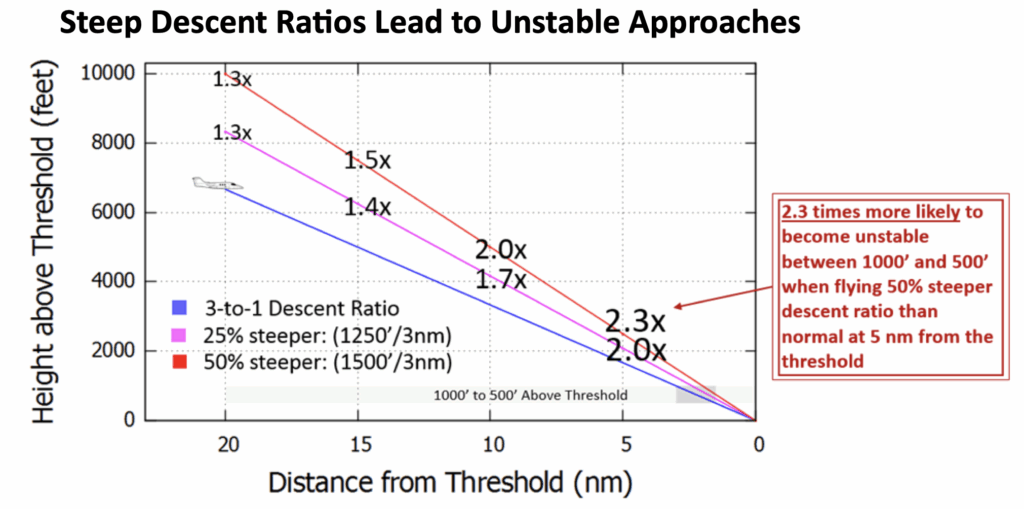
The FAA likely feels the chances of accidents resulting from an unstable approach are greater than the chances from engine failure on final approach. That said, I think regular practice of power-off, short field landings—which follow a steeper-than-three-degree final approach, is a good way to ingrain the sight picture of an engine-out landing, as well as maintain muscle memory of rounding out from an engine-out landing whether it occurs to a runway or off-airport. Thank you, David, and thanks for your patience.
More to say? Let us learn from you, at [email protected]

Share safer skies. Forward FLYING LESSONS to a friend.
Please help cover the ongoing costs of providing FLYING LESSONS through this secure PayPal donations link. Or send a check made out to Mastery Flight Training, Inc. at 247 Tiffany Street, Rose Hill, Kansas USA 67133. Thank you, generous supporters.
Thank you to our regular monthly financial contributors:
Steven Bernstein, Montclair, NJ. Robert Carhart, Jr., Odentown, MD. Greg Cohen, Gaithersburg, MD. John Collins, Martinsburg, WV. Dan Drew. Rob Finfrock, Rio Rancho, NM. Norman Gallagher. Bill Griffith, Indianapolis, IN. Steven Hefner, Corinth, MS; Ellen Herr, Ft Myers, FL. Erik Hoel, Redlands, CA. Ron Horton. David Karalunas, Anchorage, AK. Steve Kelly, Appleton, WI. Karl Kleiderer. Greg Long, Johnston, IA. Rick Lugash, Los Angeles, CA. Richard McCraw, Hinesburg, VT. David Ovad, Resiertown, MD. Steven Oxholm, Portsmouth, NH. Brian Schiff, Keller, TX. Paul Sergeant, Allen, TX. Paul Uhlig, Wichita, KS. Richard Whitney, Warrenton, VA. Jim Preston, Alexandria, VA. Johannes Ascherl, Munich, Germany. Bruce Dickerson, Asheville, NC. Edmund Braly, Norman, OK. Steven Hefner. Lorne Sheren, New Vernon, NJ. “The Proficient Pilot,” Keller, TX. Ed Stack, Prospect Heights, IL. Kynan Sturgiss, Hereford, TX. Bluegrass Rental Properties, LLC, London, KY. John Foster. Joseph Victor, Bellevue, WA. Chris Palmer, Irvine, CA. Barry Warner, Yakima, WA. Todd LeClair, Cadiz, KY. Jim Hopp, San Carlos, CA. Adrian Chapman, West Chester, PA.
Thanks also to these donors in 2025:
John Teipen (two donations). N. Wendell Todd. David Peterson. Jay Apt. SABRIS Aviation/Dave Dewhirst. Gilbert Buettner. David Larsen, Peter Baron, Glen Yeldezian, Charles Waldrop, Ian O’Connell, Mark Sletten, Lucius Fleuchaus. Thomas Jaszewski. Lauren McGavran. Bruce Jacobsen, Leroy Atkins, Coyle Schwab, Michael Morrow, Lew Gage, Panatech Computer (Henry Fiorentini), John Whitehead, Andy Urban, Wayne Colburn, Stu Spindel, Dave Buetow, Ken Vernmar, Dave Wacker, Bill Farrell, David Miller, Daniel Norris, Robert Sparks, Bill Cannon, David Yost, Don Bowles. Ed Shapiro
Pursue Mastery of Flight®
Thomas P. Turner, ATP/CFI/CFII/MEI M.S. Aviation Safety
Flight Instructor Hall of Fame Inductee
2021 Jack Eggspuehler Service Award winner
2010 National FAA Safety Team Representative of the Year
2008 FAA Central Region CFI of the Year
FLYING LESSONS is ©2025 Mastery Flight Training, Inc. For more information see www.thomaspturner.com. For reprint permission or other questions contact [email protected].