
Topics this week include: >> Shaky Cessna >> They still know >> How and why

FLYING LESSONS uses recent mishap reports to consider what might have contributed to accidents, so you can make better decisions if you face similar circumstances. In most cases design characteristics of a specific airplane have little direct bearing on the possible causes of aircraft accidents—but knowing how your airplane’s systems respond can make the difference in your success as the scenario unfolds. So apply these FLYING LESSONS to the specific airplane you fly. Verify all technical information before applying it to your aircraft or operation, with manufacturers’ data and recommendations taking precedence. You are pilot in command and are ultimately responsible for the decisions you make.
FLYING LESSONS is an independent product of MASTERY FLIGHT TRAINING, INC.
Pursue Mastery of Flight®
This week’s LESSONS:
A reader who wishes to remain anonymous is our guest instructor this week:
Last week I had a near accident, not a near death experience, I am writing this down to share.
Over the past six months our Cessna 172 would shake on takeoff. My mechanic said it was probably unbalanced tires. Since I trust my mechanic, I swallowed that as truth. Fast forward to last Wednesday evening and a night cross country with a student. When we backed the plane into the hangar it groaned and whined not unlike a Cessna 150 I’d had that routinely sounded like that. Brake shoes, I thought. Within 10 hours of the 100-hour, [inspection] that would get looked at soon.
The following day I had three private pilot students for takeoffs and landings, again with the wheels shaking on takeoff. Some of those landings were typical student-hard landings. My fourth flight of the day was a recurrency flight with stalls, slow flight and one landing. On taxi back my airport manager suggested we fill up in case anyone wanted an unexpected evening flight. Ten feet away from the pump we heard a loud bang and the plane refused to go forward. The airport manager made a throat cut shut-er-off motion.
We found the tire tipping inward with a gouge in the brake shoe mount. Four carriage bolts were missing—totally gone! Two bolts were all that held the tire to the plane. We limped it home on a dolly, slowly and carefully. In the hangar, on removal, we found only ONE bolt held that wheel on, the other having already broken off in the structure.
My mechanic, the manager and most pilots around had never heard of such a thing. But on deeper research my mechanic did find it was not uncommon in three-part McCauley wheels. My options are to repair these wheels (cost of bolts) or convert to a Cleveland two-part wheel ($4000+).
The total spectrum of what-ifs have haunted me these last few days. What if it had been a student on solo, as I was expecting the day after? What if we had done one more pattern and landing? What if… what if…. To say I’m disturbed is an understatement. There are sooooo many things to be grateful for: we didn’t crash, the wheel stayed on, I was on board. the airport manager’s suggestion we fill up…. I was at my home airport; we were on the ground. I am praising God and thankful the what-ifs didn’t happen, and looking for a good forward course of action.
Our guest author invites FLYING LESSONS reader comments.
Questions? Comments? Supportable opinions? Let us know at [email protected].

Debrief
Readers write about last week’s LESSONS:
Career flight instructor and frequent Debriefer Tony Johnson writes:
Good letter this week (why am I not surprised?!). Regarding flaps and the Cessna 150 accidents, I spend a fair bit of time teaching aerodynamics to aspiring CFIs and others. The lift-drag curve (angle of attack showing lift and induced drag) is my favorite teaching tool. It comes as a surprise to many pilots that lowering flaps, in addition to increasing the camber of that portion of the wing, also increases angle of attack. A small amount of flap (10%) primarily increases lift because the drag curve (which is exponential) is relatively flat at low angles of attack.
At higher flap settings, drag becomes the primary effect because the curve gets pretty steep at higher AOA. In the Cessna 180, for instance, with 40 degrees of flap down, in a 3-point landing attitude, if you are not within a foot or so of the ground the airplane just falls down. I believe this is because the wing root actually stalls at that point due to the very high AOA. (I am ready to be corrected if any engineers in the crowd disagree!).
The point is, at any flap setting, the wing root is flying at a higher angle of attack than the outboard section, putting it closer to the critical (stalling) angle. If you then pitch the wing up the root may well exceed critical angle and stall, removing substantial lift so the wing can no longer support the weight of the aircraft. I am pretty sure that is exactly what happened to the first C150 that you referenced.
Sorry for the long-winded response!
No need to apologize, Tony. Excellent insights. Thank you.
Reader/instructor Mark Sletten adds:
Another good FLYING LESSONS! I recently got a checkout in an early-model C172 at a flight school away from home. The school’s policy required one of two “senior” instructors conduct all checkouts. He asked me to perform a “short-field, obstacle takeoff.”When I got to the before takeoff checklist I left the flaps up. My checkout instructor suggested I had missed a step in the checklist, but after reviewing it I told him I didn’t believe I had.
“What about the flaps,” he asked.
“The checklist says flaps up for max-performance takeoff,” I said.
He insisted the flaps had to be set to 10 degrees for “minimum ground run takeoffs.” Since there wasn’t a real obstacle and we had 3,000 feet of runway I decided to just do it his way and we could discuss it in the debrief.
After the flight I dug out the POH and showed him the section in the POH with the text you quoted. He suggested the text is ambiguous, and therefore not directive. I asked, “What about the checklist? That seems directive to me.”
He replied, “Maximum performance isn’t the same as minimum ground run,” adding that his “personal experience told him the extra lift afforded by 10 deg of flaps would allow the airplane to takeoff shorter and climb higher over an obstacle.” When he sensed I wasn’t going to accept his experience over the POH he ended the discussion with, “That’s the way we do it here.”
It’s difficult to argue with someone who believes their opinion trumps manufacturer guidance.
Indeed. That’s the essence of last week’s LESSON: what everybody knows isn’t always correct. Thanks, Mark.
Another highly experienced flight instructor (and my past editor at Private Pilot and Twin and Turbine) LeRoy Cook wraps it up this week:
Comments on the July 3 newsletter from 60-year Cessna 150 instructor LeRoy Cook:
“Things everybody knows” gets a lot of us in trouble. The lowly Cessna 150 is a great airplane, as long as one doesn’t ask more of it than it can deliver. Most folks neglect to read the “amplified procedures” section of its operating handbook, which states “due to the turbulence often found near ground level, the recommended obstacle clearance airspeed is 60 knots.” The proper procedure for the short field takeoff is to begin lifting the nose at 45 knots IAS [indicated airspeed], achieving a liftoff at 52 knots, and maintaining liftoff attitude as the plane accelerates to reach 60 knots IAS at 50 feet AGL. There should be no need to pitch up or nose-down during the initial climb, as the correct attitude to achieve 60 knots is already set.
The published Vx is indeed 52 knots CAS at sea level, but it should only be used after achieving adequate altitude to handle turbulence disruptions, when maximizing climb over obstacles ahead.
LeRoy mentions the Amplified Procedures. Cessna is unique, in my experience, for having basically two Emergency Procedures and two Normal Procedures sections in its Pilot’s Operating Handbooks (POHs): a series of Operational Checklists, and repeating some the same and expanding on others, more detailed Amplified Procedures.
Let’s look at a Cessna 150M POH to see how the Operational Checklists and the Amplified Procedures compare. The Emergency Procedures section begins with this introduction:
Section 3 provides checklist and amplified procedures for coping with emergencies that may occur. Emergencies caused by airplane or engine malfunctions are extremely rare if proper preflight inspections and maintenance are practiced. Enroute weather emergencies can be minimized or eliminated by careful flight planning and good judgment when unexpected weather is encountered. However, should an emergency arise, the basic guidelines described in this section should be considered and applied as necessary to correct the problem. Emergency procedures associated with the ELT and other optional systems can be found in Section 9.
Here is a sample:
Engine Failure During Flight
The Operational Checklist provides the scope and sequence of entering a glide and attempting to restart a failed engine:
- Airspeed – 60 KIAS
- Carburetor heat – ON
- Primer – IN and LOCKED
- Fuel shutoff valve – ON
- Mixture – RICH
- Ignition switch – BOTH (or START if propeller is stopped)
Now here’s the Amplified Procedure for the same scenario:
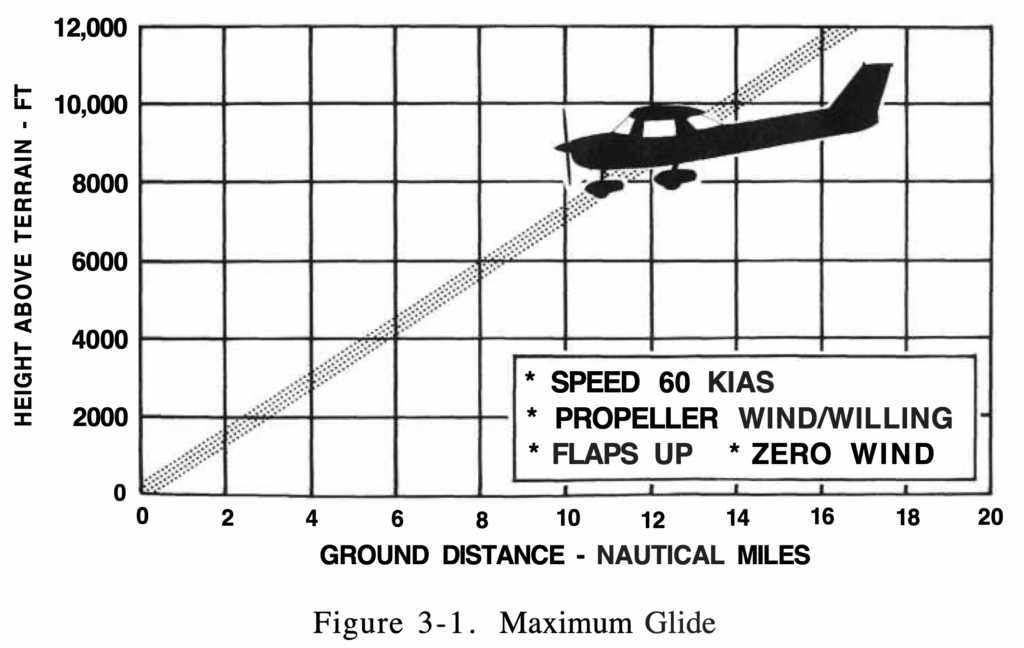
After an engine failure in flight, the best glide speed as shown in Figure 3-1 should be established as quickly as possible. While gliding toward a suitable landing area, an effort should be made to identify the cause of the failure. If time permits, an engine restart should be attempted as shown in the checklist. If the engine cannot be restarted, a forced landing without power must be completed.
The Amplified Procedures then goes on to describe making a forced landing in detail Essentially, the Operational Checklist tells you what to do, and the Amplified Procedures suggest how to do it.
Now let’s look at a sample Normal Procedure in its two Cess-nish forms:
Balked Landing
The Operational Checklist commands:
- Throttle – FULL OPEN
- Carburetor heat – COLD
- Wing flaps – RETRACT to 20°
- Airspeed – 55 KIAS
- Wing flaps – RETRACT (slowly)
The Amplified Procedures explains:
In a balked landing (go-around) climb, the wing flap setting should be reduced to 20° immediately after full power is applied. Upon reaching a safe airspeed, the flaps should be slowly retracted to the full up position.
Again, the checklist tells you what to do, the amplification suggests how to do it.
There are several items in the Emergency and Normal Amplified Procedures that do not have a corresponding Operational Checklist, including but not limited to taxiing, stalls, warm-up, magneto check, alternator check, power check, flap setting (subject of last week’s LESSONS that started this discussion), and enroute climb in the Normal Procedures; and landing without elevator control, vacuum system failure, executing a 180° turn in the clouds, emergency descent through clouds, recovery from spiral dive, spark plug fouling, and flight in icing conditions in the Emergencies section. Spins are covered in both Amplified Procedures sections, as a planned maneuver in the Normal section and an inadvertent condition in Emergencies.
If you fly a Cessna, take a good look at the Amplified Procedures portions of Sections 3 and 4 of your POH. Make reviewing these sections a routine part of your continuing education. If you fly some other aircraft type and do not have expanded discussion of normal and emergency procedures in your handbook, search online for a similar Cessna product and read through its Amplified Procedures. Use these are a jumping-off point for considering how and why you’d perform your airplane’s POH’s checklists and similar scenarios and discussion with other pilots and instructors in your type, realizing that design differences may result in different procedures and techniques in the airplane you fly.
Thank you, LeRoy.
More to say? Let us learn from you, at [email protected]
Share safer skies. Forward FLYING LESSONS to a friend.
Please help cover the ongoing costs of providing FLYING LESSONS through this secure PayPal donations link. Or send a check made out to Mastery Flight Training, Inc. at 247 Tiffany Street, Rose Hill, Kansas USA 67133. Thank you, generous supporters.
Thank you to our regular monthly financial contributors:
Steven Bernstein, Montclair, NJ. Robert Carhart, Jr., Odentown, MD. Greg Cohen, Gaithersburg, MD. John Collins, Martinsburg, WV. Dan Drew. Rob Finfrock, Rio Rancho, NM. Norman Gallagher. Bill Griffith, Indianapolis, IN. Steven Hefner, Corinth, MS; Ellen Herr, Ft Myers, FL. Erik Hoel, Redlands, CA. Ron Horton. David Karalunas, Anchorage, AK. Steve Kelly, Appleton, WI. Karl Kleiderer. Greg Long, Johnston, IA. Rick Lugash, Los Angeles, CA. Richard McCraw, Hinesburg, VT. David Ovad, Resiertown, MD. Steven Oxholm, Portsmouth, NH. Brian Schiff, Keller, TX. Paul Sergeant, Allen, TX. Paul Uhlig, Wichita, KS. Richard Whitney, Warrenton, VA. Jim Preston, Alexandria, VA. Johannes Ascherl, Munich, Germany. Bruce Dickerson, Asheville, NC. Edmund Braly, Norman, OK. Steven Hefner. Lorne Sheren, New Vernon, NJ. “The Proficient Pilot,” Keller, TX. Ed Stack, Prospect Heights, IL. Kynan Sturgiss, Hereford, TX. Bluegrass Rental Properties, LLC, London, KY. John Foster. Joseph Victor, Bellevue, WA. Chris Palmer, Irvine, CA. Barry Warner, Yakima, WA. Todd LeClair, Cadiz, KY. Jim Hopp, San Carlos, CA. Adrian Chapman, West Chester, PA.
Thanks also to these donors in 2025:
John Teipen (two donations). N. Wendell Todd. David Peterson. Jay Apt. SABRIS Aviation/Dave Dewhirst. Gilbert Buettner. David Larsen, Peter Baron, Glen Yeldezian, Charles Waldrop, Ian O’Connell, Mark Sletten, Lucius Fleuchaus. Thomas Jaszewski. Lauren McGavran. Bruce Jacobsen, Leroy Atkins, Coyle Schwab, Michael Morrow, Lew Gage, Panatech Computer (Henry Fiorentini), John Whitehead, Andy Urban, Wayne Colburn, Stu Spindel, Dave Buetow, Ken Vernmar, Dave Wacker, Bill Farrell, David Miller, Daniel Norris, Robert Sparks, Bill Cannon, David Yost, Don Bowles. Ed Shapiro
NEW THIS WEEK: Mark Kolesar, William Weber
Pursue Mastery of Flight®
Thomas P. Turner, M.S. Aviation Safety
Flight Instructor Hall of Fame Inductee
2021 Jack Eggspuehler Service Award winner
2010 National FAA Safety Team Representative of the Year
2008 FAA Central Region CFI of the Year
FLYING LESSONS is ©2025 Mastery Flight Training, Inc. For more information see www.thomaspturner.com. For reprint permission or other questions contact [email protected].