
Topics this week include: >> Asteroid down >> Not just checking a box >> Postflight postbrief

This week’s LESSONS
I was in the right seat of a G36 Bonanza a couple of weeks ago. The young corporate pilot, employed by the owners of a multistate network of building supplies stores (one of the owners a past Bonanza student of mine as well) was doing a masterful job as I guided him through experiencing some of the type-specific handling and tendencies of the airplane.
We had completed some unusual attitude recoveries toward the pilot’s Instrument Proficiency Check (IPC) requirements. That set us up at 4000 feet, about 2500 feet above ground level, maybe 10 miles from the Newton, Kansas airport (KEWK). Next up on today’s LESSON plan was an extended simulated engine-out glide to a landing using an engine-friendly technique that I explain as a single-engine equivalent of simulated zero thrust in a twin. So we started back toward the airport level at 4000 feet.
Several training airplanes were maneuvering in the area, most below us—a couple of Pipers flying under the callsign Lark from Hesston College’s small Newton-based professional pilot program, some Cessnas with N-numbers I recognized from the larger Textron Aviation Flying Club up from Beech Field, and maybe a 172 or two from the Wichita Tech program from my home airport at Wichita Jabara were taking advantage of the unusually nice late December weather. I kept my eyes out the windows with frequent scans of the ADS-B traffic display, keenly aware of my primary responsibility as a flight instructor: to assure the safe outcome of the flight.
Then a very calm voice came over the KEWK CTAF:
“Piper 6366 Romeo is about 9 miles east of Newton. We’ve had an engine failure and are landing in a field.”
There was no panic, the speech was smooth and unelevated, it sounded like any other routine call entering or in the pattern. I’d been watching one nearby ADS-B triangle—being in high school and college in the video arcade era of the late 1970s and early 1980s, I can’t scan ADS-B without thinking about the game Asteroids—and saw that it was descending quickly relative to us in a tight turn. I pointed it out to my student about the same time he said he thought he saw it out his side of the airplane, 10 o’clock low. I radioed:
“Engine out airplane at Newton, Nxxxx will call Approach and have them send first responders your way.”
My student asked and I agreed to circle in the area at our current altitude. One or two of the trainers below us were angling toward the emergency airplane on ADS-B, lower than us. I swapped COMM frequencies to Approach and checked in: “Wichita Approach, Bonanza xxxx 10 east of Newton, request.” The controller came right back with a squawk code and
“Go ahead with your request.”
I input the code as I radioed: “Nxxxx is 10 miles of Newton, there’s a Piper less than a mile south of my position reported engine out and landing in a field. Request you contact emergency services and send them toward my position.”
My customer, doing a very good job instinctively flying a turn around a point, pointed to his left and said he just saw the airplane touch down in a field and it looks like it landed okay. I saw it too, rectangular white wings in the very middle of a large, brown open field. I reported same to Approach and told them we were orbiting where the rescue forces need to be. Continuing to monitor Approach, I switched back to transmit on CTAF and called, “Emergency airplane in a field at Newton, if you’re still on frequency Approach is sending first responders your way.”
Approach then asked me if I had an address or names of the roads at the nearest intersection, but it was dirt roads 40 miles from my home and I had no idea. However, about that time one of the other airplanes in the area came up on Approach and gave them a couple of county road numbers.
Suggestion for the recently announced ATC modernization effort: If it does not already exist, create the ability to overlay Google Earth on an ATC radar screen with road names for such an occurrence.
On about our third turn around the downed airplane my student and I saw a white pickup truck driving across the field toward the airplane. The Piper appeared upright and, as best we could tell, undamaged. Although my client and I felt a bit bad for leaving the scene, there was nothing more we could do. So I told the pilot to hit “Direct To” KEWK and we proceeded to practice our own simulated engine failure to a landing with a heightened sense that we were not just checking off another box on a recurrent training syllabus.
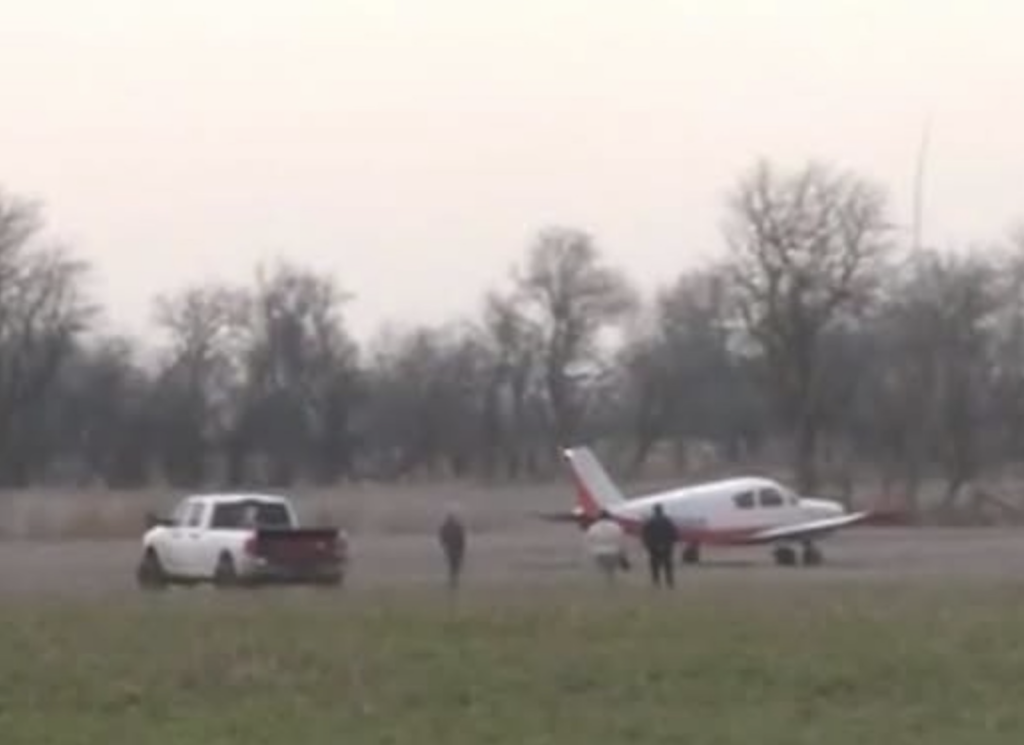
From a social media post showing the downed Piper
We don’t yet know why the Piper’s engine failed. No one was hurt and there was no reported damage, so there will be no public investigation so we’ll probably never know.
We do know that whatever the cause, in the moments that followed engine failure the instructor—I’ve since learned this was a dual instructional flight not involving any of the training organizations I mentioned earlier—and his student (I assume the male-sounding voice I heard on the radio was the CFI) flew the airplane and aimed somewhere that gave them their best chances of survival, then as best I can tell touched down wings level, under control at the slowest safe speed. I see from the social media photo that the flaps are up, requiring a little extra speed—and energy to absorb after landing—but that may have been a conscious choice necessary to make it to the excellent-looking choice of an off-airport landing spot.
In all there’s nothing as an external observer to criticize about how the emergency was handled from failure to recovery, and a lot about which to commend the pilot and instructor. What an amazing LESSON the student aboard that Piper learned to carry through a career of flying.
See, some of these LESSONS are happy endings. Merry Christmas to readers who observe the holiday, and safe, masterful flying to all.
Questions? Comments? Supportable opinions? Let us know at [email protected].

Debrief
Readers write about recent LESSONS:
Reader Karl Kleiderer writes about last week’s LESSONS on post-flight inspections:
On your postflight inspection point…just a few months ago, and ironically related to the feedback I gave about setting expectations with non-pilot passengers because we were going to need to stop for gas!
I flew with my wife, another couple, and one other adult (her husband drove) up to Ocean City, Maryland for a music festival. After shutting down, I popped the cowling open just to take a look and found a somewhat large pool of dark oil on the deck at the back of the engine underneath the accessory drive (IO-550B in an A36). I didn’t say anything to my passengers but knew I had an issue that may require a rental car at the end of the weekend.
After registering with the FBO I excused myself to get in touch with an engine shop and an AOG service. I went back out and took some pictures so I could share them with both shops. After concluding the likely cause and potential fix, I told my festival mates what was going on and that I would work on the fix while they went to the shows. The guys wanted in on the fun so off we went to Harbor Freight and then back to the airport. It got late so we headed back to the music with a plan for the morning.
Early the next morning we were back at the airport to conduct a process I’d agreed upon with the shops (several successively higher RPM runups and then a lap in the pattern with leak checks after each). Not a drop was found and we departed at the end of the weekend as we’d originally planned.
The postflight inspection surely saved us an extra overnight and allowed me to take the time needed to thoughtfully discuss and diagnose a potential fix (and attempt the fix) without the inevitable pressure of having passengers in the FBO who really want and need to get home.
Great example, Karl. Thank you.
Frequent Debriefer Arthur Utay adds:
Regarding post flight inspection: I got into the habit 40 years ago when I joined a flying club after college. Far too many times I would preflight the club planes only to discover one or more issues that required attention. Since too many of the club members either didn’t know or think about writing up maintenance squawks post-flight, I started a campaign of relentlessly documenting everything on the maintenance logs, which annoyed club management to the point that we struck an agreement – post-flight squawks would be logged and resolved in a timely manner by all club pilots.
With my Bonanza, I do a post-flight inspection of the engine compartment looking for fuel and oil leaks and underwing looking for fuel leaks, in addition to a general check of everything. I also do a final check of the cockpit to ensure all switches are in their proper positions.
Excellent, Art. I didn’t touch on the benefits of conducting a postflight inspection in an environment where multiple pilots fly an aircraft and some, without pride of ownership, may not be as diligent reporting discrepancies. Thank you.
Reader Al Chaker continues:
You’re a tremendous asset to the Beech community and to general aviation in general. However, I take issue with something you said in your last issue of FLYING LESSONS:
“Habitually remaining with the aircraft for a few minutes at the end of a flight makes it more likely you’ll stick around to ensure the proper grade and amount of fuel is added to your aircraft, and that the fueler follows best practices…”
It’s NEVER ok not to be present for fueling of a GA aircraft. I don’t even let the line guys touch my Baron with the fuel nozzle; I place the clip of the grounding wire, and I pump the fuel myself. The above, “…makes it more likely you’ll stick around…,” seems to give license to those who don’t stick around. To be so divorced from the entire flying experience, and from the care and maintenance of your own airplane, is just careless and lazy. To my mind, they’re the same kind of guys (airplane drivers; can’t call them pilots) who make me stay away from Oshkosh.
There, I’ve said my piece. Thanks for all you do for us!
I agree with you, Al. I meant that passage as a way to remove objections to someone who does not watch his/her airplane being fueled. Obviously I missed that mark.
Reader/instructor Dave Dewhirst continues our Debrief that started with a discussion on multiengine training:
We at sabriscorporation.com have insurance-approved initial and recurrent training programs for just about every piston twin built. We travel all over the country providing that service. One thing we learned is that asking a single question among ten instructors will produce ten different answers. We do not wish for a transition candidate to believe this guy from Wichita has the definitive answer to all manner of operations. Therefore, we constantly use the term, “this is what we teach” so not to undermine the efforts of his local instructor.
I say something very similar about hot starts on fuel-injected Continental engines: if you put 20 flight instructors in a room they’ll come up with 23 different hot start procedures, and most will work at least some of the time. I’m a “guy from Wichita” too and preface a lot of my teaching with “use what you like, modify what you want and throw away the rest.” I really appreciate your insights and experience, Dave.
More to say? Let us learn from you, at [email protected]
Please help cover the ongoing costs of providing FLYING LESSONS through this secure PayPal donations link. Or send a check made out to Mastery Flight Training, Inc. at 247 Tiffany Street, Rose Hill, Kansas USA 67133. Thank you, generous supporters.
“Hi, Tom. Thank you for another year of outstanding continuing aviation education. Nothing comes close to your weekly FLYING LESSONS to keep me thinking and excited to learn about my airplane and my flying. As great teachers do, you have a way of finding the right challenges to keep pushing your extended group of students (all of us Thursday morning readers) to expand our knowledge, skills, and how we think about flying. My stack of 3X5 index cards on my desk with bold print emergency procedures can attest to that!” – Andy Urban
Thank you, Andy, for your comments and your continued financial support of FLYING LESSONS Weekly.
Thank you to everyone listed below who have made one-, two- or even three-time donations to help cover the costs of hosting and delivering the weekly reports, and especially the many readers who have subscribed with a monthly automatic contribution.
Has what you’ve learned in FLYING LESSONS this year been worth it to you? How many hours of “dual” have you received from the weekly reports? If you’ve learned at least as much as you do in an hour of flight instruction please consider donating the amount you’d pay your flight instructor for just one hour of her/his time. Or send a check made out to Mastery Flight Training, Inc. at 247 Tiffany Street, Rose Hill, Kansas USA 67133.
I only make this appeal two weeks each year. Please consider donating what you’d pay for just one hour of flight instruction, to help me cover the costs of hosting, delivering and improving FLYING LESSONS Weekly. If that’s more than you think it’s been worth, any amount is greatly appreciated.
Thank you to our regular monthly financial contributors:
Steven Bernstein, Montclair, NJ. Robert Carhart, Jr., Odentown, MD. Greg Cohen, Gaithersburg, MD. John Collins, Martinsburg, WV. Dan Drew. Rob Finfrock, Rio Rancho, NM. Norman Gallagher. Bill Griffith, Indianapolis, IN. Steven Hefner, Corinth, MS; Ellen Herr, Ft Myers, FL. Erik Hoel, Redlands, CA. Ron Horton. David Karalunas, Anchorage, AK. Steve Kelly, Appleton, WI. Karl Kleiderer. Greg Long, Johnston, IA. Rick Lugash, Los Angeles, CA. Richard McCraw, Hinesburg, VT. David Ovad, Resiertown, MD. Steven Oxholm, Portsmouth, NH. Brian Schiff, Keller, TX. Paul Sergeant, Allen, TX. Paul Uhlig, Wichita, KS. Richard Whitney, Warrenton, VA. Jim Preston, Alexandria, VA. Johannes Ascherl, Munich, Germany. Bruce Dickerson, Asheville, NC. Edmund Braly, Norman, OK. Steven Hefner. Lorne Sheren, New Vernon, NJ. “The Proficient Pilot,” Keller, TX. Kynan Sturgiss, Hereford, TX. Bluegrass Rental Properties, LLC, London, KY. John Foster. Joseph Victor, Bellevue, WA. Chris Palmer, Irvine, CA. Barry Warner, Yakima, WA. Todd LeClair, Cadiz, KY. Jim Hopp, San Carlos, CA. Adrian Chapman, West Chester, PA. Ed Stack, Prospect Heights, IL. Robert Finley, Dubois, Wyoming
Thanks also to these donors in 2025:
N. Wendell Todd. David Peterson. Jay Apt. SABRIS Aviation/Dave Dewhirst. Gilbert Buettner. David Larsen, Peter Baron, Glen Yeldezian, Charles Waldrop, Ian O’Connell, Mark Sletten, Lucius Fleuchaus. Thomas Jaszewski. Lauren McGavran. Bruce Jacobsen, Leroy Atkins, Coyle Schwab, Michael Morrow, Lew Gage, Panatech Computer (Henry Fiorentini), Dave Buetow, Ken Vernmar, Dave Wacker, Bill Farrell, David Miller, Daniel Norris, Robert Sparks, Bill Cannon, David Yost, Don Bowles. Ed Shapiro, Mark Kolesar, William Weber, Anonymous Oshkosh donor, Robert Lough, Martin Sacks, Denny Southard, John Owen, Wayne Mudge, Dale Bleakney, Rod Partlo, Kevin O’Halloran, Joseph Montineri, David Kenny, Boyd Spitler, George Stromeyer, Greg Hill, Phil Parham, Arthur Utay, Lawrence Peck, Glenn Beavers, Richard Erler
NEW MONTHLY CONTRIBUTOR: Robert Finley
NEW THIS WEEK: Lorne Sheren, Tad Santino, Kenneth Bacow, Joseph Stadelmann, Randy Starbuck
Two 2025 donations: John Teipen, Denny Southard, Wayne Colburn, Andy Urban, Timothy Schryer, Stu Spindel
Three 2025 donations: John Whitehead
Pursue Mastery of Flight
Thomas P. Turner, M.S. Aviation Safety
Flight Instructor Hall of Fame Inductee
2021 Jack Eggspuehler Service Award winner
2010 National FAA Safety Team Representative of the Year
2008 FAA Central Region CFI of the Year
FLYING LESSONS is ©2025 Mastery Flight Training, Inc. For more information see www.thomaspturner.com. For reprint permission or other questions contact [email protected].