
Topics this week include: >> Haven’t the foggiest >> Shared responsibility >> Instructional safety is paramount

This week’s LESSONS
The forecast for a cool early December morning was for clear skies, visibility at least six miles. I was planning what I call an “oil warming flight,” a short hop to get the engine’s oil warmed and circulating if I’ve not been able to fly the company aircraft for a few weeks because of weather and schedules and, in this case, travel out of state to a family funeral and the Thanksgiving holiday. These flights are good to get my own “oil” circulating and back up to speed after such a down-time as well.
I expected, however, that as dawn broke under those clear skies that visibility would drop, at least locally, as the temperature reached the dew point and the cool, muggy skies condensed into fog. Sure ‘nuf, as I drove to work the skies thickened into a foggy murk, visibility quickly dropping to under half a mile at the temperature/dew point spread neared zero. I could see a halo and the dim orb of the sun through the fog as it climbed above the horizon; patches of blue sky were visible almost directly overhead, the fog slowly wisping by in the light breeze. It looked like I could take off on an instrument clearance and be above the fog layer right away. But what might that mean for getting back on the ground?
Ground fog may permit easy viewing of the ground when looking downward through a thin fog layer, but once you enter the fog and are looking forward through it, visibility becomes quite limited.
Fog is formed when the ambient air temperature cools to the point of saturation, i.e., it reaches the dew point, a measure of the amount of water vapor in the local atmosphere.
Diurnal temperature variation describes the natural rise and fall in ambient temperatures over a day’s time. The actual variation depends on local factors, including the amount of solar radiation (“sunlight” in and out of the visual spectrum) hitting the surface, the reflective qualities of that surface, and the amount of water vapor present—water tends to reduce the variation between extremes of hot and cold.
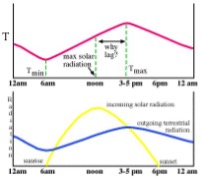
Typical diurnal temperature variation, showing the coolest times in the evening and around local dawn.
Plot the dew point as a green line, and you’ll see that any time the curve is below the dew point line, fog is likely. Of course the dew point is never greater than the ambient temperature; water vapor in the air resists temperature decline, so the atmosphere reaches saturation and dew point reduces to coincide with any further temperature reduction.

Diurnal temperature variation with dew point.
We see that the wee hours and just at and after dawn are the times when ground fog, also called radiation fog is most likely. Conditions are ripe for fog at these times if the skies are clear and winds are light.
The “gotcha” of ground fog comes from the amount of fog you’re peering through to see the ground, the runway, or runway lights. Looking down from above, the distance light must travel through the fog is fairly short. Especially at night, you may note a little fuzziness around runway lights, or you may not notice anything abnormal at all.
When you enter the fog and begin your flare, however, and you’re looking straight through the fog, you may not be able to see more than a few runway lights ahead (if that). Visibility is quickly reduced, perhaps to near zero.
If your landing light or strobes are on the effect of suddenly entering thick fog at night can be very disorienting, possibly leading to a loss of control. Be very aware of conditions conducive for fog formation. which is especially common on calm, cool nights this time of year (in the Northern Hemisphere). Temperature inversions (where warmer air overlies cooler air) is also most common on clear nights with calm winds in the wintertime. Inversions trap moist air, frequently reducing visibility near the ground.
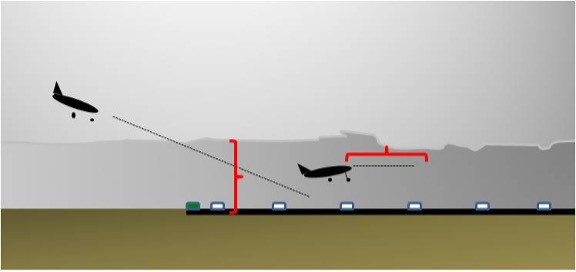
Entering ground fog during landing, you may not be able to see far enough ahead to land.
One of the scariest landings I ever had was landing a Beech Baron at an airport in New Jersey across the river from Philadelphia, Pennsylvania. It was after dark on a cool evening. My wife and son, about five at the time, were bundled under blankets in the back seats. The moonless sky was clear and full of stars when I wasn’t looking toward the urban lights. I keyed the runway’s pilot controlled lighting and a bright white rectangle appeared as I looked down onto the otherwise dark surface.
I flew an instrument approach to the field—I almost always file and fly IFR on cross-country trips, and back when I flew at night (I avoid it now) I flew an instrument approach for better orientation and obstacle clearance even when in good visual conditions. On short final I canceled IFR with Philly Approach and switched back to the CTAF (I had made switched over for quick traffic calls on my way in) for landing.
We touched down on the 1000-foot markers and the Baron rolled in smooth deceleration. Suddenly, though, about halfway down the runway I suddenly and unexpectedly rolled into milk. I’d entered a thick ground fog that was not tall enough to obscure the runway lights from above, but was dense enough to give almost zero visibility in the horizontal. My bright, dual landing lights reflecting the fog didn’t help. I shut them off, then very carefully angled to the right side of the runway before very slowly and carefully turning around to the left, tightening my turn with braking and differential power (adding power on the right engine to make the airplane turn to the left). One turned back I taxied extremely slowly until I saw the taxiway turnoff lights, then I followed the taxiway to the edge of a large ramp I saw on the diagram spread out before the dimly visible glow of the FBO. As soon as I was on the ramp I taxied clear of the taxiway and shut the engines down, afraid to taxi any further.
I’m still a little spooked remembering the situation I put myself in…because of my lack of understanding of diurnal variation.
Best practices for night arrivals are to anticipate ground fog when landing after dark on cool, clear nights with light wind. Listen to ATIS or AWOS for a local view of weather conditions if the recording exists for your chosen airport. If the runway lights look the least bit “fuzzy” or the lights cast unusual shadows, divert to another airport to avoid the disastrous threat of severely reduced visibility near the ground.
Even better, watch the temperature/dew point trends. Avoid night flight in areas where the temperature/dew point spread (the difference between the ambient temperature and the dew point) is less than two to three degrees, when the skies are clear and winds are calm. You may not be able to detect the presence of fog until you are in your landing flare.
Questions? Comments? Supportable opinions? Let us know at [email protected].

Debrief
Readers write about recent LESSONS
Reader Ed Stack writes about last week’s LESSONS:
I just wanted to tell you that I think your instructional briefing is OUTSTANDING! It sets the tone, establishes priorities and responsibilities, and it encourages your student to speak up if they notice you “drifting” from your briefed duties. I hope your flight instructor readers learn something and adopt similar briefings – well done, sir!
My pre-training briefing, and the instructional philosophy behind it, has evolved over time. I’m running your comment to reinforce part of last week’s LESSON: to encourage student pilots and other Pilots Receiving Instruction (PRIs) to initiate such a conversation with their instructor if the instructor does not his- or herself. The effectiveness and safety of instructional flights is ultimately the flight instructor’s responsibility, but it is a responsibility the PRI can share…and guide the CFI toward if needed. Thank you very much, Ed.
Reader Chris Ceplecha comments on the accident report that suggested last week’s report:
Excellent discussion on CFI roles and responsibilities. One point I’d like to bring up however that may have been missed. This training flight appears to have occurred at night, by reference to the time in the NTSB report (2115 local time), and the various references to lights that may, or may not have been inoperative. It made me think of a rule we followed in the USAF fighter community when simulating emergencies.
Simply stated, in the USAF single seat fighter community, simulating emergencies, of any kind, were restricted to day VMC conditions. Simulating emergencies at night or in IMC were strictly prohibited. That rule evolved based on decades of extremely detailed safety analysis of mishaps. It is a rule I follow to this day. Stated directly, simulating an engine failure, at night, in a single engine aircraft, to a simulated engine out landing, with no VASI, is NOT, in my opinion, an acceptable level of risk.
This conservative rule (only simulating emergencies in day, VMC conditions) was good enough for the USAF, and it’s good enough for me. Complex, higher risk emergency training such as a simulated engine out at night is best left for the simulator.
This instructor basically destroyed a perfectly airworthy aircraft by accepting and initiating a high risk training scenario. This is, in my opinion, poor ADM (aeronautical decision making). I’ll admit up front, this is a somewhat conservative mindset, but it is what we practiced for my 26 years flying fighters in the USAF, and I’ll stick to it.
I agree with you—I would never have simulated an engine failure at night, let alone close to the ground and/or with degraded runway lighting. I could have taken that tangent for my LESSONS last week. But I went another way, to discuss instructor/student responsibilities on a larger scale. Thank you, Chris.
Another fellow Air Force veteran, Gil Buettner, adds:
Your comment, “If the instructor had reminded himself his primary responsibility is to assure the safe outcome of the flight” reminded me of a conversation I had with Lt. Paul Sims, my T-37 instructor in the Air Force. I told him I thought I might want to be an instructor pilot one day. He said, “Are you crazy? Every day, I let you guys take me up there and try to kill me, and my job is to save our butts at the last minute. That’s the only way you will learn.” Our job as CFIs isn’t that dramatic, but I certainly agree with your statement. Safety is paramount.
Any USAF veteran, or at least anyone who attended US Air Force Officer Training School, certainly knows that last sentence. This is a dramatic (and common) way to express, albeit darkly, the primary role of the flight instructor: to assure the safe outcome of each training flight. Thanks you, Gil.
More to say? Let us learn from you, at [email protected]

Share safer skies. Forward FLYING LESSONS to a friend.
Please help cover the ongoing costs of providing FLYING LESSONS through this secure PayPal donations link. Or send a check made out to Mastery Flight Training, Inc. at 247 Tiffany Street, Rose Hill, Kansas USA 67133. Thank you, generous supporters.
Thank you to our regular monthly financial contributors:
Steven Bernstein, Montclair, NJ. Robert Carhart, Jr., Odentown, MD. Greg Cohen, Gaithersburg, MD. John Collins, Martinsburg, WV. Dan Drew. Rob Finfrock, Rio Rancho, NM. Norman Gallagher. Bill Griffith, Indianapolis, IN. Steven Hefner, Corinth, MS; Ellen Herr, Ft Myers, FL. Erik Hoel, Redlands, CA. Ron Horton. David Karalunas, Anchorage, AK. Steve Kelly, Appleton, WI. Karl Kleiderer. Greg Long, Johnston, IA. Rick Lugash, Los Angeles, CA. Richard McCraw, Hinesburg, VT. David Ovad, Resiertown, MD. Steven Oxholm, Portsmouth, NH. Brian Schiff, Keller, TX. Paul Sergeant, Allen, TX. Paul Uhlig, Wichita, KS. Richard Whitney, Warrenton, VA. Jim Preston, Alexandria, VA. Johannes Ascherl, Munich, Germany. Bruce Dickerson, Asheville, NC. Edmund Braly, Norman, OK. Steven Hefner. Lorne Sheren, New Vernon, NJ. “The Proficient Pilot,” Keller, TX. Kynan Sturgiss, Hereford, TX. Bluegrass Rental Properties, LLC, London, KY. John Foster. Joseph Victor, Bellevue, WA. Chris Palmer, Irvine, CA. Barry Warner, Yakima, WA. Todd LeClair, Cadiz, KY. Jim Hopp, San Carlos, CA. Adrian Chapman, West Chester, PA. Ed Stack, Prospect Heights, IL.
Thanks also to these donors in 2025:
N. Wendell Todd. David Peterson. Jay Apt. SABRIS Aviation/Dave Dewhirst. Gilbert Buettner. David Larsen, Peter Baron, Glen Yeldezian, Charles Waldrop, Ian O’Connell, Mark Sletten, Lucius Fleuchaus. Thomas Jaszewski. Lauren McGavran. Bruce Jacobsen, Leroy Atkins, Coyle Schwab, Michael Morrow, Lew Gage, Panatech Computer (Henry Fiorentini), Stu Spindel, Dave Buetow, Ken Vernmar, Dave Wacker, Bill Farrell, David Miller, Daniel Norris, Robert Sparks, Bill Cannon, David Yost, Don Bowles. Ed Shapiro, Mark Kolesar, William Weber, Anonymous Oshkosh donor, Robert Lough, Martin Sacks, Denny Southard, Timothy Schryer, John Owen, Wayne Mudge, Dale Bleakney, Rod Partlo, Kevin O’Halloran, Joseph Montineri, David Kenny, Boyd Spitler, George Stromeyer, Greg Hill, Phil Parham, Arthur Utay
NEW THIS WEEK: Lawrence Peck
Two 2025 donations: John Teipen, Denny Southard, Wayne Colburn, Andy Urban
Three 2025 donations: John Whitehead
Pursue Mastery of Flight
Thomas P. Turner, M.S. Aviation Safety
Flight Instructor Hall of Fame Inductee
2021 Jack Eggspuehler Service Award winner
2010 National FAA Safety Team Representative of the Year
2008 FAA Central Region CFI of the Year
FLYING LESSONS is ©2025 Mastery Flight Training, Inc. For more information see www.thomaspturner.com. For reprint permission or other questions contact [email protected].