
Topics this week include: >> More on ice >> A hair’s breadth >> No guarantee

FLYING LESSONS uses recent mishap reports to consider what might have contributed to accidents, so you can make better decisions if you face similar circumstances. In most cases design characteristics of a specific airplane have little direct bearing on the possible causes of aircraft accidents—but knowing how your airplane’s systems respond can make the difference in your success as the scenario unfolds. So apply these FLYING LESSONS to the specific airplane you fly. Verify all technical information before applying it to your aircraft or operation, with manufacturers’ data and recommendations taking precedence. You are pilot in command and are ultimately responsible for the decisions you make.
FLYING LESSONS is an independent product of MASTERY FLIGHT TRAINING, INC.
Pursue Mastery of Flight®
This week’s LESSONS
Test pilot, flight instructor, retired Designated Pilot Examiner, father of my auto tire guy and and frequent Debriefer Dale Bleakney wrote about last’s week’s LESSONS on airframe ice:
As always, your discussion on icing was thorough and accurate.
One other piece of information that is in the known icing certification information but is rarely explicitly stated in an AFM [Airplane Flight Manual] is that the “known icing” certification only includes “moderate” icing and for a maximum exposure time of 45 minutes.
The FAA expects the pilot of a known ice airplane to be out of the ice in 45 minutes regardless of the type of icing protection the airplane has.
For [rubber deice] booted airplanes, I always want to get out of the ice within 3 boot cycles.
I treat icing in the same light as thunderstorms and RADAR. RADAR is to help you avoid and get out of thunderstorms. The ice protection system is meant to help you get out of MODERATE icing conditions. No airplane that I know of is approved for SEVERE icing conditions (freezing rain or freezing drizzle).
The other interesting thing about icing is that the inadvertent encounter (equivalent of frost) often has the biggest impact on maximum coefficient of lift (e.g., stall speed change and low speed characteristics). Airplanes with thinner airfoil sections (for reduced drag) are much more severely affected by icing conditions.
Keep it up my friend. You provide a great service to the aviation community.
Lots of great points, Dale. Thank you. Let me expand on your comments and continue last week’s discussion of Things I Will Not Do:
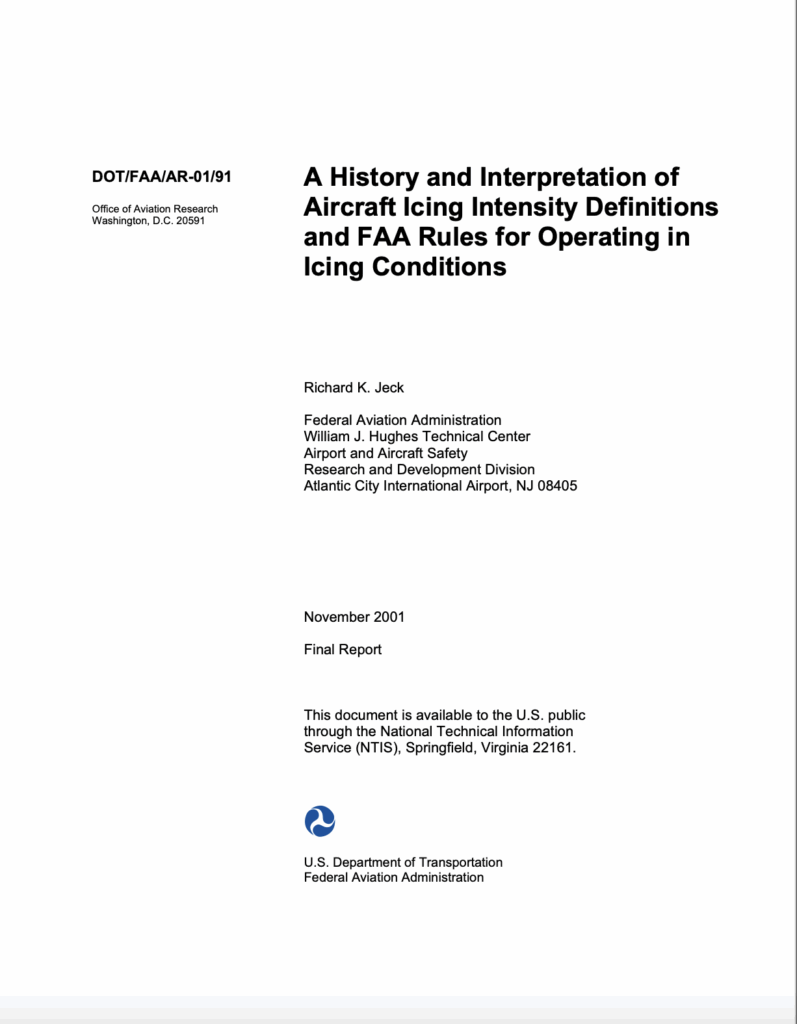
Known ice certification limits. As Dale states, virtually all “known ice” approvals are limited to moderate or lower accumulation rates. The definition of airframe ice intensity has evolved over time. The FAA says that in moderate rates of ice accumulation:
The rate of accumulation is such that even short encounters are potentially hazardous and the use of deicing/anti-icing equipment or flight diversion is necessary.
The U.S. Air Force states in moderate icing:
Evasive action desirable (noticeable effects on performance).
Dig deeper into the rules of ice certification and you’ll learn the important details of which Dale speaks. I covered this in the January 2019 issue of Twin and Turbine beginning on page 6. Here’s part of that article:
FAA certification for flight in icing conditions requires that the airplane’s ice protection system be adequate to prevent or remove accumulations of ice in one of two conditions: continuous exposure and intermittent exposure. Known ice airplanes are permitted to remain in continuous icing conditions only in stratus clouds when water droplets are no more than 40 microns in diameter. That’s 0.0019 inches (0.05 mm). Even then known ice certification assumes the pilot will exit icing conditions before traveling 17.4 nautical miles—any more exposure that that and the accumulation may exceed the system’s ability to remove accumulated ice.
In cumulus clouds, only very short ice exposures are approved. The maximum droplet size under known ice protection is 0.002 inches (0.05 mm). Exposure to ice accumulation is limited to 2.6 nm—requiring an immediate exit from icing conditions to avoid overwhelming the protection system.
Any water droplet greater than 50 microns in diameter is considered a “large droplet.” If the water is in a liquid state and the temperature is at or below freezing it is a “supercooled” large droplet, or SLD. By definition no ice protection system is certified:
- In any SLD conditions;
- In icing in stratus clouds for more than 17.4 nautical miles of continuous exposure;
- In cumulus clouds for more than 2.6 nautical miles of continuous exposure.

I titled that 2019 article “A Hair’s Breadth.” As explained in my article, here’s why:
To put this in perspective, the diameter of a human hair is 90 microns, or 0.070 mm—nearly 150 percent of the maximum water droplet exposure limit…. At or below freezing temperatures if water droplets are large enough to be perceived as individual drops or “streams” on your windshield or wings, they are too big for even known ice airplanes to be protected. Not matter what you’re flying, you need to exit this type of visible moisture immediately.
A decade before that I wrote about then-new guidance on ice certification and flying in FLYING LESSONS for February 5, 2009:
FAA has revised [in 2009] what it means to have “known icing” conditions, as a result of a query from AOPA. The revised definition improves flight planning flexibility by placing ice-related flight planning authority squarely in the hands of the pilot-in-command. Just as earning your instrument rating means you have to work harder to plan a flight, so too does this new definition require us to see and know more to exercise our authority to fly in cold-weather IMC. FLYING LESSONS looks at the new definition and its implications later in this issue. First, however, let’s learn from some recent ice-related accidents.
Attempting to overfly icy clouds works only as long as you have a way down without flying through them. Reference this [then-] recent NTSB report:
The pilot stated he flew the enroute portion of the flight…at 9,000 feet above mean sea level (msl) and that the cloud tops were at 6,500 msl. He was in contact with…approach control when nearing [his planned destination]. He stated the only pilot report regarding icing was from an airplane over Lake Michigan.
The pilot was cleared for the GPS approach and the airplane picked up light rime ice during the descent through the clouds, breaking out of the clouds around 1,700 msl (900 above ground level). He stated he had the pitot head [sic] and defrosters on, but he was unable to see out of the forward windscreen so he had to look out the side window during the landing. He stated he maintained as much airspeed as possible until the airplane contacted the frozen river. The pilot reported the airplane normally stalls at 62 knots; however, it stalled at 82 knots during the landing.
Turbo power isn’t a panacea, either. The same report continues:
The pilot reported that as he neared the airport he attempted to add engine power, but was able to maintain only 17 inches of manifold pressure.
Commonly when an engine’s alternate induction air source is in the lower, low-pressure area of an engine compartment [as was the case with this accident airplane], if the inlet air filter clogs with ice or snow the induction air pressure is low enough the turbocharger cannot provide full power. Further, when iced the propeller becomes less efficient at turning power into thrust, and the wings and tail become aerodynamic unknowns. What has been said about the effects of density altitude on airplane performance goes for airframe ice accumulation as well—you can’t turbocharge the propeller, wings or tail.
Nor is “known ice” certification a guarantee, as the pilot of this turbocharged and ice-certificated twin found:
The pilot reported that during a cross-country flight conducted under instrument flight rules, he encountered clouds that contained clear ice. Ice built up rapidly on the airplane, which was in cruise flight at 16,000 feet. In an effort to get out of the icing conditions, he requested and received clearance to progressively lower altitudes down to 10,000 feet. The airplane continued to accumulate ice. He requested a turn, and this was denied by the controller as there were two other airplanes in the vicinity with similar icing problems. He then requested and received clearance to descend to 9,000 feet, where he could see portions of the ground.
At this point, “both windshields were completely covered with clear ice as were the unprotected portions of the aircraft” and both engines were operating at full power. The pilot informed the controller that he needed to descend further. At an altitude of 7,500 feet, he circled several times attempting to see if he could reach an airport for landing. No ice had melted or come off the airplane, and the weather was deteriorating. The pilot decided to land on a highway. On final approach to land, the airplane collided with a power line, which severed the upper half of the rudder and vertical stabilizer. The pilot turned the airplane slightly left, and landed the airplane with the landing gear down in a terraced field next to the highway. During the landing roll, the landing gear was sheared off when the airplane encountered a ditch. The pilot stated that he had “no forward visibility due to the clear ice that completely covered the windshields.”
Landing an ice-laden airplane can be tricky. Read this report:
The pilot reported that during the flight he encountered unforecasted freezing rain. He questioned air traffic control about the weather and was told that they were not showing any precipitation. The pilot requested and received a descent to a lower altitude to stay below the clouds. The airplane’s airspeed continued to decrease and the pilot informed air traffic control that he wanted to divert to a nearby airport. The pilot made two low passes over the airport while trying to clear ice off of the windshield; however, the windshield alcohol de-ice could not keep up with the ice accumulation. The pilot stated he had to look out of the side window during the landing and once he descended below the tree line, he was unable to accurately judge his height over the runway. He stated this was compounded by the light color of the new concrete runway which had snow blowing across it. A hard landing resulted. The right wing strut was bent and the wing was pushed into the fuselage during the landing.
Anti-ice protection, like most alcohol-based systems (except TKS), is designed to prevent formation of light amounts of ice, must be turned on before ice begins to form, and is generally incapable of preventing “moderate” or greater ice accumulation or any flight in freezing rain or supercooled large droplets (more on this in a minute). Turn it on before you enter suspected icing conditions, and be ready to exercise your preplanned ice escape route if any ice begins to form.
The FAA’s Small Airplane Directorate recently [2009] published a General Aviation Safety Challenge report on ice that includes these items:
- Standards used to certificate airplanes for icing do NOT cover all possible icing conditions. The standards only cover some of the water forms that can exist in clouds. Icing conditions can overwhelm your ice protection.
- Certification standards assume you will hold in icing conditions less than 45 minutes. Pilots of aircraft certificated for flight in icing conditions should not be casual about operations in those conditions – particularly extended operations.
- More importantly, certification standards do NOT include supercooled large droplet (SLD) icing. SLD will impinge farther aft on the wing and tail, forming ice behind your de-icing boots or other ice-protection system. The aerodynamic penalties can be larger than what comes from ice that forms on leading edges.
- Learn the cues and exit procedures of severe icing for your airplane. If your airplane’s Pilot’s Operating Handbook (POH) or airplane flight manual (AFM) does not have any, consult Advisory Circular 91-74[B] “Pilot Guide: Flight in Icing Conditions” for cues and exit procedures.
- Some airplanes may exhibit little visual cues, such as side-window icing. On single- engine airplanes, spinner ice, which may provide a cue in multiengine airplanes, cannot be seen by the pilot. It is important to look for indications of drizzle and rain, such as drops that splatter on your windscreen. In a certification flight test of a single-engine turboprop, the only indication of SLD, which resulted in nodules of ice covering the underside of the wing, was a noticeable increase in required power to maintain the approach glide slope.
- What certification testing is done to show airplanes without ice protection equipment can safely exit an inadvertent icing encounter? The answer is simple – NONE. There are only requirements for engine induction icing and pitot and static source ice protection for IFR approved airplanes.
- Most icing encounters are of low water content and drop size, so if you have safely exited one encounter, or hear hangar talk that your airplane is okay in icing, don’t gamble that the next encounter will have the same result.
The Challenge continues:
- Icing certification standards have changed dramatically over the years. Prior to 1973, small airplanes were not required to test in icing conditions nor be analyzed or tested to the icing condition standard used today. The standards have changed significantly, even in the last few years. Advisory Circular 91-74[B] provides a good history for those who want more information.
- The two major changes are in stall warning and climb performance. Small airplanes certificated prior to 2000 were given certification credit for natural aerodynamic stall warning (buffet) even if the airplane was equipped with a stall-warning system. Since ice buildup on the wing lowers the stall angle of attack, the stall-warning sensor might not provide warning in icing conditions. Pilots therefore should know the POH/AFM minimum icing airspeeds and treat them as limitations, even if they are not in the Limitations section.
- If your POH/AFM does not have minimum icing airspeeds, add 15 to 20 knots indicated airspeed to your normal approach and landing airspeed. This goes for all phases of flight, including approach and landing, where most small airplane icing accidents occur. Also, treat any buffet or vibration as an impending wing stall, and limit maneuvering in icing conditions.
- Likewise, prior to 1993, there were no quantitative requirements for climb performance in icing conditions. An airplane being certificated today is required to have enroute climb performance data in the POH/AFM if the airplane’s service ceiling in icing is less than 22,000 feet. Pilots should consider the climb performance of the airplane and the route’s minimum altitude when determining routes and exit strategies in preflight planning. The airplane’s climb performance will be degraded in icing conditions. Consider climbing or descending to take yourself out of icing.
- However, don’t assume you can climb with ice on your airplane. If you cannot climb to exit icing, do not fly below the minimum airspeed in icing. Exit by making a 180-degree turn, or, if you cannot maintain altitude in icing at your minimum airspeed, trade altitude to keep airspeed above the minimum airspeed in icing.
- Airplane certification assumes the airplane is clean on takeoff. The ability to safely take off with contamination, including polished frost, is not tested. No airplane manufacturer, nor the FAA, has an established procedure for polishing frost, and the lift and drag penalties are unknown. Taking off with any contamination reduces the already small stall margin and reduces climb performance. Make sure critical surfaces such as lifting surfaces, control surfaces, propeller blades, and engine inlets are free of contamination.
Coming back from 2009 briefly: At least at one time the Cessna 208 Caravan’s “known ice” certification had a novel and unusual requirement: the pilot in command was required to have been completed by the PIC within the previous 12 months for the C208’s “known ice” certification to be valid. The Cessna Aircraft e-Learning Caravan pilot ice certification course cost $50 but Cessna’s e-Learning site appears to be down and the icing course no longer appears to be available. Although many parts of this program are airplane type-specific, it is/was superbly detailed coverage of what is, and is not, meant by approval for flight in icing conditions regardless of the airplane you fly. I took the course twice even though I only dream of flying a Cessna Caravan. C208 pilots, please update me on the status of this program and the requirement for annual icing training as a required part of Caravan known ice certification.
Mentioned in my 2009 report: Cirrus Design’s announced Icing Awareness training program, optimized for the [then] soon-to- be-certified “known ice” SR22 Turbo variant and, like the Caravan course, an integral part of the airplane’s flight-in-ice certification. [The program is now available here. Known ice Cirrus pilot/readers, have you taken this course? Is it required to exercise ice certification in a “known ice” Cirrus?].
More on FAA’s [then] new “known ice” definition:
AOPA post[ed] an interpretation of the new definition of “known ice” on its website, including a copy of the FAA letterexplaining the [then-] new “known ice” rule. The FAA letter states:
Any assessment of known icing conditions is necessarily fact-specific. Permutations on the type, combination, and strength of meteorological elements that signify or negate the presence of known icing conditions are too numerous to describe exhaustively in [the FAA’s] letter. Whether a pilot has operated into known icing conditions contrary to any [aircraft] limitation will depend on the total information available to the pilot, and his or her proper analysis of that information in evaluating the risk of encountering known icing conditions during a particular operation. The pilot should consider factors such as the route of flight, flight altitude and time of flight when making such an evaluation.
FAA lists these products, at a minimum, as those a “prudent” pilot would evaluate before and during flight to determine there is no likelihood of airframe ice accumulation:
- Surface observations [METARs]
- Temperatures aloft
- Terminal forecasts [TAFs]
- Area forecasts [now Graphical Forecasts for Aviation]
- AIRMETs
- SIGMETs
- Pilot Reports
FAA also states, “As new technology becomes available, pilots should incorporate the use that technology into their decision-making process.” Examples include the Current Icing Potential (CIP), Forecast Icing Potential (CIP) and similar products.
What does this all mean? From the FAA:
If the composite [of available weather] information indicates to a reasonable and prudent pilot that he or she will be operating the aircraft under conditions that will cause ice to adhere to the aircraft along the proposed route and altitude of flight, then known icing conditions likely exist. If the pilot operates the aircraft in known icing conditions contrary to the requirements of [FAR] 91.9(a), the FAA may take enforcement action.
The FAA concludes:
Pilots should not expose themselves or others to the risk associated with flight into conditions in which ice is likely to adhere to an aircraft. If ice is detected or observed along the route of flight, the pilot should have a viable exist strategy and immediately implement or terminate at [deviate to] an alternate landing facility. If icing is encountered by a pilot when operating an aircraft not approved or equipped for flight in known icing conditions, the FAA strongly encourages the submission of PIREPs and immediate requests to ATC for assistance. Such actions can significantly enhance safety, reduce accidents, and benefit the entire aviation community.
The [then-] new FAA definition of “known icing conditions”, then, provides greater flexibility to pilots planning flights in areas of below-freezing conditions, and places responsibility on the pilot-in-command (where it should be) to actively plan a route and altitude that will keep his or her aircraft out of conditions of visible moisture in the range of temperatures and conditions conducive to airframe ice accumulation. It is not blanket approval to “climb through” or descend into reported or “prudently”-anticipated icing conditions in airplanes unequipped for or prohibited from flight in icing conditions.
FAA’s interpretation is entirely consistent with most aviation mentors, instructors and training providers’ advice to “always have an out” when faced with the possibility weather reports or the pilot’s planning may prove wrong and actual icing conditions exist. It also confirms FLYING LESSONS’ frequent teaching to treat the first sign of ice accumulation just as you would an unexpected sounding of the stall warning horn—an indication you must do something different now to escape icing conditions and remove the ice that has already formed, whether your airplane is certified for flight in ice or not.
Questions? Comments? Supportable opinions? Let us know at [email protected].


Share safer skies. Forward FLYING LESSONS to a friend.
Please help cover the ongoing costs of providing FLYING LESSONS through this secure PayPal donations link. Or send a check made out to Mastery Flight Training, Inc. at 247 Tiffany Street, Rose Hill, Kansas USA 67133. Thank you, generous supporters.
Thank you to our regular monthly financial contributors:
Steven Bernstein, Montclair, NJ. Robert Carhart, Jr., Odentown, MD. Greg Cohen, Gaithersburg, MD. John Collins, Martinsburg, WV. Dan Drew. Rob Finfrock, Rio Rancho, NM. Norman Gallagher. Bill Griffith, Indianapolis, IN. Steven Hefner, Corinth, MS; Ellen Herr, Ft Myers, FL. Erik Hoel, Redlands, CA. Ron Horton. David Karalunas, Anchorage, AK. Steve Kelly, Appleton, WI. Karl Kleiderer. Greg Long, Johnston, IA. Rick Lugash, Los Angeles, CA. Richard McCraw, Hinesburg, VT. David Ovad, Resiertown, MD. Steven Oxholm, Portsmouth, NH. Brian Schiff, Keller, TX. Paul Sergeant, Allen, TX. Paul Uhlig, Wichita, KS. Richard Whitney, Warrenton, VA. Jim Preston, Alexandria, VA. Johannes Ascherl, Munich, Germany. Bruce Dickerson, Asheville, NC. Edmund Braly, Norman, OK. Steven Hefner. Lorne Sheren, New Vernon, NJ. “The Proficient Pilot,” Keller, TX. Kynan Sturgiss, Hereford, TX. Bluegrass Rental Properties, LLC, London, KY. John Foster. Joseph Victor, Bellevue, WA. Chris Palmer, Irvine, CA. Barry Warner, Yakima, WA. Todd LeClair, Cadiz, KY. Jim Hopp, San Carlos, CA. Adrian Chapman, West Chester, PA.
NEW THIS WEEK: Ed Stack, Prospect Heights, IL.
Thanks also to these donors in 2025:
N. Wendell Todd. David Peterson. Jay Apt. SABRIS Aviation/Dave Dewhirst. Gilbert Buettner. David Larsen, Peter Baron, Glen Yeldezian, Charles Waldrop, Ian O’Connell, Mark Sletten, Lucius Fleuchaus. Thomas Jaszewski. Lauren McGavran. Bruce Jacobsen, Leroy Atkins, Coyle Schwab, Michael Morrow, Lew Gage, Panatech Computer (Henry Fiorentini), Andy Urban, Stu Spindel, Dave Buetow, Ken Vernmar, Dave Wacker, Bill Farrell, David Miller, Daniel Norris, Robert Sparks, Bill Cannon, David Yost, Don Bowles. Ed Shapiro, Mark Kolesar, William Weber, Anonymous Oshkosh donor, Robert Lough, Martin Sacks, Timothy Schryer
Two 2025 donations: John Teipen, John Whitehead, Denny Southard, Wayne Colburn
Pursue Mastery of Flight®
Thomas P. Turner, M.S. Aviation Safety
Flight Instructor Hall of Fame Inductee
2021 Jack Eggspuehler Service Award winner
2010 National FAA Safety Team Representative of the Year
2008 FAA Central Region CFI of the Year
FLYING LESSONS is ©2025 Mastery Flight Training, Inc. For more information see www.thomaspturner.com. For reprint permission or other questions contact [email protected].