
Topics this week include: >> Why? >> Influencer >> Utility mythbusting

FLYING LESSONS uses recent mishap reports to consider what might have contributed to accidents, so you can make better decisions if you face similar circumstances. In most cases design characteristics of a specific airplane have little direct bearing on the possible causes of aircraft accidents—but knowing how your airplane’s systems respond can make the difference in your success as the scenario unfolds. So apply these FLYING LESSONS to the specific airplane you fly. Verify all technical information before applying it to your aircraft or operation, with manufacturers’ data and recommendations taking precedence. You are pilot in command and are ultimately responsible for the decisions you make.
FLYING LESSONS is an independent product of MASTERY FLIGHT TRAINING, INC.
Pursue Mastery of Flight®
This week’s LESSONS:
The tragic crash of a twin Cessna turboprop cost six lives. From the NTSB preliminary report:
…video…captured the airplane rotating…approximately 4,400 to 4,500 feet down the 9,003-foot runway. The aircraft then climbed to an estimated altitude of about 100 feet above ground level before leveling off and continuing along the runway heading at a consistent altitude until it was no longer visible on camera.
According to…ADS-B data, targets were noted during almost the entire takeoff roll and continued to very close proximity to the first identified broken tree limb on the ground associated with the impact sequence. A review of reported barometric altitude data while airborne compared to while on the runway revealed only about 100 ft of altitude gain during the entire flight.
Security camera video from a farm located .40 nm nearly due east from the accident site depicted the airplane emerging from behind trees flying at a low altitude in a westerly direction in a nearly nose-level and wings level attitude. The video with sound depicted the airplane flying for about 7 seconds before going out of view behind trees.
Witnesses who were located about 1.5 nm northwest from the accident site reported hearing the sound of an airplane initiating its takeoff roll. They then heard a noticeable pitch change in the engine sound. They reported that the airplane never appeared above the tree line and that the engine was “roaring.” Moments later, they heard the sound of trees breaking, followed by a loud explosion, and observed smoke rising from the area where the airplane had gone down.
Local television news posted on its website about the crash, saying:
A post-mortem report for the co-pilot…revealed an “acute” intoxication with fentanyl and ethanol.
On the face of it that news report is suspect, because the Cessna 441 Conquest does not require a second pilot. It’s possible the operator chose to have a second pilot aboard for safety or redundancy, but it’s not clear the right-seat occupant—although a certificated pilot—was acting in any capacity other than passenger.
The report raises a question, however: what responsibility does the pilot-in-command have for passengers who are under the influence of alcohol or chemical substances? For U.S. readers the answer comes from 14 CFR 91.17. Outside FAA jurisdiction, check your general operating rules for the use of drugs and alcohol to find if there are similar rules for you.
91.17b tells us:
Except in an emergency, no pilot of a civil aircraft may allow a person who appears to be intoxicated or who demonstrates by manner or physical indications that the individual is under the influence of drugs (except a medical patient under proper care) to be carried in that aircraft.
Another question: “Why?” Other parts of 91.17 prohibit operating an aircraft or serving as pilot-in-command under the influence or within a time limit after using certain medications or intoxicating substances…so the pilot must protect him- or herself. The reality is that the Federal Air Regulations give pilots a great deal of freedom to operate as long as no one else is endangered. It’s when passengers and persons on the ground are at risk that many regulatory restrictions come into play. I suspect the restriction against drunk or drugged passengers stems from the hazard they present to themselves, and the potential risks to other passengers and persons on the ground if that passenger should interfere in the safe operation of the aircraft.
Regardless of “why,” one of the many ancillary responsibilities of the pilot-in-command is to detect the symptoms of substance abuse among passengers before flight, and to prevent “influenced” persons from boarding the aircraft. In that regard, the TV news report was not wrong to report the right-seat occupant’s condition.
Questions? Comments? Supportable opinions? Let us know at [email protected].

Debrief
Readers write about recent LESSONS:
Several readers responded to last week’s “The Myth of Utility.” Let’s begin with this from John Majane:
Interesting article. I will come out and say it. The main reason I bought the Bonanza is because it is fast. I wanted a plane that had 200 hp, 4 seats and did 160 mph. The Bonanza filled those needs. I mainly use it to fly around for $200 burgers and occasionally a trip to NJ to see my wife’s parents. I can afford it but cannot justify owning it. But it is such a pleasure to fly and downright fun. So there you go.
John, I see you on Facebook posting about flying your Bonanza almost every week, sometimes multiple times. Few people seem to enjoy flying their airplane more than you. Thanks for writing…and for reading FLYING LESSONS.
A reader and student pilot who chooses to be anonymous addresses the question that prompted last week’s LESSONS:
RE: Brad Wolansky wrote: [I’m] still looking for a compact way to convince my wife. How’s this for a compact answer? “You can have anything you want on this plane, but you can’t have everything you want on this plane.”
That may be a better answer than mine! Thank you, Anonymous.
Reader Sarah Staudt adds:
I enjoyed this week’s discussion on “choose your utility.” I had a similar experience years ago when I was brought on as a pilot for a family-owned Piper Mirage. The owners, neither of them pilots or with any experience in aviation, bought the airplane because they liked the range and useful load numbers. They even had the aircraft modified to have outboard tanks for increased fuel capacity! The owners purchased the airplane, then hired the pilots: me and another CFI at the school where I was teaching at the time. We had to be the unfortunate souls to explain to the owners that they bought a 6-place airplane so they’d have choices on where to sit, not so they could load up themselves and a couple of buddies (one of the owners weighed over 230 pounds, and so did a few of the buddies) and fly a few states over non-stop. And those outboard tanks were near useless with more than three people (including the pilot) on board because of the weight and moment of that extra fuel.
Needless to say, the other pilot and I did not score any popularity points with the owners. They were soon on the search for a larger airplane. In the meantime they still insisted on loading up 3 – 4 people plus a bit of luggage. They weren’t pleased with the multiple fuel stops it would take to get to the destination, but it was the only way to keep the airplane safely within the utility window since the only weight we could sacrifice was fuel. Once the passengers were out of the back, the pilot could fly home non-stop. 🙂
I appreciate your thoughtful insights and these weekly letters. I always learn something.
Congratulations on standing your ground in the name of safety and performance, Sarah. Thanks for addling your insights.
Reader Brad Wolansky, whose question about loading his Piper Seneca began this discussion, sent me this follow-up:
Your [August 28] newsletter this morning reminded me that we started a trip and I never replied. Thank you, that might do it, or, some version thereof. The “trade-off” argument, with your additional detail, is useful. Thanks.
Thanks for the update, Brad, and thank you for prompting these LESSONS.
Here are a few additional, short notes from readers:
“Tom, I think this is the BEST piece you have ever written.” – Jeff Edwards
“What a great article, The Myth of Utility. I thoroughly enjoyed it and agree with you. – Mike Dolin
“I had to chuckle a bit reading The Myth of Utilitybelow. My call sign in certain circles is “Buzzkill” due to me throwing a “cold bucket of water” on overly optimistic, dare I say unrealistic, plans, expectations, and positions. Keep up the good work.” – Roy Aycock
I was once described by my supervisor to prospective new hires as “the one who tells you to eat your spinach.” Thank you Roy, Mike and Jeff.
Reader David Horvath addresses a Debrief item in last week’s report:
In the August 28, 2025, FLYING LESSONS John Majane wrote, “Also I always checked first to make sure the ignition keys were out of the ignition switch. I cannot tell you how many times a pilot left plane with the mags on.”
I was taught (and follow) the “keys out, on top of instrument panel, shown to anybody approaching” method. Before the fueler or chock person or right-seater approaches with the tow bar, the keys are waving in the air to catch their attention and then put up where they remain visible until I exit the plane or we start up. Checking for the keys-out status keeps everybody safe – and nobody exits the plane until the propeller stops moving and [the] keys are out.
I also make a big show of waving the keys to a marshaller as soon as I shut down and before he/she approaches the airplane. I wonder how many FBOs train their linepeople to know the significance of that motion. Good reminder, David, thank you.
Our very insightful anonymous student pilot also wrote:
[Regarding the] August 21, 2025, issue on fuel exhaustion, you wrote the following:
Check that the proper type and grade of fuel is added. Misfueling a piston airplane with jet fuel can result in total engine failure before you get beyond the airport traffic area.
This sent me scurrying back to my PHAK [Pilot’s Handbook of Aeronautical Knowledge] section on Fuel Grades (7-27). I recalled reading “If the proper grade of fuel is not available, use the next higher grade as a substitute.”
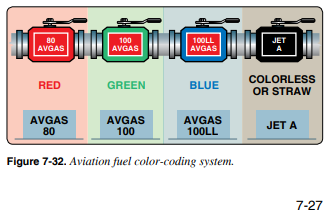
There is no “next higher” for 100LL. However, the graphic showing lowest to highest (left to right) for Avgas ends with the Jet A to the right. Unless the reader has read the text that Jet A is not a substitute for 100LL (human error) this image may imply Jet A is the next highest grade.
Perhaps the editors of the next revision will consider a graphic that doesn’t appear to imply low to high… Just a thought.
Excellent idea, and great catch! The high-level people at FAA who can make this happen are reading this report. Do you need me to submit a formal request, or can you take it from here? Thanks again, Anonymous.
More to say? Let us learn from you, at [email protected].

Share safer skies. Forward FLYING LESSONS to a friend.
Please help cover the ongoing costs of providing FLYING LESSONS through this secure PayPal donations link. Or send a check made out to Mastery Flight Training, Inc. at 247 Tiffany Street, Rose Hill, Kansas USA 67133. Thank you, generous supporters.
Thank you to our regular monthly financial contributors:
Steven Bernstein, Montclair, NJ. Robert Carhart, Jr., Odentown, MD. Greg Cohen, Gaithersburg, MD. John Collins, Martinsburg, WV. Dan Drew. Rob Finfrock, Rio Rancho, NM. Norman Gallagher. Bill Griffith, Indianapolis, IN. Steven Hefner, Corinth, MS; Ellen Herr, Ft Myers, FL. Erik Hoel, Redlands, CA. Ron Horton. David Karalunas, Anchorage, AK. Steve Kelly, Appleton, WI. Karl Kleiderer. Greg Long, Johnston, IA. Rick Lugash, Los Angeles, CA. Richard McCraw, Hinesburg, VT. David Ovad, Resiertown, MD. Steven Oxholm, Portsmouth, NH. Brian Schiff, Keller, TX. Paul Sergeant, Allen, TX. Paul Uhlig, Wichita, KS. Richard Whitney, Warrenton, VA. Jim Preston, Alexandria, VA. Johannes Ascherl, Munich, Germany. Bruce Dickerson, Asheville, NC. Edmund Braly, Norman, OK. Steven Hefner. Lorne Sheren, New Vernon, NJ. “The Proficient Pilot,” Keller, TX. Ed Stack, Prospect Heights, IL. Kynan Sturgiss, Hereford, TX. Bluegrass Rental Properties, LLC, London, KY. John Foster. Joseph Victor, Bellevue, WA. Chris Palmer, Irvine, CA. Barry Warner, Yakima, WA. Todd LeClair, Cadiz, KY. Jim Hopp, San Carlos, CA. Adrian Chapman, West Chester, PA.
Thanks also to these donors in 2025:
N. Wendell Todd. David Peterson. Jay Apt. SABRIS Aviation/Dave Dewhirst. Gilbert Buettner. David Larsen, Peter Baron, Glen Yeldezian, Charles Waldrop, Ian O’Connell, Mark Sletten, Lucius Fleuchaus. Thomas Jaszewski. Lauren McGavran. Bruce Jacobsen, Leroy Atkins, Coyle Schwab, Michael Morrow, Lew Gage, Panatech Computer (Henry Fiorentini), Andy Urban, Stu Spindel, Dave Buetow, Ken Vernmar, Dave Wacker, Bill Farrell, David Miller, Daniel Norris, Robert Sparks, Bill Cannon, David Yost, Don Bowles. Ed Shapiro, Mark Kolesar, William Weber, Anonymous Oshkosh donor, Robert Lough
New this week: Martin Sacks
Two 2025 donations: John Teipen, John Whitehead, Denny Southard, Wayne Colburn
Pursue Mastery of Flight
Thomas P. Turner, M.S. Aviation Safety
Flight Instructor Hall of Fame Inductee
2021 Jack Eggspuehler Service Award winner
2010 National FAA Safety Team Representative of the Year
2008 FAA Central Region CFI of the Year
FLYING LESSONS is ©2025 Mastery Flight Training, Inc. For more information see www.thomaspturner.com. For reprint permission or other questions contact [email protected].