

Topics this week include: >> Doin’ your fuelin’ >> Trust but verify. >> Speed secrets

FLYING LESSONS uses recent mishap reports to consider what might have contributed to accidents, so you can make better decisions if you face similar circumstances. In most cases design characteristics of a specific airplane have little direct bearing on the possible causes of aircraft accidents—but knowing how your airplane’s systems respond can make the difference in your success as the scenario unfolds. So apply these FLYING LESSONS to the specific airplane you fly. Verify all technical information before applying it to your aircraft or operation, with manufacturers’ data and recommendations taking precedence. You are pilot in command and are ultimately responsible for the decisions you make.
FLYING LESSONS is an independent product of MASTERY FLIGHT TRAINING, INC.
Pursue Mastery of Flight®
This week’s LESSONS:
An NTSB Final (Probable Cause) report details the fuel exhaustion crash of a Beech Duke pressurized twin:
The pilot reported that he was under the impression that his airplane’s inboard fuel tanks had been topped and he had 202 gallons on board prior to departure. He had a “standing order” with the airport’s fixed base operator to top the tanks; however, the fueling was not accomplished and he did not visually check the fuel level prior to departure. He entered 202 gallons in cockpit fuel computer and unknowingly commenced the flight with 61 gallons on board.
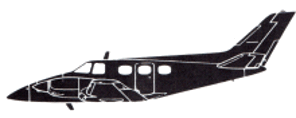
Prior to reaching his destination, his fuel supply was exhausted, both engines lost all power, and he performed a forced landing in a cemetery about one mile from the airport. The pilot and his passenger had minor injuries. Inspectors with the Federal Aviation Administration examined the wreckage and determined that damage to the wings and fuselage was substantial. The pilot reported that there were no preaccident mechanical malfunctions or failures with the airplane that would have precluded normal operation.
Probable Cause and Findings
The National Transportation Safety Board determines the probable cause(s) of this accident to be: The pilot’s improper preflight inspection of the airplane’s fuel system, resulting in him commencing the flight with an inadequate fuel supply.
Doin’ your fuelin’
It’s always preferable to be physically present as your airplane is being fueled, for several reasons including to:
- Check that the proper type and grade of fuel is added. Misfueling a piston airplane with jet fuel can result in total engine failure before you get beyond the airport traffic area. This is especially likely in airplanes that look like a turboprop—the Duke might qualify—or have turbine conversions available (the line person’s last experience might have been with that unusual model). In the 1960s through early 1980s some manufacturers put the word “turbo” or “turbocharged” on airplanes and this can lead to fueler confusion. I had to turn the Jet-A truck away from an A36TC Bonanza twice that had a factory-applied TURBO in large print on the vertical stabilizer. Sometimes it’s simply a mix-up by the fueler that puts the wrong truck in front of an airplane. Restrictor devices in fuel filler ports aren’t foolproof and depend on the FBO’s fueling nozzle to be fitted with an adapter to prevent it from being inserted into an aircraft. Be there to check for sure.
- Confirm the proper amount of fuel is added. Ensure fuel is added as you request: to all tanks you want, to the levels you want, and not more than you asked for or in tanks you don’t want filled if you need a reduced fuel load for weight and balance issues or want it for improved performance (for example, single-engine climb performance in a twin). Like pilots, even the best fuelers get distracted. I’ve spoken with several pilots over the years who had to get the fuelers back out to the airplane to add all the fuel that was requested, or wait for a laborious defueling process if too much fuel was added for the conditions of a flight. Many others have displayed the hazardous pilot attitude of resignation and taken off overweight or out of the loading envelope when the tanks were topped off instead of partly filled as the pilot requested (sometimes even in writing). Be there to get all the fuel you want, where you want it, and no more.
- Watch that fueling limitations are observed. Some aircraft have placards advising fuelers not to insert the fuel nozzle too deeply into the tank to avoid damaging the bottom of rubber bladder tanks. Some airplanes require tanks to be filled in a certain order, or for one wing’s tanks to be partly filled, then the other wing’s filled, and then the first wing’s tanks topped off to avoid tipping the airplane from an unbalanced fuel load. Electrically grounding an aircraft before fueling is a very best practice, but it’s vital in some types, especially rotorcraft. Be there to make sure the fueling’s done right.
- Ensure the fueling is done at all. As with that Beech Duke, sometimes word doesn’t get far enough down the line for the work to get done. Maybe there’s a mechanical reason a fuel order isn’t carried out (the truck won’t start or it’s inside a hangar with the door blocked by snow and ice, etc.). Perhaps the FBO’s fuel tanks are contaminated, or the airport runs out of your grade of gas. An employee might have gotten hurt or sick, or otherwise had to leave in a hurry for an emergency, and others thought the fueling was already done or didn’t think to pick up the slack. Be there, because you never know if something might interrupt carrying out your fuel order.
I fully realize that’s it’s not always possible to be there when your aircraft is fueled. You have to trust that it was done but then verify that it was done correctly (to complete the Russian proverb commonly attributed to Ronald Reagan which he apparently chose deliberately to win over Mikhail Gorbachev in those heady days when the nuclear launch key was in my hand). How can you verify the fuel load?
You have several ways you can verify a fuel load depending on your aircraft’s equipment. Verify using all the resources available in your case:
- Visual check. There’s no substitute for looking into the filler ports and visually confirming the amount of fuel on board. This also gives you the opportunity to confirm the filler caps were closed correctly so you don’t lose fuel overboard in flight. If the tanks are less than full the installation may have “tabs” or other means to visually confirm the amount of fuel in the tanks. If not, or if the level is lower than the tabs, a carefully calibrated dip stick is essential. In many aircraft, especially airplanes with wing dihedral, you may not be able to see any fuel at all once the tank is below some level. In that case you must verify fuel load using less definitive means and apply larger safety margins.
- Sight gauges. Some designs accommodate the visual limitation of dihedral with a fuel “sight gauge” on the top of the wing. This is usually connected to a float at that point in the fuel tank and indicates fuel load within some capacity range.Floats can stick and gauges can be inaccurate, so use a sight gauge if you have one but don’t take its indication to be definitive.
- Cockpit fuel gauges. Aircraft fuel gauges have a bad reputation, but they are required to be accurate at each gauge marking level and, in some countries and operations, must be recalibrated every few years. Fuel gauges are a great “sanity check” against other sources because in most cases they directly read the fuel level in the displayed tank, and they show the result of fuel siphoning and leaks that might not appear elsewhere. If a fuel gauge indicates lower than you expect don’t ignore the warning (as that Duke pilot seems to have done). Use the discrepancy as indication you need to confirm other sources.
- Fuel totalizers. Fuel totalizers can be extremely accurate. I’m a huge fan. Totalizers are probably responsible in part for the huge drop in fuel starvation and exhaustion accidents since the late 1970s (the change in the number of flight hours over that same timeframe is no doubt a major factor as well). But fuel totalizers tell you how much fuel is thought to be on board, but not where it is (in which tank). So they’re less effective at preventing fuel starvation. Totalizers track fuel burn, but they do not detect leaks or venting. And like in our Duke example, fuel totalizer information is only as good as the pilot’s manual inputs. Never update a totalizer or other fuel computer without having confirmed the fuel load using other resources.
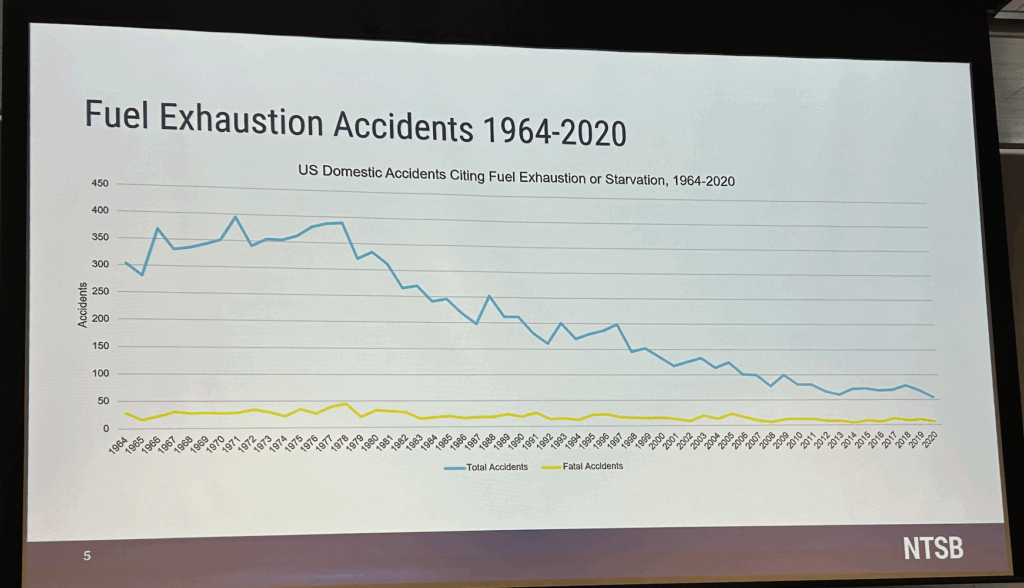
From a presentation by NTSB Member [and FLYING LESSONS reader] the Honorable Michael Graham made at the National Center for Aviation Training in Wichita, Kansas August 19, 2025
- Manual fuel tracking. When I flew airplanes that were also flown by others (a pair of corporate Beech Barons at one time, airplanes in a large flying club at another) we kept a small notebook in each airplane and recorded the date, aircraft time and amount of fuel added each time we fueled the aircraft. This record helped confirm fuel loads from other sources if we could not visually check a partial load due to the aircraft’s design. It also added confirmational confidence to a partial-load dipstick or sight gauge reading.
- Fuel records and receipts. Perhaps the least definitive information, because people make paperwork mistakes, FBO fuel records and receipts can still help piece together a complete fuel loading picture, and be part of sleuthing out the actual fuel load when a discrepancy occurs.
If any time there is an anomaly, if any one resource differs significantly from the others, you have no choice but to add enough fuel for a visual check, or at least enough to ensure you have enough fuel for your next flight.
Assume nothing, be there whenever possible, and use all your resources to confirm the airplane is fueled the way you want and need. Some sources state as much as 90% of all NTSB engine failure accidents are the result of fuel mismanagement. Think of how reliable our engines will be if we only ensure they get the fuel they need.
Questions? Comments? Supportable opinions? Let us know at [email protected].

Debrief
Readers write about recent LESSONS:
Reader/instructor Brian Sagi writes about last week’s LESSONS stemming from the well-handled crash of Cirrus Vision Jet:
I am typed in the SF50 and fly several types of turbine aircraft. Indeed, excellent use of checklists and resources by the SF50 pilot, and a safe outcome!
You boldfaced that the pilot “did not check for fuel contamination,” and I am not sure if you are implying that the engine trouble was a result of fuel contamination. Regardless, my observation is that while many piston pilots sump fuel tanks prior to flight to check for contamination, many turbine pilots skip that check. There are a couple of “reasons” (read: “excuses”) for that. First, Jet A is stinky and is less volatile than 100LL. If you can get some Jet A on your hand or on your clothing it is hard to get rid of the smell with just regular hand washing. Second, while piston engines are non-tolerant of water (the most common contaminant) in their fuel, turbine engine can tolerate water in Jet A fuel because Jet A can hold water in suspension. Therefore, many turbine pilots incorrectly assume that their airplane can “handle” contaminated fuel. Water contamination may create major problems, especially at the cold temperatures of high altitude flight, when water crystals freeze and clog fuel filters and perhaps even fuel nozzles. Unchecked water contamination in turbine fuel can also generate large maintenance bills in the required repairs for corrosion on fuel system components including sumps, fuel lines, and fuel control units.
And this brings me to the important point: to properly check for contamination in fuel, and especially in turbine aircraft, the airplane must be have been stationary and undisturbed – ideally for a few hours and, at a minimum, for 30 minutes. Even minor agitation of the fuel, e.g., the FBO towing the aircraft out of its hangar to stage it for the pilot, may cause water to mix with the jet fuel and become suspended, thereby evading detection. Likewise, a fueling of the airplane will agitate the fuel and mix things up, making subsequent fuel sumping contamination checks unreliable.
All of this holds true with respect to solid contaminants in piston airplane as well: agitation may cause contamination to mix with the fuel and avoid detection. The bottom line is: do sump your tank, regardless of the airplane you are flying, and to maximize your ability to detect contaminants, sump after the airplane has been undisturbed, ideally for a few hours.
I’m did not mean to imply the SF50’s engine issues were the result of fuel contamination; what NTSB has reported to date seems to imply otherwise. I highlighted the phrase, however, because it might suggest an area where pilots flying personal aircraft that are closer in design and operation to a corporate type might omit actions that in a commercial operation would be handled by dedicated support staff. The owner/operator of a light jet can’t assume the less savory tasks were done for him/her. I have a very little time in turboprop conversion Beech Bonanzas. I remember one of the pilots directing me to bring a change of clothes for his instructional flight—he did not allow people to enter his aircraft in the same clothes they wore performing the preflight inspection. He followed the same rule for himself. While that’s a bit extreme, it’s one way of addressing the physical characteristics of jet fuel.
Your points about the time it takes contamination to settle out of fuel, and the mixing effect of aircraft movement that restarts the settling timer, are spot on. I recall a demonstration in my Air Crash Investigation class 35 years ago in which the instructor showed it takes 10 to 15 minutes for water to settle out of each inch of fuel tank depth into the sump drains, including the time needed to flow “downhill” to the sump drain. Thank you, Brian.
An anonymous student pilot reader writes:
At Oshkosh I attended an excellent session explaining how sports teams use complete visualization techniques to train the body and the mind. This visualization is after learning theory of the maneuver, the physics, etc. I have not been successful in finding any such guided visualization training online. Granted each plane is different, but not much of anything out there unless you are a Blue Angels pilot.
Several years ago a friend in the Pacific Northwest paid my expenses to attend a weekend seminar by Ross Bentley, a well-known race car driver instructor with an impressive racing record of his own. The seminar was based on Ross’ book Ultimate Speed Secrets. The underlying theme of the seminar, the book and Ross’ instructional practice was detailed and extensive pre-race practice and visualization of each twist, turn, bump and slope of the track, wet, dry, hot, cold, icy, slick with oil and other environmental factors, as well as the anticipated actions and motivations of other drivers in the race. Ross has quite a following that attests to their success following his teachings.

My friend sponsored my attendance because Ross Bentley had then-recently earned his Private Pilot certificate (in helicopters) and was considering adapting his program to pilots, primarily commercial airline crews. He and Ross wanted my reaction to the program. I was honored to have Ross chauffeur me around Seattle in his souped-up Mini Cooper, and more importantly to feel welcome in a room full of race car drivers. I enjoyed it immensely and somewhere have detailed notes about applying this to pilot training that I made during the event. We debriefed on the airline application of Speed Secrets and traded several emails afterward brainstorming the process. I don’t know whether Ross ever made the leap to pilot training or influencing those who do (I understand he was working with a QANTAS captain to test concepts in Australia). I hope he has.
Military and air show pilots, of course, already make extensive use of briefing and visual, even physical, walk-throughs of operations and maneuvers. There’s likely validity to extending this to other types of flying as well. Maybe virtual reality training will eventually become a standard part of learning to fly. Thank you, anonymous.
More to say? Let us learn from you, at [email protected]

Share safer skies. Forward FLYING LESSONS to a friend.
Please help cover the ongoing costs of providing FLYING LESSONS through this
secure PayPal donations link. Or send a check made out to Mastery Flight Training, Inc. at 247 Tiffany Street, Rose Hill, Kansas USA 67133. Thank you, generous supporters.
Thank you to our regular monthly financial contributors:
Steven Bernstein, Montclair, NJ. Robert Carhart, Jr., Odentown, MD. Greg Cohen, Gaithersburg, MD. John Collins, Martinsburg, WV. Dan Drew. Rob Finfrock, Rio Rancho, NM. Norman Gallagher. Bill Griffith, Indianapolis, IN. Steven Hefner, Corinth, MS; Ellen Herr, Ft Myers, FL. Erik Hoel, Redlands, CA. Ron Horton. David Karalunas, Anchorage, AK. Steve Kelly, Appleton, WI. Karl Kleiderer. Greg Long, Johnston, IA. Rick Lugash, Los Angeles, CA. Richard McCraw, Hinesburg, VT. David Ovad, Resiertown, MD. Steven Oxholm, Portsmouth, NH. Brian Schiff, Keller, TX. Paul Sergeant, Allen, TX. Paul Uhlig, Wichita, KS. Richard Whitney, Warrenton, VA. Jim Preston, Alexandria, VA. Johannes Ascherl, Munich, Germany. Bruce Dickerson, Asheville, NC. Edmund Braly, Norman, OK. Steven Hefner. Lorne Sheren, New Vernon, NJ. “The Proficient Pilot,” Keller, TX. Ed Stack, Prospect Heights, IL. Kynan Sturgiss, Hereford, TX. Bluegrass Rental Properties, LLC, London, KY. John Foster. Joseph Victor, Bellevue, WA. Chris Palmer, Irvine, CA. Barry Warner, Yakima, WA. Todd LeClair, Cadiz, KY. Jim Hopp, San Carlos, CA. Adrian Chapman, West Chester, PA.
Thanks also to these donors in 2025:
John Teipen (two 2025 donations). N. Wendell Todd. David Peterson. Jay Apt. SABRIS Aviation/Dave Dewhirst. Gilbert Buettner. David Larsen, Peter Baron, Glen Yeldezian, Charles Waldrop, Ian O’Connell, Mark Sletten, Lucius Fleuchaus. Thomas Jaszewski. Lauren McGavran. Bruce Jacobsen, Leroy Atkins, Coyle Schwab, Michael Morrow, Lew Gage, Panatech Computer (Henry Fiorentini), Andy Urban, Wayne Colburn, Stu Spindel, Dave Buetow, Ken Vernmar, Dave Wacker, Bill Farrell, David Miller, Daniel Norris, Robert Sparks, Bill Cannon, David Yost, Don Bowles. Ed Shapiro, Mark Kolesar, William Weber, Anonymous Oshkosh donor, John Whitehead (two 2025 donations), Denny Southard
Pursue Mastery of Flight©
Thomas P. Turner, M.S. Aviation Safety
Flight Instructor Hall of Fame Inductee
2021 Jack Eggspuehler Service Award winner
2010 National FAA Safety Team Representative of the Year
2008 FAA Central Region CFI of the Year
FLYING LESSONS is ©2025 Mastery Flight Training, Inc. For more information see www.thomaspturner.com. For reprint permission or other questions contact [email protected].