

Topics this week include: >> A new level of complexity >> Pattern patter >> Safety continuum
Download this week’s report in a pdf

FLYING LESSONS uses recent mishap reports to consider what might have contributed to accidents, so you can make better decisions if you face similar circumstances. In most cases design characteristics of a specific airplane have little direct bearing on the possible causes of aircraft accidents—but knowing how your airplane’s systems respond can make the difference in your success as the scenario unfolds. So apply these FLYING LESSONS to the specific airplane you fly. Verify all technical information before applying it to your aircraft or operation, with manufacturers’ data and recommendations taking precedence. You are pilot in command and are ultimately responsible for the decisions you make.
FLYING LESSONS is an independent product of MASTERY FLIGHT TRAINING, INC.
Pursue Mastery of Flight®
This week’s LESSONS:
The recent crash of a Cirrus Vision Jet provides an unusual number of LESSONS for a preliminary report, made possible in part by the incredible data collection capability of the SF50. From the NTSB preliminary report:
A Cirrus SF50 was substantially damaged in an accident at Kissimmee Gateway Airport (ISM), Orlando, Florida. The commercial pilot was not injured. The pilot performed a standard preflight, utilizing the Airplane Flight Manual checklist with no discrepancies reported, but he did not check the fuel tanks for contamination, believing that task would be accomplished by Cirrus personnel.
One Crew Alerting System (CAS) message associated with engine start volts low was noted before engine start, but the engine started normally, and the message extinguished after engine start. The flight departed from runway 24 about 0725, and after takeoff was flying with the autopilot and autothrottle engaged. While climbing at flight level (FL) 198 [approximately 19,800 feet above sea level], about 0737:23 the message FADEC NO DISPATCH Caution displayed. He went thru that checklist while continuing to climb and reported the message continued following checklist completion, but continuance of the flight was allowed.
About 2 minutes while flying at FL234 [approximately 23,400 MSL], the red FADEC CTRL DEGRADED Warning illuminated. He pulled up that checklist and worked through it but the message continued. He contacted the controller and requested a vector to return to ISM, but did not declare an emergency at that time.
He reported performing the FADEC Reset via the multifunction (MFD) display and recalled a warning that the engine power may not be reliable. In going thru that checklist, the engine did not respond to thrust lever change, so he then declared an emergency. While descending he attempted to slow the airplane using the manual mode of the autothrottle by setting a target speed of 180 knots indicated airspeed (KIAS), but the airplane did not slow, nor did the thrust lever move as expected.
At that time the flight was in close proximity to ISM while the thrust remained at + or – 30% so he requested delaying vectorsas the flight was fast and close to ISM. He then pushed the thrust lever full forward and the thrust increased to 42%, then brough it back to flight idle and the thrust decreased to 1%, which did not change with further thrust lever advancement. The pilot added that having the thrust go from 30% to 1% added a new level of complexity to the situation.
The pilot considered either deploying the Cirrus Airframe Parachute System (CAPS) or gliding to ISM and noted the later was possible. At that point while on the base leg of the airport traffic for runway 6 at ISM, he extended the flaps to 50% and proceeded to the runway lowering the landing gear and flaps to 100% at the last minute.
The flight touched down fast 2/3’s down the 5,001 ft long runway and he was unable to stop using normal brakes. The flight rolled off the end of the runway onto grass and collided with an airport boundary fence. He shut down the engine, which occurred at 0804, and evacuated the airplane.
A review of the maintenance records revealed that [six days before the accident flight], when turning on power a “FADEC No Dispatch and FADEC CTRL Degraded” CAS Messages were displayed. A download of the FADEC was performed and the information was provided to the engine manufacturer. Because the airplane was on a list for replacement of the fuel control unit (FCU) by a Service Bulletin, the FCU was removed and a modified FCU was installed on March 20, 2025. Following the replacement of the FCU maintenance personnel performed acceleration and stability checks with no discrepancies noted. The maintenance was signed off on March 21, 2025, and the accident flight was the 1st flight since the modified FCU was installed.
What are some of the LESSONS we might learn from what we know so far? The pilot:
- Made excellent use of his checklists. Each time a new condition was reported or appeared he completed the appropriate AFM checklist. With training and practice checklists cease to be a challenge and provide a valuable increase in safety. The more complex the airplane, the higher the single-pilot workload, and the more a pilot needs to put in the time it takes to make flying without using checklists unacceptable.
- Declared an emergency. Perhaps he might have done so sooner, but he had already requested a vector back to Kissimmee and at least to that point did not appear to need any special services from Air Traffic Control. Eventually he did“declare”—an action with as much (in my opinion) a psychological benefit as a physical one. By that I mean declaring an emergency puts the pilot in the emergency mindset. It’s this mindset that causes a pilot to commit to get the aircraft on the ground at the earliest safe opportunity, and to focus on what’s most important to be successful. I believe that by declaring an emergency a pilot decides against trying to be a hero, and helps him/her resists the temptation to rationalize flying beyond the closest safe alternative.
- Should not have assumed that someone else would confirm the fuel load or check it for confirmation. Ensuring a good, accessible supply of usable fuel is a prime responsibility of the flight crew. With a crew of one that confirmation falls on the pilot, every time.
- Should have not departed on a cross-country flight—he was on a flight plan to Gulf Shores, Alabama—on the first flight after major maintenance. I recommend a post-maintenance test flight in the immediate vicinity of the airport following a test flight checklist of tasks designed to test operation of the new or repaired equipment, and also detect changes to any ancillary systems or items that may have inadvertently been adversely affected by the work performed.
- Consciously evaluated the risks and benefits of gliding vs. deploying the Cirrus whole-airplane parachute and chose what he felt made the most sense under current conditions. This indicates another benefit of training and practice—the ability to make best use of whatever resources are available. His choice may have been the best, or it may not have been, but he made a choice…and emerged unhurt.
There may have been ways the pilot could have dissipated some airspeed and/or altitude and avoided the runway overshoot. And you’ve got to give it to anyone who uses this understatement in his own accident report: having the thrust go from 30% to 1% added a new level of complexity to the situation.
To command a jet aircraft requires a pilot to earn a Type Rating specific to the systems and operation of that particular aircraft type (under U.S. rules, anyway). The Type Rating practical test is identical to an Airline Transport Pilot (ATP) checkride and requires the pilot to perform to ATP standards even if that pilot does not otherwise qualify for the ATP certificate (for example, does not have the minimum flying experience). The pilot’s checklist discipline and decision-making skills may not have been perfect—who ever is?—but overall his performance is a strong testament to the results of challenging, type-specific training.
Readers, what LESSONS do you learn from this event?
Questions? Comments? Supportable opinions? Let us know at [email protected].

Debrief
Readers write about recent LESSONS:
Several readers added to the conversation begun in last week’s LESSONS prompted by reader Lew Gage’s comments about traffic pattern priorities. Reader Eric Hect writes:
Mr. Gage’s message is well taken and his point is an important one. Predictably matters. I fly in the New York City airspace and being where people think you’ll be undoubtedly keeps us safer.
I have one complaint about the message you shared: Mr. Gage’s apparent comfort with clogging the radio frequency with his feedback. If the traffic pattern is so busy, the patter needs to be kept open [to a minimum]. Just recently, I was flying over New Jersey on a beautiful sunny Sunday and the 123.00 CTAF was chockful of position calls from my and several nearby airports. Then, two gentlemen at one of those other airports decided to have a back-and-forth chat on the frequency while I’m trying to call downwind-to-base and base-to-final turns, but couldn’t get a word in (though I tried, so hopefully traffic near me heard me).
It’s possible that Mr. Gage’s feedback could be given from the ground on the phone rather than in the air, clogging the airwaves and preventing others from communicating. That, too, is unsafe and makes planes harder to find. His feedback is valid. His timing seems suboptimal.
I should have commented on that last week. There’s a time and place for everything. Thank you, Eric.
Reader and Mastery of Flightâ supporter Gil Buettner adds:
I appreciate Lee Gage’s observations and comments about traffic patterns. On the departure leg, a small underpowered trainer may well go some distance from the runway before turning crosswind if the pilot is following the AIM recommendation to make that turn within 300 feet of pattern altitude.
That’s a good point. The most variable thing about a closed traffic pattern is the turn from upwind (departure) to crosswind legs. FAA indeed does recommend climbing the at least 700 feet above ground level (AGL), which is 300 feet below the standard traffic pattern altitude. The horizontal distance required to climb 700 feet will be very different between a light trainer and piston twin, and even for that light trainer at different weights and density altitudes. So it’s hardest to predict where to look for closed-circuit traffic until it is opposite the runway on the downwind leg. Thanks for pointing this out, Gil.
Instructor/reader Richard McGinnis has more to say:
The following ideas are in the context of trying to establish SOPs [Standard Operating Procedures] that are applicable in the most variety of a particular situations with the goal to train to the fewest SOPs for safe flight connected to VFR patterns and IFR approaches. The following ideas are likely not new.
In the debate over VFR pattern entry at no tower airports, if one trying to achieve this goal, and the pilot is Instrument rated and flies instrument approaches, then defining a SOP common to both VFR and end of IFR final approach segment would be a desirable goal. This could be accomplished by a common the visual reference for intercepting a 3 to 3.5 degree glide path for the stabilized final approach pitch sight picture from say 400 or 500 feet AGL. When a PAPI or VASI is available, then there is a reinforcing reference to repeat this pitch sight picture time after time. This is particularly true if the SOP has an airspeed target for this approach segment. This is the basis for is a single SOP to practice and maintain a high level of proficiency with single set of skills for the final approach segment.
If this is the desired SOP, then the visual base to final intercept distance from the runway is governed by the choice of what altitude to intercept the 3-degree path and VASI. In my [twin-engine Beech] Baron. I use 500 feet AGL as my target. Some of my clients prefer 400 feet AGL as a target for this intercept. Trigonometry then defines the distance from the glide path intercept point on the runway to the completion of the turn from base to final. The 500-foot target is obviously further from the end of the runway and results in a longer pattern of 1.5 nm from glide path intercept on the runway to completing the base to final turn. The 400-foot intercept yields a 1.2 nm. The VASI lights and glide path intercept with the runway are typically at least 250 feet from the end of the runway.
Other advantages of this technique include:
1. Consistent reinforced visual image of the runway painted markings.
2 Reinforces use of VASI
3. Protection from getting too low at night or in poor visibility.
4 Protection from landing short
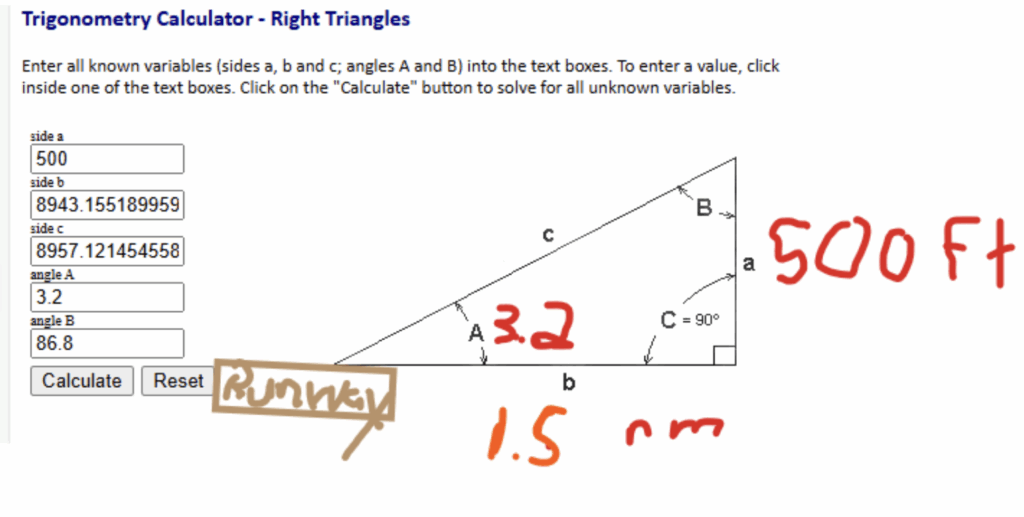
Other considerations include using lower than 400 feet AGL to complete the base to final turn is too low for VFR night operation for obstacle clearance in my opinion. It also does not give enough time to stabilize on the final approach segment.
However, this SOP single engine pattern or any 3-to-3.2-degree glide path will likely not enable a glide to the airport in case of total engine failure in many single engine airplanes. A headwind only makes this less likely. This presents choices for risk management for IFR flying and VFR patterns for single engine pilots. If you fly a precision instrument approach on a 3-to-3.2-degree glide slope, and also want a stabilized final approach segment, gliding to the runway is likely not an option.
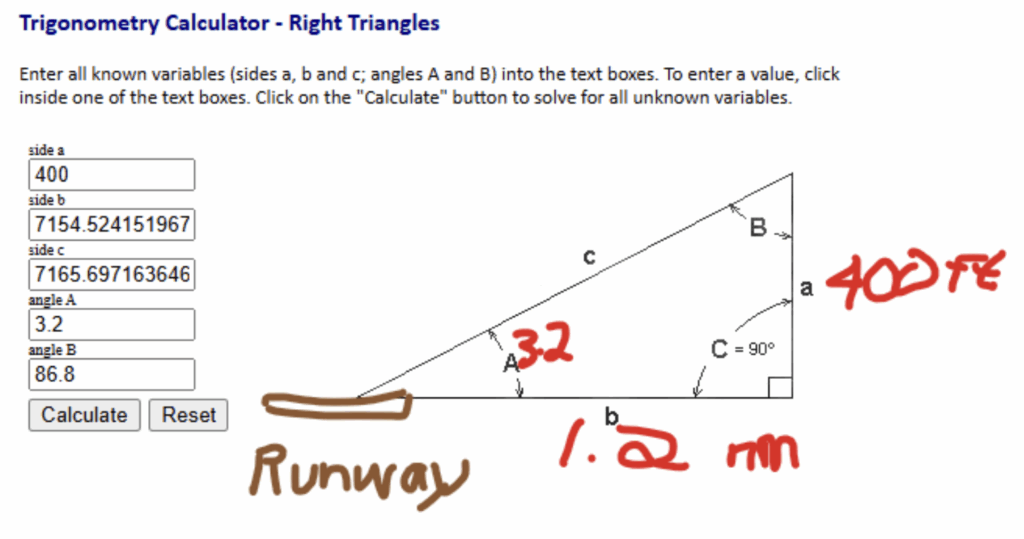
I ask my single engine clients to study this dilemma carefully and come to their own risk management decision. I also encourage them to study their visual VFR pattern SOP and adjust to their own goals, practice time, and risk management rather than the many opinions that are available including the opinion I have expressed above.
This goes to reinforce Lew Gage’s major focus, repeated by FAA documentation, that predictability in traffic pattern procedure is more about collision avoidance and avoiding the dangers of an unstabilized approach than anything to do with engine failures and glide distance. Thank you, Richard.
Reader Jim Piper writes:
I think it’s ironic that Lew Gage chose Stead Field (his home base and the former home of the Reno Air Races through 2023) to discuss traffic pattern size! The T-6 Gold race had just finished on Sunday’s final day of racing and the winner and 2nd place finisher (both very experienced pilots) opted to bypass entering the “cool down” racetrack pattern above the race course and fly directly into a crosswind leg and then enter the downwind leg of the landing pattern for runway 08. For reasons unknown (at least to me) flew an extremely wide downwind. The 2nd place finisher flew a normal pattern an apparently lost sight of each other. The winner called “base with gear” the standard base leg call to race control and it is believed that the number 2 T-6 had directed his attention to his left expecting to see number 1 close to base to final when he was actually still on a wide base and to the right of number 2 who was still on downwind. The two aircraft collided with one of them cutting the other’s entire tail assembly off and sending him vertically into the ground from several hundred feet in the air. The other aircraft subsequently crashed and both pilots were fatally injured! That brought a sudden sad, tragic, and totally unnecessary end to the 2023 National Championship Air Races.
I mention this because at my home airport (Torrance Zamperini Field) there is a huge pilot training operation ongoing in Sling aircraft and many of the students make enormous patterns. The City of Torrance has banned touch and go landings which is unfortunate but one can only wonder how far from the airport the downwind legs would extend with these oversized traffic patterns being flown!
The Reno tragedy is a classic example of traffic pattern unpredictability. As for the training operation, are there any DPEs (Designated Pilot Examiners) or foreign equivalents out there who wish to comment on pass/fail criteria for traffic pattern distance (anonymously if you wish)? Thank you, Jim.
And from a reader who wishes to remain anonymous:
Thoughts from a student pilot:
- Pattern is 1000 AGL and overflying the pattern is +500 feet. I always feel this is risky business since larger and/or turbines fly the pattern at 1500 AGL and as they are faster, maybe harder to spot. Is this an imagined risk on my part?
No, there’s a very real chance of conflict with turbine aircraft flying a higher traffic pattern, usually 1500 feet AGL…precisely where you’ll be if following FAA guidance for traffic pattern overflight prior to pattern entry. Keep your eyes open. The reader continues:
- Extending a downwind to accommodate another plane, once in a while, ends up with the plane behind me making its turn to base at the 45 degree point. f the (left) pattern is busy, I need to either turn right, go out and up to re-enter the down on the 45, or, go further out and do a straight in. Any thoughts on this?
Exiting the pattern and re-entering is the Federally preferred technique. I’ve done that many times when the pattern spacing just isn’t working out.
Reader David Davies writes about the previous week’s LESSONS that began to unravel the massive new MOSAIC rules:
I finally read your MOSAIC piece and have two comments:
Regarding Sport Pilot night flying, the new rules allow that but only with BasicMed or 3rd class and higher medical certificate (so driver’s license only pilots still can’t) [Table 4, page 209, 2/3 the way down, in the final rules].
Correct. A deeper reading of the MOSAIC rule confirms that.
Regarding your comment on the ambiguity around 59kts Vs1 (std airworthiness certificated aircraft) and 61kts Vs0 (new special airworthiness certificated still to arrive) — I see none as the 2 speeds address 2 separate problems: pilot experience and aging GA fleet. The safety continuum rules, so the less experienced pilots are being limited to the safer aircraft (in terms of kinetic energy to be dissipated in an accident). The newer consensus standard light sport aircraft that are going to be built (we hope, that will replace the aging type certificated GA fleet) can be faster and pilots with more training get to fly them (which should provide incentive for the sports pilots that can, to upgrade to private or higher).
I tried to address the same thing last week—the rule adds ambiguity only if you don’t read the Final Rule thoroughly. The reasoning for the two separate and exclusive criteria seem to be as you describe: higher training requirements with higher stall speeds (with flaps) for new designs and, as I’ve seen in some discussions, presumed higher occupant protection than that in lighter and legacy aircraft in another place on the FAA’s safety continuum. I missed watching the EAA webinar on MOSAIC that was broadcast live last Thursday but intend to watch the recording here. Thank you, David.
More to say? Let us learn from you, at [email protected]

Share safer skies. Forward FLYING LESSONS to a friend.
Please help cover the ongoing costs of providing FLYING LESSONS through this secure PayPal donations link. Or send a check made out to Mastery Flight Training, Inc. at 247 Tiffany Street, Rose Hill, Kansas USA 67133. Thank you, generous supporters.
Thank you to our regular monthly financial contributors:
Steven Bernstein, Montclair, NJ. Robert Carhart, Jr., Odentown, MD. Greg Cohen, Gaithersburg, MD. John Collins, Martinsburg, WV. Dan Drew. Rob Finfrock, Rio Rancho, NM. Norman Gallagher. Bill Griffith, Indianapolis, IN. Steven Hefner, Corinth, MS; Ellen Herr, Ft Myers, FL. Erik Hoel, Redlands, CA. Ron Horton. David Karalunas, Anchorage, AK. Steve Kelly, Appleton, WI. Karl Kleiderer. Greg Long, Johnston, IA. Rick Lugash, Los Angeles, CA. Richard McCraw, Hinesburg, VT. David Ovad, Resiertown, MD. Steven Oxholm, Portsmouth, NH. Brian Schiff, Keller, TX. Paul Sergeant, Allen, TX. Paul Uhlig, Wichita, KS. Richard Whitney, Warrenton, VA. Jim Preston, Alexandria, VA. Johannes Ascherl, Munich, Germany. Bruce Dickerson, Asheville, NC. Edmund Braly, Norman, OK. Steven Hefner. Lorne Sheren, New Vernon, NJ. “The Proficient Pilot,” Keller, TX. Ed Stack, Prospect Heights, IL. Kynan Sturgiss, Hereford, TX. Bluegrass Rental Properties, LLC, London, KY. John Foster. Joseph Victor, Bellevue, WA. Chris Palmer, Irvine, CA. Barry Warner, Yakima, WA. Todd LeClair, Cadiz, KY. Jim Hopp, San Carlos, CA. Adrian Chapman, West Chester, PA.
Thanks also to these donors in 2025:
John Teipen (two 2025 donations). N. Wendell Todd. David Peterson. Jay Apt. SABRIS Aviation/Dave Dewhirst. Gilbert Buettner. David Larsen, Peter Baron, Glen Yeldezian, Charles Waldrop, Ian O’Connell, Mark Sletten, Lucius Fleuchaus. Thomas Jaszewski. Lauren McGavran. Bruce Jacobsen, Leroy Atkins, Coyle Schwab, Michael Morrow, Lew Gage, Panatech Computer (Henry Fiorentini), Andy Urban, Wayne Colburn, Stu Spindel, Dave Buetow, Ken Vernmar, Dave Wacker, Bill Farrell, David Miller, Daniel Norris, Robert Sparks, Bill Cannon, David Yost, Don Bowles. Ed Shapiro, Mark Kolesar, William Weber, Anonymous Oshkosh donor, John Whitehead (two 2025 donations)
NEW THIS WEEK: Denny Southard
Pursue Mastery of Flight®
Thomas P. Turner, M.S. Aviation Safety
Flight Instructor Hall of Fame Inductee
2021 Jack Eggspuehler Service Award winner
2010 National FAA Safety Team Representative of the Year
2008 FAA Central Region CFI of the Year
FLYING LESSONS is ©2025 Mastery Flight Training, Inc. For more information see www.thomaspturner.com. For reprint permission or other questions contact [email protected].