
Topics this week include: >> Pattern priorities >> Learning objective >> Washout

FLYING LESSONS uses recent mishap reports to consider what might have contributed to accidents, so you can make better decisions if you face similar circumstances. In most cases design characteristics of a specific airplane have little direct bearing on the possible causes of aircraft accidents—but knowing how your airplane’s systems respond can make the difference in your success as the scenario unfolds. So apply these FLYING LESSONS to the specific airplane you fly. Verify all technical information before applying it to your aircraft or operation, with manufacturers’ data and recommendations taking precedence. You are pilot in command and are ultimately responsible for the decisions you make.
FLYING LESSONS is an independent product of MASTERY FLIGHT TRAINING, INC.
Pursue Mastery of Flight®
This week’s LESSONS:
Reader and retired Pan American World Airways navigator and captain Lew Gage recently wrote me with this editorial for our mutual education and comment:
Stead Airport (KRTS), Reno, Nevada, serves as a training airport for a high percentage of airplanes and pilots that actually are based at Reno, Nevada (KRNO), due to the number of airline flights in and out of KRNO. So we folks at Stead have to watch out for all of the students and instructors that operate training flights at Stead Airport.
I have to say that I believe the instructors of today were never taught what a normal Cessna 172 or Cherokee 140 or other such training airplanes’ normal traffic pattern actually is. Maybe they are trying to pad the time of flight for income purposes or they are just plain ignorant of staying close enough to the runway being used that they could make it back to the departure runway or maybe to another runway on the airport should the engine fail suddenly and completely.
In those small training aircraft, and also in Cessna 210s, Beech Bonanzas, Piper Comanches, and light twin engine airplanes, their touch-and-go type landing practice patterns wind up with a downwind leg being around two miles from the runway with a base leg that takes around a full minute or more to fly. Most of the times the instructor is also making the radio calls, which is a mistake since use of the radio is something the student also needs to learn. If I can understand what he/she is saying that he/she is just calling turning downwind or just turning base leg you really do not know where to look since the airplane is so far away and becomes rather invisible.
When I learned to fly in 1961 my instructor (Larry Martin, CFI 17744, that is a really low number!) insisted that the airplane stay the normal distance from the runway for a small training airplane (Continental C85-powered Taylorcraft), which is very similar to today’s training airplanes. I can tell you that when the throttle was pulled to idle when abeam the target touchdown spot on the runway, it stayed closed except for one very short “burping” of the engine on mid base leg. That is the way normal VFR practice landings should be flown.
I will say that during my airline days at PAN AMERICAN WORLD AIRWAYS, when going through Boeing 707 type rating training (all done in an airplane), that we flew smaller patterns than most of these instructors are doing at Stead airport and the same for the one takeoff and landing Boeing 747 training flight I had. If and when we got a visual approach and landing during actual airline arrivals we also used a normal standoff from the runway for the involved airplane. Not a downwind in the adjacent country.
On rare occasions there will be a student pilot doing solo takeoff and landing practice using the correct pattern size and very good radio communication skills, all of which is very important to the other traffic (ME) in the area. When I see and hear that I always inquire if that is a student pilot doing that performance and always extend a compliment for demonstrating good airport area flying and excellent communication skill. That does not happen very often. Usually when the instructor reports turning downwind three miles from the runway after a touch and go landing I will acknowledge that position call with a reply that says “OK, I hope you have enough fuel to make it back to the runway.” I really do not think that response does anything to change the instruction given to the student but at least I got to express my judgement of the instruction and demonstration the student is getting.
The usual reason pilots give for flying fairly close-in traffic patterns is to be able to glide to a landing in the event of engine failure while on downwind, base or final approach. A cursory look at the NTSB database for the past five years’ worth of final, Probable Cause reports reveals this almost never happens—my search was quick so I won’t stay anything definitive, but in a first run-through I can count the number of accidents resulting from an engine failure in the traffic pattern (not including takeoff or upwind) on one hand with a thumb and a finger left over.
Of course, pilots may have experienced engine failures in the arrival legs of a visual circuit and successfully made it to the runway, but that defeats the thesis that “most everyone flies patterns too wide and they can’t get to the runway if the engine quits.”
Lew Gage focuses more on collision avoidance as the reason to fly closer-in traffic patterns. I agree that one of the key elements of see-and-avoid near airports is to fly predictably. Be where they will be looking for you. Wider traffic patterns put other airplanes further away and therefore harder to see. Such circuits add a lot of unpredictability to the airplane’s relative position as well. Distance and unpredictability are not conducive to seeing other aircraft long before they become a threat. And when they and you do draw nearer you each may be somewhere the other pilot isn’t looking because of unusual closure angles and paths.
With all that in mind let’s see what training documents have to say about the spacing of airport traffic patterns for fixed-wing aircraft.
The Aeronautical Information Manual (AIM) section 4 describes visual traffic patterns. The narrative includes this single statement about the spacing of aircraft relative to the runway while in the pattern:
- Propeller-driven aircraft enter the traffic pattern at 1000 feet above ground level (AGL)
- Large and turbine-powered aircraft traffic pattern at an altitude of not less than 1500 AGL or 500 feet above the established traffic pattern.
- (b) A pilot may vary the size of the traffic pattern depending on the aircraft’s performance characteristics.
Chapter 8 of the Airplane Flying Handbook (AFH) is devoted to airport traffic patterns. What does it say about the size and spacing of visual patterns? With my emphasis added:
- Jets or heavy airplanes will frequently fly wider and/or higher patterns than lighter airplanes.
- Traffic pattern altitude is usually 1000 feet above the elevation of the airport surface.
- The downwind leg…is flown approximately ½ to 1 mile out from the landing runway.
- The pilot should continue the downwind leg past a point abeam the approach end of the runway to a point approximately 45° from the approach end of the runway, and make a medium-bank turn onto the base leg.
- The pilot should establish the base leg at a sufficient distance from the approach end of the landing runway to permit a gradual descent to the intended touchdown point.
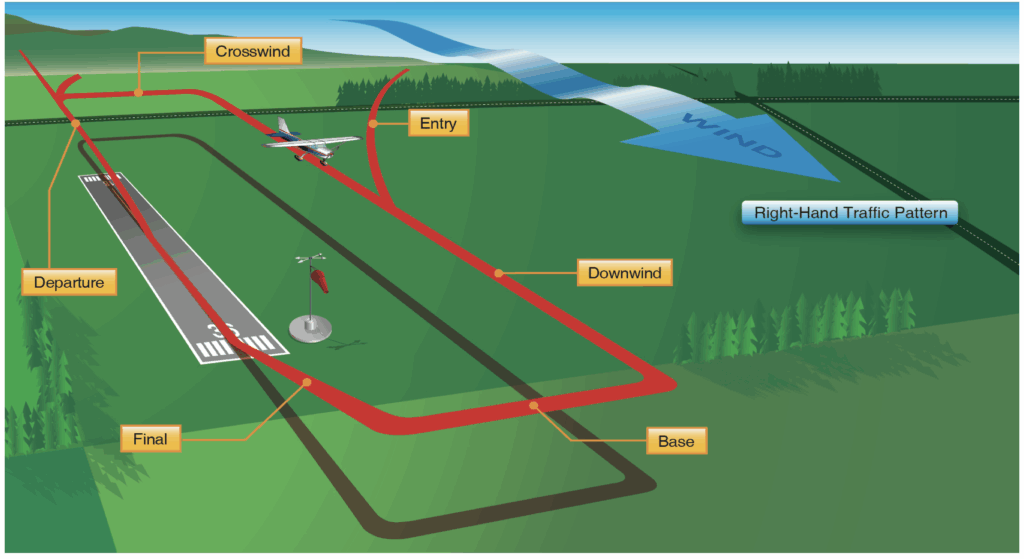
Traffic pattern illustration from the AFH coincides with the recommendation to fly fairly close to the runway, to initiate the turn to base when the runway appears about 45° behind the aircraft’s wing, and to “square off” the base leg.
Like Lew Gage, the AFH focuses on this standard pattern not in terms of engine failures but instead for collision avoidance. Immediately after defining the traffic pattern the AFH move on to the topic of midair collisions. The Handbook includes this breakdown of the location of mid-air collisions in the visual circuit:
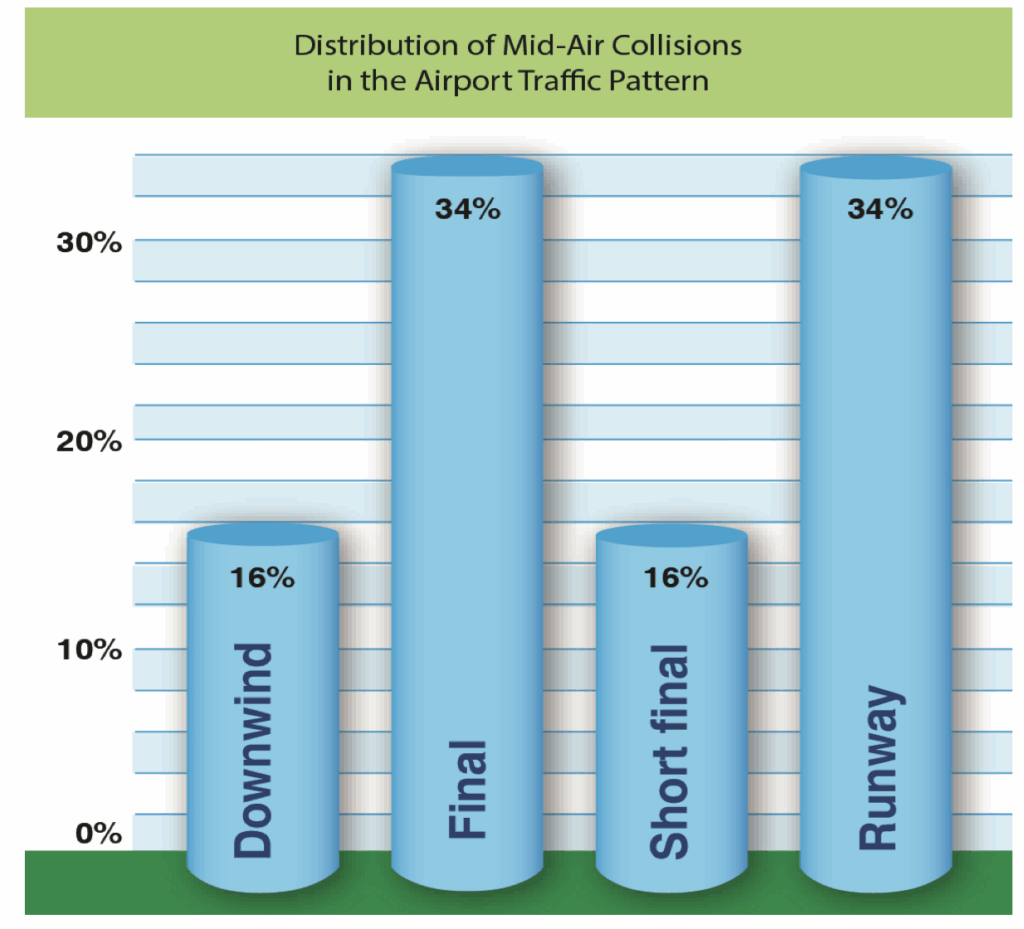
Distribution of Mid-Air Collisions in the Airport Traffic Patterns (AFH chapter 8)
…and provides these notes on the scenarios that most frequently result in a mid-air collision in the airport traffic pattern:
- Mid-air collisions generally occur during daylight hours—56% occur in the afternoon, 32% in the morning, and 2% at night, dusk or dawn.
- Most mid-air collisions occur under good visibility.
- A mid-air collision is most likely to occur between two aircraft going in the same direction.
- The majority of pilots involved in a mid-air collision are not on a flight plan.
- Nearly all mid-air accidents occur at or near uncontrolled airports and at altitudes below 1000 feet.
- Pilots of all experience levels can be involved in mid-air collisions.
Thank you, Lew, for prompting this week’s LESSONS. Readers, what do you think?
Questions? Comments? Supportable opinions? Let us know at [email protected].

Debrief
Readers write about recent LESSONS:
I want to reinforce that I see the FLYING LESSONS Debrief as a high-level “hangar flying” session. The objective is for us all to learn. Sometimes discussion begins with what turns out to reflect an incorrect or incomplete understanding of a topic, and others fill that knowledge gap—that’s how we learn. I try to avoid leaving anyone feeling they have been rebuffed; instead, we’re here to raise everyone’s level of safety and understanding. In that spirit, let’s begin the Debrief.
Long-time reader Randy Starbuck writes about last week’s initial overview of the new MOSAIC rules:
Whew! This is some very heavy-duty analysis . . . no wonder you’re not “fresh” [from Oshkosh].
Frequent Debriefer Dave Dewhirst adds:
Outstanding discussion of the MOSAIC issue. Best I have seen anywhere. Keep up the good work, my friend.
Thank you both. There’s a whole lot more in the new regulations too. But I’ve seen a lot of incomplete and incorrect information online and felt compelled to write this.
Reader Boyd Spitler comments on the July 17th LESSONS inspired by reports on the crash of a Cessna 172 when two pilots both attempted to control the airplane during a bounced landing. Boyd writes:
Bravo Tom. Your comments and illumination of crew training and operations are spot on.
In the 172 scenario, clear preflight briefing re[garding] who will do what is essential. It seems possible that underlying dynamics may have further complicated interactions at critical moments. There have been hull losses in transport operations over crew dynamics, but this is beyond the scope of the article.
Standard callouts from supporting crew members (PMs) in the context of “sterile cockpit” observation simplify and clarify necessary input in low vis approach environments. Additional automated callouts from the aircraft, especially radio altitude calls at 500, minimums, 100, 50, 40, 30, 20, 10 feet (wheel height) allow tactile technique where tactile inputs are not available from the yoke.
Part 25 [Transport Category] aircraft also have wash out on the wing for the same reasons of controllability. Stall training at “first indication of a stall” is important since recovery from full stall is likely to overstress big airplanes…and spill the drinks. Buffet on the wing root is the first indication, often before audible stall warning, and enables a recovery with little or no loss of altitude.
Another technique: After 15-ish years and 11,000 hours of US Navy training and transition to first GA [general aviation] and then [Parts] 135 and 121 scheduled operations, I moved to the global Express carrier. I was grateful through all of that to learn from some of the best, and some of the worst fellow crew members in the business.
Debriefing issues in appropriate real time was a feature of any flight where any question lingered. I experienced some consternation as a new flight engineer on the 727 to have the front-end crew often trample me to get to ground transport without even a query as to possible or certified issues on the flight. After adapting to the various new SOP I looked forward to the time when I could end each flight by asking “what could we do better“ whether or not there were necessary conversations to be had. This eventually became SOP along with other methods designed to improve system safety and crew coordination quality.
Even in a single pilot operation, there is value in taking a moment to reflect before moving to the door/pax/baggage responsibilities which usually follow.
Thank you for sharing your full experience in illuminating good operator technique. The more aviation changes, the more important emphasizing the basics remains.
Thank you, Boyd, for Debriefing us on what you’ve learned about the value of debriefing.
Frequent Debriefer/instructor Anthony Johnstone continues the discussion about the angle of attack effect of extending flaps:
Chord line, which defines AOA, is a straight line from leading edge to trailing edge of the wing. When you put flaps down you move the trailing edge down which changes the AOA. Period. I spend a fair bit of my retirement time trying to keep people from killing themselves in stall-spin accidents.
Washout is another discussion. [It’s] about 3 degrees on high-wing Cessnas and a good teaching point, you can see the twist. The biggest point is washout keeps people from spinning due to using ailerons in stall recovery. If the outboard section of the wing exceeds critical AOA the ailerons actually work backwards and right aileron becomes a pro-spin input to the left. [It’s an] eye-opener to most of my CFI spin students.
Thank you for helping us all learn, Tony.
Reader Robert Lough wraps up this week’s Debrief:
In the comments of the newsletter I did detect a possible misunderstanding from one of your commentators.
Basically extending trailing edge flaps, increases the wing camber, and all things held equal, also increases the AoA. AoA is defined by the angle of the chord line to relative airflow. Furthermore, albeit a slight simplification, the chord line is defined as the line from the leading edge to the trailing edge. A white board drawing can easily show that self-evidently AoA increases with trailing edge flaps deployed, holding relative airflow constant. This is partly the reason the airplane “balloons” and you reduce AoA by lowering pitch to keep the Coefficient of Lift constant. Recall the wing does not “see” the horizon, it only responds to relative airflow and AoA.
On multi crew coordination, the world owes a great debt to the pioneering work by NASA and John Lauber in the 1970s, further enhanced by pioneering behavioural psychologists Kahnemann and Tversky. The famous nine KSAs (Knowledge, Skill, Aptitude) have become the cornerstone of safety management in commercial air transport. I have wondered why the relationship of SOPs, Crew Resource Management don’t get more of a mention in single-crew operations and training. A lot of the behavioural insights from CRM apply equally to single crew.
Thank you for your continued contribution to safety.
My second book, Cockpit Resource Management: The Private Pilot’s Guide (titled before the terms Single-Pilot Resource Management was coined, and even before the phrase Crew Resource Management was in widespread use), attempted to translate crew topics into techniques for the single-pilot cockpit. The second edition is 27 years old. I’ve long wanted to publish a modern update. In today’s environment I might produce a series of videos instead… some day. Meanwhile I’ll try to draw LESSONS from these concepts here. Thank you, Robert.
More to say? Let us learn from you, at [email protected]
Share safer skies. Forward FLYING LESSONS to a friend.
Please help cover the ongoing costs of providing FLYING LESSONS through this secure PayPal donations link. Or send a check made out to Mastery Flight Training, Inc. at 247 Tiffany Street, Rose Hill, Kansas USA 67133. Thank you, generous supporters.
Thank you to our regular monthly financial contributors:
Steven Bernstein, Montclair, NJ. Robert Carhart, Jr., Odentown, MD. Greg Cohen, Gaithersburg, MD. John Collins, Martinsburg, WV. Dan Drew. Rob Finfrock, Rio Rancho, NM. Norman Gallagher. Bill Griffith, Indianapolis, IN. Steven Hefner, Corinth, MS; Ellen Herr, Ft Myers, FL. Erik Hoel, Redlands, CA. Ron Horton. David Karalunas, Anchorage, AK. Steve Kelly, Appleton, WI. Karl Kleiderer. Greg Long, Johnston, IA. Rick Lugash, Los Angeles, CA. Richard McCraw, Hinesburg, VT. David Ovad, Resiertown, MD. Steven Oxholm, Portsmouth, NH. Brian Schiff, Keller, TX. Paul Sergeant, Allen, TX. Paul Uhlig, Wichita, KS. Richard Whitney, Warrenton, VA. Jim Preston, Alexandria, VA. Johannes Ascherl, Munich, Germany. Bruce Dickerson, Asheville, NC. Edmund Braly, Norman, OK. Steven Hefner. Lorne Sheren, New Vernon, NJ. “The Proficient Pilot,” Keller, TX. Ed Stack, Prospect Heights, IL. Kynan Sturgiss, Hereford, TX. Bluegrass Rental Properties, LLC, London, KY. John Foster. Joseph Victor, Bellevue, WA. Chris Palmer, Irvine, CA. Barry Warner, Yakima, WA. Todd LeClair, Cadiz, KY. Jim Hopp, San Carlos, CA. Adrian Chapman, West Chester, PA.
Thanks also to these donors in 2025:
John Teipen (two 2025 donations). N. Wendell Todd. David Peterson. Jay Apt. SABRIS Aviation/Dave Dewhirst. Gilbert Buettner. David Larsen, Peter Baron, Glen Yeldezian, Charles Waldrop, Ian O’Connell, Mark Sletten, Lucius Fleuchaus. Thomas Jaszewski. Lauren McGavran. Bruce Jacobsen, Leroy Atkins, Coyle Schwab, Michael Morrow, Lew Gage, Panatech Computer (Henry Fiorentini), Andy Urban, Wayne Colburn, Stu Spindel, Dave Buetow, Ken Vernmar, Dave Wacker, Bill Farrell, David Miller, Daniel Norris, Robert Sparks, Bill Cannon, David Yost, Don Bowles. Ed Shapiro, Mark Kolesar, William Weber, Anonymous Oshkosh donor, John Whitehead (two 2025 donations)
Pursue Mastery of Flight®
Thomas P. Turner, M.S. Aviation Safety
Flight Instructor Hall of Fame Inductee
2021 Jack Eggspuehler Service Award winner
2010 National FAA Safety Team Representative of the Year
2008 FAA Central Region CFI of the Year
FLYING LESSONS is ©2025 Mastery Flight Training, Inc. For more information see www.thomaspturner.com. For reprint permission or other questions contact [email protected].